
• TalkBass has been independent since 1998. Add your voice.
    Create a free account to reply to discussions, view embedded media, and browse with fewer display ads.
    Join freeLog in
    Want zero display ads or expanded classifieds tools? Compare plans.

1 2x10 and 1 4x10 makes sense ?

See post #6 - it explains things properly...


- georgestrings

I would hate to find out what a 4Ohm 410 would sound like next to a 8Ohm 210.
I'm not sure you would hear the 210 as much as the 410 really.

BTW, still searching for a manufacture that says this is the best practice............
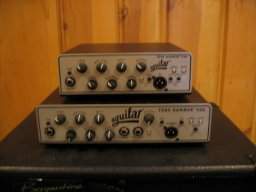
 
Yes, yes, yes!

That is what I use and it gives such good options depending upon your sonic needs at any given time, though I usually go with the combo of both cabs.

The 2X10 that I use has both an input and output so I can run the cabs in series or parallel depending upon if I need 4 or 8 ohms.
 
I would hate to find out what a 4Ohm 410 would sound like next to a 8Ohm 210.
I'm not sure you would hear the 210 as much as the 410 really.

BTW, still searching for a manufacture that says this is the best practice............


A 4 ohm 410 and an 8ohm 210 is...... a 610:smug: You would hear each driver equally, which is key. You need to think 'driver', not cab when doing this (again, assuming the 410 and the 210 are from the same manufacturer). Of course, if you have two identical cabs (two 210's or two 410's), then you would want them the same impedance.

It won't hurt anything to run a 210 and 410 at the same impedance (as long as your amp isn't so powerful as to blow up the 210), but it just doesn't really make much sense to do it that way.
 
if they are both 8 ohm each driver in the 210 will get twice the watts as each driver in the 410. each cab wil get the same amount of watts in total. twice the watts = 3dB increase in volume which isn't much. As long as you aren't overpowering the 210 the 8+8 setup works ok. I did it for years. This of course is assuming a mono amp.


This is also correct - I did it similarly, only with 4 ohm cabs out of a 2 ohm capable head, and never had any troubles... In *some* ways, this might've been a plus - since the top 210 received 2x the power per driver, and was up at ear levels, it *probably* helped me to hear myself better without being too loud overall... Of course, one has to pay attention to any signs of speaker distress when doing this...


- georgestrings
 
This is also correct - I did it similarly, only with 4 ohm cabs out of a 2 ohm capable head, and never had any troubles... In *some* ways, this might've been a plus - since the top 210 received 2x the power per driver, and was up at ear levels, it *probably* helped me to hear myself better without being too loud overall... Of course, one has to pay attention to any signs of speaker distress when doing this...


- georgestrings

It surely can work, just not optimal.
 
A 4 ohm 410 and an 8ohm 210 is...... a 610:smug: You would hear each driver equally, which is key. You need to think 'driver', not cab when doing this (again, assuming the 410 and the 210 are from the same manufacturer). Of course, if you have two identical cabs (two 210's or two 410's), then you would want them the same impedance.

It won't hurt anything to run a 210 and 410 at the same impedance (as long as your amp isn't so powerful as to blow up the 210), but it just doesn't really make much sense to do it that way.

OK man, but I am yet to ever hear a manufacture EVER say that.
There could be a 1000 reasons why they wouldn't, but really only one why they would.
 
OK man, but I am yet to ever hear a manufacture EVER say that.
There could be a 1000 reasons why they wouldn't, but really only one why they would.

Many manufacturers don't have heads capabable of under 4ohm operation (at least until recently). And, in the case of Eden, for example, the nice balance control on the WT800 made the whole issue a moot point, since you could balance a little more of the output to the 410 than the 210 if they were the same impedance.

This also assumes the cabs by the same manucturer in the same line. Using as extreme example, if you were combining an Acme B210 (LOW SPL) with a Bergantino AE410 (high SPL), you probably WOULD want the 210 and 410 to be the same impedance, since it would take double the power per speaker to drive the Acme to the same 'per driver' volume as the Berg.

The cool thing about doing this with a 210/410 or 112/212 is that you literally get a modular version of the total number of drivers in a larger cab (i.e. a 610 or 312).

However, per above, as long as 1/2 power of your amp doesn't totally excede the capabilities of the 210 when you start cranking the rig, an 8ohm 410 and 8ohm 210 can work fine.:) To your point, I guess if you would want 'equal volume' out of a 210 and a 410, then equal impedance would actually work better. However, I'm viewing it more as making a balanced sounding, modular 610, and would not be interested in having a little 210 try to keep up with a big 410, but rather that they work together as the siz drivers in a 610 would.
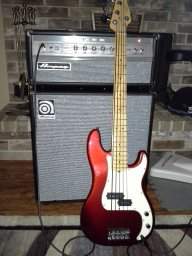
I love this stuff!
 
Sure. I had a rig like that. 210 for rehearsal/small gigs, 410 for medium, and 610 for the big shows.


I did something like that for awhile, but found that I used 6 tens for all my gigs, and that the 210 wasn't enough for my rehearsals without pushing it harder than I wanted to... In other words, I ended up ALWAYS bringing both the 210 and 410 to gigs, which meant rolling in the 410, then CARRYING in the 210 - and using the 410 for rehearsals...

So, I sold the 210, bought a 610, and that worked better for *my* situation - I roll in one cab(the 610) for gigs, and use the 410 for rehearsals - and never have to push either one hard enough to damage a driver... The modern rock/metal bands I play in always seem to have a pounder for a drummer, and need fairly loud guitar to sound right - so, a 210 just doesn't cut it for anything but home practice *for me*... If you typically play in loud bands, you might find the same thing... I feel it's better to have more than enough speakers - and not have to push them too hard - than it is to try to get by with less speakers, and push them harder...


- georgestrings
 
Yeah, I have, it's no big deal... If both cabs have same ohm-age the speakers in the 2x10 will be driven harder than the ones in the 4x10, thus making their lifespan shorter (theoretically, at least).

Not only that, you'll not be able to turn up as loud because the 2x10 will distort earlier.

Best is just 2 2x10 cabs stacked vertically - the height and reach of a 8x10 but none of that comb filtering rubbish.
 
Not only that, you'll not be able to turn up as loud because the 2x10 will distort earlier.

Best is just 2 2x10 cabs stacked vertically - the height and reach of a 8x10 but none of that comb filtering rubbish.

A do like the 2 x 210 idea, but the whole comb filtering thing when in the context of bass backline has been WAY overstated by some on this site.
 
"The 2X10 that I use has both an input and output so I can run the cabs in series or parallel depending upon if I need 4 or 8 ohms."

My cabs also have input/output 1/4" jacks but I thought it stayed in parallel regardless which jack you use. Maybe depends on the brand/model of cab? Just wanting to clarify.
 
"The 2X10 that I use has both an input and output so I can run the cabs in series or parallel depending upon if I need 4 or 8 ohms."

My cabs also have input/output 1/4" jacks but I thought it stayed in parallel regardless which jack you use. Maybe depends on the brand/model of cab? Just wanting to clarify.

+1 always parallel. Daisy chaing cabs is identical to running out of multiple outlets on the amp.
 
Can't tell without knowing what your cab is, but most are wired for parallel, unless opened and meddled with...

And there's no way a series or parallel option will give you 4 or 8 ohms. two 8s in parallel is 4, but two 8s in series is 16...

+1 Standard wiring is for parallel in every cab I've ever experienced.
 
FYI, stereo is quite different from dual mono. A head like the Puma1000, the Shuttle Max 12, the Eden WT800, the SWR900, etc. have two power amps, but mono preamps. So, while you can drive two cabs with separate amps, they would not be in stereo for effects, etc.

The only true stereo bass amp currently in production that I'm aware of is the TecAmp Bonafide, which has dual power amps AND a stereo two channel preamp. So, that is literally like having two completely separate amps in the same box, and would allow for stereo chorusing through two cabs, etc.

While not a true stereo bass head, the WT800 can do stereo effect as it has separate L/R channels for the post-EQ effect loop.

Eden WT1205 is another true stereo head.