Today I finally got a little time to take my gear out of the closet and A/B the HP vs. the Aguilar db751 into a single NV212t for the second time since I got the HP. And it left me with a couple of new thoughts/impressions that I felt were worth sharing with you all.
I know one of Jim’s main goals in designing amps is to let the amp really bring out the true sound of your instrument, rather than have a single characteristic sound that can be attributed to a certain brand. Today, I realized how much he has really achieved this goal with the HP, and how cool that really is.
Obviously, the Aguilar db751 is a great example of one of these one trick ponies I’m speaking of, as are most brands I’ve played over the years, like GK, Hartke, SWR and Eden, for example. And don’t get me wrong, I love the Aggie, and as I’ve said in previous posts, it’s characteristic sound is really a match made in heaven for Jim’s cabs, particularly the NV series. As I was A/Bing the two amps while playing along with various songs, there were even a few songs that the Aguilar’s sound suited just a little better than the HP. The Aguilar’s wholly/pillowy tone just works really well in certain contexts, in my opinion.
But, whenever I was using the HP, it’s clarity and ability to let the few basses I was playing truly sound like themselves was something the Aguilar simply couldn’t do. And that was true even with the Drive engaged. The Drive on the HP, at its lower settings, does add some grit and harmonic content to the tone, but it definitely remains a clear and clean tone that lets the individual instrument shine.
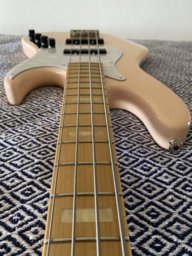
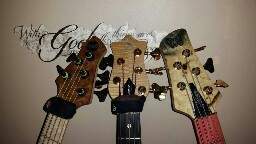
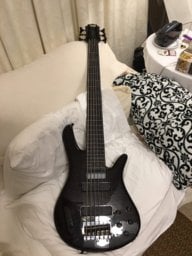
Honestly, the only two knobs on the HP that really shape your tone significantly are the high and low pass filters, and those things are so useful! For example, with my 21 year old Lakland 55-94, which has 21 years of sweat and humidity caked into the neck and fingerboard, keeping the low pass filter more towards noon-3 o’clock really lets that bass sing in the high mids in a way that the Aguilar simply cannot. However, when I was playing a Fender P Deluxe through it, which is a bass that has a tendency to get a little hissy and barky due to its 18V active electronics and huge soapbar bridge pickup, turning the low pass filter towards 9 o’clock was just what the doctor ordered. Also, we all know that P basses can lose something special when you roll the tone knob all the way to the numb side. But, the low pass filter on the HP allows you to keep the bass’s tone knobs where you want them, and then fine tune the tone further with the amp.
And again, as for the “slam” factor, the HP certainly has all the slam anyone could ever need in a bass amp, period. If that couldn’t be said of the original Forte, it surely can of the HP. I have never needed to use more than half of the available power on the head yet, and I’ve had it cutting through a dense guitar heavy mix on numerous stages now, with excellent transient attack.
One more thing to note from today’s playing. The Forte HP is deep! The high pass filter allows you to get out all the sub-lows that overwhelm, which is awesome, but my first thought every time I went back to the HP was, “wow that is fat!”
So, I would venture to say that if what you are looking for is a big powerful fat amp that is crystal clear and excels at making your bass sound like itself, this has to be the best amp you will find. It is worth noting that if you know you love a certain tone that is characteristic of a certain brand, the HP can probably approximate that sound pretty well. This is because you can use the filters and the punch and bright switches in various configurations to get an interesting variety of filtrations. But, it seems pretty clear to me that making the HP sound like your favorite other amp is not what this amp was really designed to do. It was was clearly designed to allow you to make your bass sound like the clearest and best version of itself, and that’s a really special thing.
I know this was a little wordy. But, it’s also the result of an epiphany, so hopefully it was a good read, and informative to a potential buyer.