
Enjoy the benefits of a premium membership!
Upgrade Account
-
TalkBass has been independent since 1998. Add your voice.
Create a free account to reply to discussions, view embedded media, and browse with fewer display ads.
Join free Log in
Want zero display ads or expanded classifieds tools? Compare plans.
You are using an out of date browser. It may not display this or other websites correctly.
You should upgrade or use an alternative browser.
You should upgrade or use an alternative browser.
2013 Ampeg V-4B 100W Reissue
- Thread starter z11111
- Start date
- Status
- Not open for further replies.
More options
Who Replied?
Would love to hear it with a 15 or pair of 15's too...

I think I found my amp for my Schroeder 2x15 cab.
I've been gassing for a 100 watt tube head.
Was going to pull the trigger on a Bassman 100T.
But, dang, Ampeg goes and does this. I love the old V-4B.
And less $$$$ than the Fender.
!!!!!!!!!!GAS!!!!!!!!!!!


Thanks all. I think I prefer the sound of power tubes working hard over preamp tubes. I've been waiting for this amp for quite some time. I think it will pair well with my SVT4x12...
here too!
There's a reason that Ampeg chose to use 7027 back in the day instead of 6L6GC. It was all about using rugged, higher performance tubes in their amplifiers, because Ampegs ran at voltages that tended to destroy 6L6GC.
While the 6L6GC was designed as a common tube for the commercial market, the 7027 was designed as a higher dissipation/ premium-quality ruggedized tube that was intended for more extreme-duty use. It had a 35W plate dissipation instead of the 30W dissipation of the 6L6. Back in the day the advertising literature talked about higher headroom and lower distortion.
In order to get the increased power output the 7027 was designed to safely operate at higher voltages than the 6L6GC could tolerate. There were a lot of changes in the tubes -- the envelope was different to assist with cooling. There were also some changes that went along with the screen and control grids, bringing the connections out to assist in their cooling. The pinouts were even changed to facilitate cooling, so on an amp that runs 7027 pins 1&4 have to be tied together and pins 5&6 have to be tied together.
6L6 don't use pins 1&6, so amp builders often "cheated" and used these these terminals on the sockets as binding posts for other components. What this meant then, was that back in the day a 6L6 amp and a 7027 amp were not pin compatible unless you made some necessary changes to make the amps compatible.
The real interesting question about the new reissue amp is going to be what kind of B+ voltages it runs at, and whether those are the types of voltages that are more typical of 6L6 designs or 7027 designs. If the plate voltages remain high, you might run into trouble with 6L6 tube life.
> Just because JJ still makes them doesn't mean they're any good.
although the pinouts on the bases are different, the current production JJ 6L6 and 7027 use the same guts.
While the 6L6GC was designed as a common tube for the commercial market, the 7027 was designed as a higher dissipation/ premium-quality ruggedized tube that was intended for more extreme-duty use. It had a 35W plate dissipation instead of the 30W dissipation of the 6L6. Back in the day the advertising literature talked about higher headroom and lower distortion.
In order to get the increased power output the 7027 was designed to safely operate at higher voltages than the 6L6GC could tolerate. There were a lot of changes in the tubes -- the envelope was different to assist with cooling. There were also some changes that went along with the screen and control grids, bringing the connections out to assist in their cooling. The pinouts were even changed to facilitate cooling, so on an amp that runs 7027 pins 1&4 have to be tied together and pins 5&6 have to be tied together.
6L6 don't use pins 1&6, so amp builders often "cheated" and used these these terminals on the sockets as binding posts for other components. What this meant then, was that back in the day a 6L6 amp and a 7027 amp were not pin compatible unless you made some necessary changes to make the amps compatible.
The real interesting question about the new reissue amp is going to be what kind of B+ voltages it runs at, and whether those are the types of voltages that are more typical of 6L6 designs or 7027 designs. If the plate voltages remain high, you might run into trouble with 6L6 tube life.
> Just because JJ still makes them doesn't mean they're any good.
although the pinouts on the bases are different, the current production JJ 6L6 and 7027 use the same guts.

That would require someone having had played both and being able to make a comparison. Sounds a lot like the vintage model to me, but since they don't street for another few weeks...
it was more of a question for ampeg..
and after reading the above post it makes me really wonder.
if it's true to the original in terms of volume, tone, and breakup, im very interested, but if it's more the V4bh in dad's clothes, then not so much. I loved the tone of my V4bh, but it didn't have the muscle I needed like the original did.

Well now you're way over my head, except for the last sentence. If they use the same guts, then I don't see how different they could be. I don't claim to be any sort of expert on them, but if they have the same guts, the only difference is the pinout, no?There's a reason that Ampeg chose to use 7027 back in the day instead of 6L6GC. It was all about using rugged, higher performance tubes in their amplifiers, because Ampegs ran at voltages that tended to destroy 6L6GC.
While the 6L6GC was designed as a common tube for the commercial market, the 7027 was designed as a higher dissipation/ premium-quality ruggedized tube that was intended for more extreme-duty use. It had a 35W plate dissipation instead of the 30W dissipation of the 6L6. Back in the day the advertising literature talked about higher headroom and lower distortion.
In order to get the increased power output the 7027 was designed to safely operate at higher voltages than the 6L6GC could tolerate. There were a lot of changes in the tubes -- the envelope was different to assist with cooling. There were also some changes that went along with the screen and control grids, bringing the connections out to assist in their cooling. The pinouts were even changed to facilitate cooling, so on an amp that runs 7027 pins 1&4 have to be tied together and pins 5&6 have to be tied together.
6L6 don't use pins 1&6, so amp builders often "cheated" and used these these terminals on the sockets as binding posts for other components. What this meant then, was that back in the day a 6L6 amp and a 7027 amp were not pin compatible unless you made some necessary changes to make the amps compatible.
The real interesting question about the new reissue amp is going to be what kind of B+ voltages it runs at, and whether those are the types of voltages that are more typical of 6L6 designs or 7027 designs. If the plate voltages remain high, you might run into trouble with 6L6 tube life.
> Just because JJ still makes them doesn't mean they're any good.
although the pinouts on the bases are different, the current production JJ 6L6 and 7027 use the same guts.
Me, I'm still all about what it sounds like and I'll leave the engineering stuff to you types. But the SVT's over the years have seen completely different tube configs and they all still sound like SVT's, so I'm optimistic that they made the magic happen with this one

I think what he's saying is that modern tubes don't really have much difference, but the original V4b used industrial grade 7027s that could take alot more juice and be run alot "hotter" than today. so, that makes me wonder is it the dynamo of the past with some upgrades, or is it lacking something that made that sooooo awesome. got my fingers crossed for "dynamo" even though my checkbook is hoping for "lack".
The difference between the two isn't very significant in the long run IMHO. Maybe a 20w difference? At best, you might eke out a tiny bit more clean headroom but it would be very hard to tell the difference, if you could at all.
well, there was a huge difference in the output of the original and the reissue of the 90s.
Im not trying to belabor that, I'd just like some idea where it is between the two before I start foregoing my lunch for some extra bucks!
Im not trying to belabor that, I'd just like some idea where it is between the two before I start foregoing my lunch for some extra bucks!
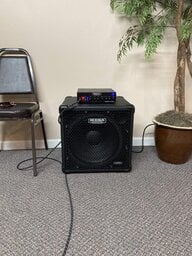
From what I've read about the Fender Bassman 100t is that it has quite a bit more clean headroom than the older models. That's what I'm hoping for with the new V4B. If it does it will be right up my alley. A simple design and layout with that Ampeg tone. I'm currently satisfied with my rig but I have only one head at the moment and we all know we need at least two.
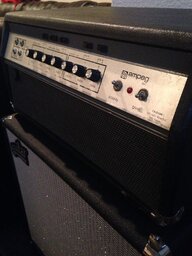
I'm excited for the V4B vs 100T shootout! I have owned many vintage Ampegs over the years, but the 100T is a really, really great sounding head. I know the Ampeg has a slightly lower street cost (although I paid much less for my new 100T than the Ampeg street cost), but the 100T is like a Cadillac with all of its features.
I loved my vintage V4 and V4B. Hopefully the reissue nails it at 30 less lbs. It will have stiff competition from the 100T in the new 100 watt class.
Being a lifelong vintage Ampeg fan, I will admit to not being blown away at the cosmetics of the reissue V4B. I don't know if its the mix of different era switches, the new Anpeg logo on it, or the 24" width or what. I personally would have liked a Blueline B25 look, which I think is the best looking head ever (slightly smaller SVT look) along with the Blueline SVT.
I loved my vintage V4 and V4B. Hopefully the reissue nails it at 30 less lbs. It will have stiff competition from the 100T in the new 100 watt class.
Being a lifelong vintage Ampeg fan, I will admit to not being blown away at the cosmetics of the reissue V4B. I don't know if its the mix of different era switches, the new Anpeg logo on it, or the 24" width or what. I personally would have liked a Blueline B25 look, which I think is the best looking head ever (slightly smaller SVT look) along with the Blueline SVT.
well, there was a huge difference in the output of the original and the reissue of the 90s.
Im not trying to belabor that, I'd just like some idea where it is between the two before I start foregoing my lunch for some extra bucks!
Don't forget to save some lunch money for a full compliment of NOS RCA, Phillips or Sylvania valves if you pull the trigger. They'll last decades. Keep the JJs for backup. The Soviet military 6p3S-e (6l6gc analogs) are working well in my V4B; Cheap, tough and sound great. The original 7027s were still pumping it out 100% when I swapped them. They're my backup set now.
Whoa! Nobody told me it would be this good looking! Dang, might have to get this despite my wife's edict. Oh well, she sprang that she wants a horse on me today...I guess I'll have to use this as leverage
Mr. M.
May I suggest you try this logic regarding horses, and amplifiers:
(sorry for converting W to hp on TB again, but I just could not resist).
If your wife gets 1 horse, (which by definition would be rated at 1 hp), (and, which equals 746 Watts).
Then surely you should not be denied 100 Watts, which equals a paltry 0.13404825737 hp
Make her promise to take it for walks, and clean up after it if has an accident on the living room carpet.
Besides that, a horse eats like a horse.

Don't forget to save some lunch money for a full compliment of NOS RCA, Phillips or Sylvania valves if you pull the trigger. They'll last decades. Keep the JJs for backup. The Soviet military 6p3S-e (6l6gc analogs) are working well in my V4B; Cheap, tough and sound great. The original 7027s were still pumping it out 100% when I swapped them. They're my backup set now.
+100
It is well worth it to me to have the best tubes available, even though it can add significant cost. However in the long run, you have a tube that typically will last much longer and the best tone possible.
I yanked the GT's out of my brand new 100T immediately and replaced with GE 6L6's, an Amperex BB and blackplate RCA 12ax7's, and a blackplate 12AT7. I should be set for a decade or two


Chef
In Memoriam
Personally, I -want- a master volume on any tube amp.
On any amp, really, but especially a tube amp, so I can control tube saturation and output independently.
ymmv I guess, but I see no downside to that.
On any amp, really, but especially a tube amp, so I can control tube saturation and output independently.
ymmv I guess, but I see no downside to that.

I can see both sides of the gain vs no gain question. Gigged with my Magnavox era V4 last night. Sounded amazing as always (sound guy offered to buy if from me). It does not have the gain/master setup. But there have been occasions when I wished it did have a gain control. But, then again, I do a lot of fill-in stuff, which requires me to be able to cop quite a few different tones. Having a gain would allow me to get to a few more grindy ones without insanely high volumes.
By the way, I had it paired with my B40 loaded with Eminence Legends (old school sealed Ampeg 4-10) and I couldn't it turn it any higher than just under 2 on the volume at an outdoor show with a big stage. The drummer literally hugged my amp after the first set. That setup KILLS.
As for this new guy, not only does it look and sound great, but I really gotta tip my hat to the guys at Ampeg for coming here to check in with us. Not only are they offering up a lot of info, but taking requests as to what we would like to see/hear is a big deal to me. I'm sure they can't do everything we ask, but just the fact that they are asking says a lot.
If anyone in the NC, VA, SC area pics one of these up, please get up with me. We will have to get together and make a video and/or sound clips comparing my early 70s one with this new offering so we can put a few things to rest. (I'm sure the new one will hold up just fine.) Mine has the original Magnavox 7027 tubes in it.
By the way, I had it paired with my B40 loaded with Eminence Legends (old school sealed Ampeg 4-10) and I couldn't it turn it any higher than just under 2 on the volume at an outdoor show with a big stage. The drummer literally hugged my amp after the first set. That setup KILLS.
As for this new guy, not only does it look and sound great, but I really gotta tip my hat to the guys at Ampeg for coming here to check in with us. Not only are they offering up a lot of info, but taking requests as to what we would like to see/hear is a big deal to me. I'm sure they can't do everything we ask, but just the fact that they are asking says a lot.
If anyone in the NC, VA, SC area pics one of these up, please get up with me. We will have to get together and make a video and/or sound clips comparing my early 70s one with this new offering so we can put a few things to rest. (I'm sure the new one will hold up just fine.) Mine has the original Magnavox 7027 tubes in it.
- Status
- Not open for further replies.


