
Enjoy the benefits of a premium membership!
Upgrade Account
-
TalkBass has been independent since 1998. Add your voice.
Create a free account to reply to discussions, view embedded media, and browse with fewer display ads.
Join free Log in
Want zero display ads or expanded classifieds tools? Compare plans.
You are using an out of date browser. It may not display this or other websites correctly.
You should upgrade or use an alternative browser.
You should upgrade or use an alternative browser.
2x10 vs 1x12
- Thread starter MrRiff
- Start date
More options
Who Replied?


Same manufacturer, but those two are different lines. So, I assume built around different speakers?It depends, for example in the Genz Benz cabinets the NeoX 112 will generally outperform the LS-210.
It really depends on the cabinet and design.
To the OPs point...... it’s about the limitations of any 1x12 comparing to the same design and speakers to a 2x10.
Given two different speakers from the same line, how much engineering can you do to make them them sound / perform the same?
Say for example, a box with a FaitalPRO 12PR300, and a box with 2x FaitalPRO 10PR300.
I get that our ears and our performance needs are all subjective... but just for fun as a thought expeiment:
Can you get that 112 to put out as much low end as the 210 with the right box and ports?
Could you actually get the two cabs to sound and behave the same by engineering the boxes?

I don't have a 1-12 and never have had one but, I do have an Acme Low B 2-10 and whoa!!!!!!!!!!!!!..............it's like playing through a 1-18.
Logic tells me that for most frequencies, the 1-12 is gonna has better bottom than most 2-10s but the 2-10 is gonna be louder and have better punch and low mids.
2-12s?
Logic tells me that for most frequencies, the 1-12 is gonna has better bottom than most 2-10s but the 2-10 is gonna be louder and have better punch and low mids.
2-12s?

- Feb 12, 2006
- 61,042
- 5
- 220,985
- Disclosures
- Development Engineer-Mesa Boogie, Development Engineer-Genzler (pedals), Product Support-Genz Benz
That was the intent and voicing of the original designs.Same manufacturer, but those two are different lines. So, I assume built around different speakers?
To the OPs point...
Given two different speakers from the same line, how much engineering can you do to make them them sound / perform the same?
Say for example, a box with a FaitalPRO 12PR300, and a box with 2x FaitalPRO 10PR300.
I get that our ears and our performance needs are all subjective... but just for fun as a thought expeiment:
Can you get that 112 to put out as much low end as the 210 with the right box and ports?
Could you actually get the two cabs to sound and behave the same by engineering the boxes?
With the Faital drivers listed above, I could fairly easily create a design where the 112 outperforms the 210 if that was my intent, and I could get them to sound the same in the low end as well. The mid-high mid voicing will be different which is unrelated to the box.

I started with one GK Neo IV 112 and found it was very punchy, cutting in the mix and very detailed but no deep bass.
I then added another one, put it on top of the first one and boom ! Magic happened and I now have everything a bass player wants. Deep and controlled deep bass and kept the punchy low mids and mids.
I then added another one, put it on top of the first one and boom ! Magic happened and I now have everything a bass player wants. Deep and controlled deep bass and kept the punchy low mids and mids.

1x12 = 113 sq in of cone area, 2x10's = 157 sq in of cone area. 2x10's can move more air.
2x10 will surely have more voice coil area and will have better power handling capacity.
(imho) a 2x10 cab will produce more volume with better power handling capacity than a 1x12 cab.
This is all assuming that we are comparing similar xmax and power handling.
International SPL League - Cone Area
2x10 will surely have more voice coil area and will have better power handling capacity.
(imho) a 2x10 cab will produce more volume with better power handling capacity than a 1x12 cab.
This is all assuming that we are comparing similar xmax and power handling.
International SPL League - Cone Area
Last edited by a moderator:
Too many opinions on a topic that does not have an answer that can be proved. All depends on the sound of tens or twelves appeals to you. Agedhorse is correct as usual. Brand quality, components used and design are the determining factors. People have different likes and needs.
The Neo 112 is among the best 112’s out there. Best I ever had, sold it because of the handle location.It depends, for example in the Genz Benz cabinets the NeoX 112 will generally outperform the LS-210.
It really depends on the cabinet and design.
….on paper maybe but not to my ears 2-110’s have lower reach. Look what Phil Jones does with multiple small speaker.I don't have a 1-12 and never have had one but, I do have an Acme Low B 2-10 and whoa!!!!!!!!!!!!!..............it's like playing through a 1-18.
Logic tells me that for most frequencies, the 1-12 is gonna has better bottom than most 2-10s but the 2-10 is gonna be louder and have better punch and low mids.
2-12s?
- Feb 12, 2006
- 61,042
- 5
- 220,985
- Disclosures
- Development Engineer-Mesa Boogie, Development Engineer-Genzler (pedals), Product Support-Genz Benz
Except that you have to use the Sd parameters for area comparison because the gasket and suspension area must be corrected for and represent a larger proportion of area for a 10” versus 12” speaker.1x12 = 113 sq in of cone area, 2x10's = 157 sq in of cone area. 2x10's can move more air.
2x10 will surely have more voice coil area and will have better power handling capacity.
(imho) a 2x10 cab will produce more volume with better power handling capacity than a 1x12 cab.
This is all assuming that we are comparing similar xmax and power handling.
International SPL League - Cone Area
Xmax must be considered as part of the overall design because Xmax x Sd represents total air volume displaced. It makes no sense to assume the same Xmax because by design they are often intentionally different.

It is quite good. Have been using a Neox 112 as a standalone cab for most gigs lately. I have the Neox212 if it’s really needed.The Neo 112 is among the best 112’s out there. Best I ever had, sold it because of the handle location.
Out of laziness and car space, I brought the 112 for an outdoor gig in a 6 piece band and it did just fine. The person we had listening for levels said there was too much bass and asked for less low end to even out the mix. I was surprised.
Last edited:


I’m late to this conversation….. but no one mentioned the fact of 3db gain when stacking cabinets. Cabinet placement at your venue (back wall proximity, corner) coupling makes a difference when stacked vs side by side. Side by side couples the cabs to each and to the floor for a possible 6db gain but less left to right dispersion. When I run two 2x10 cabinets, I stack them in a column (4 vertical) and that gives more overall room dispersion. Knowing all the tricks of speaker placement/coupling can do wonders on gigs with little PA support. 
So, just to derail slightly....when comparing speaker area between cabs, what about a cab that has a 1x12 and a 6" driver or similar? Do you consider that little driver in your calculations of "cone area"? Total dummy here with this stuff, but 12+6=18, while 10+10=20. Seems pretty close.
So, just to derail slightly....when comparing speaker area between cabs, what about a cab that has a 1x12 and a 6" driver or similar? Do you consider that little driver in your calculations of "cone area"? Total dummy here with this stuff, but 12+6=18, while 10+10=20. Seems pretty close.
Nope, it wouldn't work like that.
First, in a 12+6 cab, the drivers are going to be operating in separate frequency ranges - the 6 only covering the upper mids-lower treble, so it doesn't add anything in terms of maximum volume.
Secondly the addition is based on area, not diameter - a typical 12 will have about 530cm2, a 10 around 350cm2 and a 6 ~125cm2.
So, the 210 would have ~700cm2 total area while the 12+6 would have ~655cm2 even if they were being run in the same frequency range, which, they almost invariably aren't.
HTH,
David.
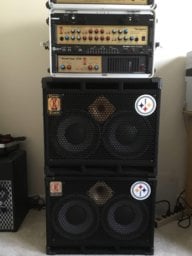
This depends on cab design way more than the speaker size. Personal preference has a large part over what is acceptable, or preferred. Personally, I have (2) 210 cabs that are the same brand but have much different tonal characteristics, but provide just about anything I need tonally. One of those cabs I have used in rooms that seat over 700 with no FOH support as well as rehearsal and recording sessions.Having a 2x10 for a while I just added a 1x12 same manufacture thinking I would trade off some tone for portability. After playing both back and forth I have to say the difference is much more than I thought it would be. The 1x12 sounds good and seems like it would fit nice in a band mix but the bottom end is lacking in comparison, low mids are real punchy but on the lower E string notes that soft bottom isn’t there. Could be the break in factor but I don’t think so. Would like to hear from anyone who has the same configuration. My 2x10 cab is on the left. Thanks
A second 210 cab might not be ideal for you from a portability standpoint, and being honest mine are heavy by today’s standards at around 50 lbs. I’ll be 72 here in a couple of weeks and have no problems moving them around (for now). The sturdy handles, and the way the location balances the weight IMO are much easier to transport a single handle 112 cab despite the extra poundage.
- Feb 12, 2006
- 61,042
- 5
- 220,985
- Disclosures
- Development Engineer-Mesa Boogie, Development Engineer-Genzler (pedals), Product Support-Genz Benz
Your
The +3dB of gain from coupling 2 point sources occurs regardless of orientation (vertical or horizontal) and is primarily predictable below ~200Hz.
The coupling to the floor (1/2-space) always occurs regardless of orientation, though it becomes less predictable as the stack height grows relative to the driver diameter and frequency.
Stacking vertically does not increase horizontal coverage, though it does reduce vertical coverage somewhat. The issue is that the length (height) of the stack is way too short to affect frequencies below 200-300Hz. It does change the plane that the comb filtering occurs, which may (or may not) be a real world benefit.
understanding of coupling is missing some fundamental accuracy issues.I’m late to this conversation….. but no one mentioned the fact of 3db gain when stacking cabinets. Cabinet placement at your venue (back wall proximity, corner) coupling makes a difference when stacked vs side by side. Side by side couples the cabs to each and to the floor for a possible 6db gain but less left to right dispersion. When I run two 2x10 cabinets, I stack them in a column (4 vertical) and that gives more overall room dispersion. Knowing all the tricks of speaker placement/coupling can do wonders on gigs with little PA support.
The +3dB of gain from coupling 2 point sources occurs regardless of orientation (vertical or horizontal) and is primarily predictable below ~200Hz.
The coupling to the floor (1/2-space) always occurs regardless of orientation, though it becomes less predictable as the stack height grows relative to the driver diameter and frequency.
Stacking vertically does not increase horizontal coverage, though it does reduce vertical coverage somewhat. The issue is that the length (height) of the stack is way too short to affect frequencies below 200-300Hz. It does change the plane that the comb filtering occurs, which may (or may not) be a real world benefit.
I have heard of people mixing a 210 and 112, however many I have seen mentioned in most settings a 112 is not going to cut it like a 210. Now another 112 added to a 112 or an actual 212 is then a different story against a 210 (or 410). I have always been a fan of 10's, but 12's have started to intrigue me more.

As a former speaker cab designer, all I can add to the discussion is that, in a blind, side by side comparison of cabs with different speaker sizes, there is no way anyone can tell what size speaker they were actually listening to, much less have a preference for.
There are far too many other variables at play. Bias is an interesting phenomenon, much like the placebo effect.

There are far too many other variables at play. Bias is an interesting phenomenon, much like the placebo effect.
If I'm reading that correct, does that mean that the craze of stacking drivers vertically does not really have much benefit beyond - "the speaker is closer to your ear?"Stacking vertically does not increase horizontal coverage, though it does reduce vertical coverage somewhat. The issue is that the length (height) of the stack is way too short to affect frequencies below 200-300Hz. It does change the plane that the comb filtering occurs, which may (or may not) be a real world benefit.
I remember seeing something once about placing drivers at a 90 degree angle. Is that a thing?
- Feb 12, 2006
- 61,042
- 5
- 220,985
- Disclosures
- Development Engineer-Mesa Boogie, Development Engineer-Genzler (pedals), Product Support-Genz Benz
For bass guitar, the benefit is indeed getting the top drivers closer to your ear. There are other less impactful benefits, not earth shattering. Now for (pro) PA applications, the benefits can be huge (especially when the array becomes long relative to the wavelength). For example in the larger format touring world, it;s common to see arrays reach 24 feet or more which provides plenty of low mid control down to ~100Hz IN THE VERTICAL PLANE. In the horizontal plane it's relatively unchanged.If I'm reading that correct, does that mean that the craze of stacking drivers vertically does not really have much benefit beyond - "the speaker is closer to your ear?"
I remember seeing something once about placing drivers at a 90 degree angle. Is that a thing?
View attachment 7082196
This doesn't eliminate the effects of comb filtering due to the summing of multiple point sources, it just changes the plane they reside in... generally for the better but not always.
The cross-firing is more for increasing mid dispersion, especially where beaming at higher frequencies is problematic.


