

Enjoy the benefits of a premium membership!
Upgrade Account
-
TalkBass has been independent since 1998. Add your voice.
Create a free account to reply to discussions, view embedded media, and browse with fewer display ads.
Join free Log in
Want zero display ads or expanded classifieds tools? Compare plans.
You are using an out of date browser. It may not display this or other websites correctly.
You should upgrade or use an alternative browser.
You should upgrade or use an alternative browser.
4, 5 -Or- 6 String?
- Thread starter IrishRifles
- Start date
More options
Who Replied?
I play a 5 string Jazz bass. Had I a bass with more strings I'd be adding low strings to play more exclusively on a shorter scale.
Similarly, I would like to have a few 4-bangers of standard and shorter scales and an upright as well but for now I'm fine with my JV.
I like 'em all for the most part. Haven't found too many 'modern' basses that really do it for me (thumb5, boutique fenderesques, dingwalls), but then again who strings an MTD 6er with flats done high and tight?
I'd love to have my hands on a fretless 4 string MusicMan Sterling right now though.
Had I a 4-stringer as mine own I'd probably get used to playing up and down the neck a lot more, more open strings, etc.
Gotta keep learning!
Similarly, I would like to have a few 4-bangers of standard and shorter scales and an upright as well but for now I'm fine with my JV.
I like 'em all for the most part. Haven't found too many 'modern' basses that really do it for me (thumb5, boutique fenderesques, dingwalls), but then again who strings an MTD 6er with flats done high and tight?
I'd love to have my hands on a fretless 4 string MusicMan Sterling right now though.
Had I a 4-stringer as mine own I'd probably get used to playing up and down the neck a lot more, more open strings, etc.
Gotta keep learning!
Roy Vogt
Supporting Member
- Sep 20, 2000
- 4,433
- 537
- Disclosures
- Endorsing Artist: Kiesel Basses, Ampeg Amplification, Hotone Ampero II effects
That is awesome.
And thanks for sharing your experiences and insights on the forum!
Bob
Thanks for your kind words, Bob!

4, less is more
Then ... maybe play a 1 string bass with 0 fret.
Roy Vogt
Supporting Member
- Sep 20, 2000
- 4,433
- 537
- Disclosures
- Endorsing Artist: Kiesel Basses, Ampeg Amplification, Hotone Ampero II effects
Then ... maybe play a 1 string bass with 0 fret.
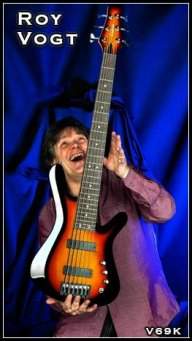
I borrowed one of those from Victor Wooten for a photo shoot! LOL
Attachments

I borrowed one of those from Victor Wooten for a photo shoot! LOL
Les Claypool also play something that looks like that that he call a Whamola.
I only played 6 strings basses for th past 7 years. I moved to the 5 strings after one year on the 4 strings bass.
A 4 strings bass never made sense to me unless you tune it in 5th.
A 4 strings bass never made sense to me unless you tune it in 5th.
4...I've just always hated the sound of the low B...it annoys the crap out of me for some reason....
I agree. I would love the range, but have yet to find a bass that has a low b string that I like the sound of. They always sound different somehow...difficult to find the words.

4-string for me.
I love the range offered by a 5, but I've never played a 5-string neck that I liked the feel of.
Many years ago, after 10 years of experience on a 4, I switched to 5 exclusively for about 3 years. During those 3 years, I always felt something was missing, and for me, that something was enjoyment.
I switched back to 4, and the enjoyment of playing returned. With different tunings, my 4-strings offer all of the range of 5 & 6-ers, but with the comfortable neck profile I prefer.
I love the range offered by a 5, but I've never played a 5-string neck that I liked the feel of.
Many years ago, after 10 years of experience on a 4, I switched to 5 exclusively for about 3 years. During those 3 years, I always felt something was missing, and for me, that something was enjoyment.
I switched back to 4, and the enjoyment of playing returned. With different tunings, my 4-strings offer all of the range of 5 & 6-ers, but with the comfortable neck profile I prefer.
A 4 strings bass never made sense to me unless you tune it in 5th.

Play 4 strings 5's and 6's.
I play too many things that require a low B so guess what i use the most. Tbh my 4-string is always tuned in tenor tuning now
I play too many things that require a low B so guess what i use the most. Tbh my 4-string is always tuned in tenor tuning now

With different tunings, my 4-strings offer all of the range of 5 & 6-ers, but with the comfortable neck profile I prefer.
I wish that would work for me. I have pretty much settled on playing 5 strings and I'm very comfortable on them and can cover basically 95% of what I want to do.
The other 5% requires a 6 as I want/need both the low B and high C when doing something like Yellowjackets music where Jimmy uses the entire range of his 6 string when playing grooves and solos. Having one strung B-G and the other E-C doesn't work. I don't have any gigs where Yellowjackets or similar music is being performed so I haven't felt a real NEED for a 6 string - but it would be fun to have one again to explore that genre of music.
I learned playing bass as the same time I learn reading music and well .. when I saw others instruments having several notes on extra lower extra ledger while the bass is limited at one line I was like : "what the ... the range is so small".
I never thought of tuning in 5th at first so I took the 5 strings route. I wanted a bigger range so I could have a chance of playing music that wasn't written for bass. I wanted to play music, not really be a bass player, just be a musician that happen to have a bass and not limit myself with only play bass line.
so after 14 years of bass and DB, I think of dropping bass and learn more piano or guitar.
I learned playing bass as the same time I learn reading music and well .. when I saw others instruments having several notes on extra lower extra ledger while the bass is limited at one line I was like : "what the ... the range is so small".
I never thought of tuning in 5th at first so I took the 5 strings root. I wanted a bigger range so I could have a chance of playing music that wasn't written for bass. I wanted to play music, not really be a bass player, just be a musician that happen to have a bass and not limit myself with only play bass line.
so after 14 years of bass and DB, I think of dropping bass and learn more piano or guitar.
This may actually be the root of why so many people have such passionate responses to the 4, 5, or 6 debate, and its kind of what I mentioned in my post. Its as simple as some of us think of ourselves as bassists and some of us think of ourselves as musicians. I myself am a bassist, my approach is "oldschool" I play a 4 string with flatwounds. I have no use for the extended range, but can see where someone else might.
[MINIRANT] I never really got the whole 'Jaco only needed 4' train of thought, or worse, the, '6 if you are a wanna-be guitarist' nonsense. What Jaco played or would be playing today if he were alive affects me not in the slightest. Also, I've been playing guitar since '72, bass and keys since '75 so there's no 'wanna be' in me. Whatever I've got in my hands, be it my BB75 or my ES-175 or a Motif under one hand and a Minimoog under the other they are all just tools to get the music out. [/MINIRANT]
You also have to look at the personalities/playing abilities of the people making these statements. Most of them I've found aren't very good on 4 strings and have a chip on their shoulder about anybody who plays better than they do or plays with more strings than they do. Rather than hit the woodshed to get better they immediately say "If it has more than 4 strings you should play guitar.
Usually if this is said in a music store I'll point at the uke in the corner and ask them if that is a bass as it only has 4 strings. Or the right store the banjo, the mandolin, the violin, the cello etc. and ask if they are all basses. Or mention Stanley Clarkes Piccolo Bass that is tuned like the low four strings of a guitar is still a bass if having a lower range on mine makes it not a bass.
C/S,
Rev J
^ Unlike the above statement I don't wish to generalise, however it seems that all the negativity in this thread is coming from the 5 and 6 string camp. Us 4 stringers are either: old, punks, not men, or aren't very good and we need to practice more.
Where as all the 4 string players have simply said that they feel more comfortable on a 4 string. Perhaps instead of making fun of the 4 stringers you could spend your time explaining why you use what you use, it might be more constructive in answering the OP.
Rev J, you seem offended that someone told you that a 6 string isn't a bass... well in a way when you start getting into 6, 7, and 8 string basses, or even 8 string basses that are doubled up, they aren't really bass specific instruments. There is a point where it becomes more "full range."
Where as all the 4 string players have simply said that they feel more comfortable on a 4 string. Perhaps instead of making fun of the 4 stringers you could spend your time explaining why you use what you use, it might be more constructive in answering the OP.
Rev J, you seem offended that someone told you that a 6 string isn't a bass... well in a way when you start getting into 6, 7, and 8 string basses, or even 8 string basses that are doubled up, they aren't really bass specific instruments. There is a point where it becomes more "full range."

I started on a Yamaha 24-fret 4-string then moved to a Carvin 24-5 (B) and continued onto a Brubaker 24-5 (B). I've mucked around on a lot of basses and now I'm exclusively playing 4-strings with 20 frets or less.
I have only played 2 24 fret basses that had perfect intonation all the way to the 24th fret across all strings... a $12000 Fodera and a Sadowsky NYC.
It took me many years to realise it but I'm a 4-string vintage singlecoil passive guy... I'll take fewer notes if they all sound better and are perfectly in tune.
As a point of interest... a 20-fret 4 string has an effective range of almost 3 octaves... this is the same as a Tenor saxophone (not including the half octave of altísimo some players have available to them)... draw your own conclusions.
I have only played 2 24 fret basses that had perfect intonation all the way to the 24th fret across all strings... a $12000 Fodera and a Sadowsky NYC.
It took me many years to realise it but I'm a 4-string vintage singlecoil passive guy... I'll take fewer notes if they all sound better and are perfectly in tune.
As a point of interest... a 20-fret 4 string has an effective range of almost 3 octaves... this is the same as a Tenor saxophone (not including the half octave of altísimo some players have available to them)... draw your own conclusions.
As a point of interest... a 20-fret 4 string has an effective range of almost 3 octaves... this is the same as a Tenor saxophone (not including the half octave of altísimo some players have available to them)... draw your own conclusions.
I conclude I need the effective range of a Bari sax I guess as I make use of the B string often.
Who needs more than 4 strings, if you are able to tune the damn thing down, or simply put fatter strings there ?
Thats why I always stayed with the 4 strings, because I've never used more than 4, no matter what music I was playing.
Thats why I always stayed with the 4 strings, because I've never used more than 4, no matter what music I was playing.


