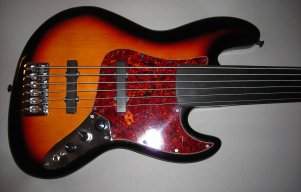
4 tuned BEAD, 5 tuned standard, 12 for #%@ & giggles, 6 confounds me.
+1 A four tuned BEAD is awesome.

TalkBass has been independent since 1998. Add your voice.
Create a free account to reply to discussions, view embedded media, and browse with fewer display ads.
Join free Log in
Want zero display ads or expanded classifieds tools? Compare plans.
4 tuned BEAD, 5 tuned standard, 12 for #%@ & giggles, 6 confounds me.

Who needs more than 4 strings, if you are able to tune the damn thing down, or simply put fatter strings there ?
Thats why I always stayed with the 4 strings, because I've never used more than 4, no matter what music I was playing.
+1 A four tuned BEAD is awesome.
Just ask yourself "what would Geddy Lee do?"
You want to play a B? Bam! There's a perfectly good one right there at the 2nd string 9th fret. Want to go extra deep? Pow! There is a great deep B on the fourth string 7th fret.

I started on a Yamaha 24-fret 4-string then moved to a Carvin 24-5 (B) and continued onto a Brubaker 24-5 (B). I've mucked around on a lot of basses and now I'm exclusively playing 4-strings with 20 frets or less.
I have only played 2 24 fret basses that had perfect intonation all the way to the 24th fret across all strings... a $12000 Fodera and a Sadowsky NYC.
It took me many years to realise it but I'm a 4-string vintage singlecoil passive guy... I'll take fewer notes if they all sound better and are perfectly in tune.
As a point of interest... a 20-fret 4 string has an effective range of almost 3 octaves... this is the same as a Tenor saxophone (not including the half octave of altísimo some players have available to them)... draw your own conclusions.

I play a 5 when I have to but prefer a 4. I'd never use a 6 string. I don't even like using the low E on a 4 that much.
Just don't like that big huge low end, in basses, cabs, amps etc.

Well, apparently plenty of people need more than 4 strings as there are a lot of more than 4 string basses out there. Tuning down isn't always an option.
If 4 strings work for you that's great. For many of us, they don't.


I got a 5 string Lakland 55-02 and love it. To me it's the perfect balance. Wider neck but not to wide. Still has the same string spacing at the bridge as my 4 string j. When you get to 6 strings you really have to start compromising. Plus on a 4 I'm frequently drop d tuning but rarely needing the extra range on the high end.
^ Unlike the above statement I don't wish to generalise, however it seems that all the negativity in this thread is coming from the 5 and 6 string camp. Us 4 stringers are either: old, punks, not men, or aren't very good and we need to practice more.
Where as all the 4 string players have simply said that they feel more comfortable on a 4 string. Perhaps instead of making fun of the 4 stringers you could spend your time explaining why you use what you use, it might be more constructive in answering the OP.
Rev J, you seem offended that someone told you that a 6 string isn't a bass... well in a way when you start getting into 6, 7, and 8 string basses, or even 8 string basses that are doubled up, they aren't really bass specific instruments. There is a point where it becomes more "full range."

Just playing devil's advocate... how often does a bassist with 5 or 6 strings actually use notes outside of the three octaves on a standard 4 string. Other than maybe in metal, I would say for most not very often. Usually the argument I hear for 5 and 6 strings isn't the extra range but the ability to play a broader range in any given position. If that is the case then "need" isn't quite the right word. Kind of like saying a guitarist "needs" a capo to play a song.
But I agree with your last statement, what works for you great, what works for others, also great, just play what you like.
This stuff is not worth thinking about or arguing about. If you want to play professionally have a 5 and a 4. Learn and own both and you are covered. Its all about getting the gig and fitting into the situation.
If you do it for fun, play whatever the heck you want.