
The 115 + 410 rig gets some criticism because it doesn't do what some proponents of the setup traditionally thinks it does. The 'bloke down the pub' received wisdom is that you need a 115 for "lows", but these cabs are too "slow", so you need a 410 for "highs" because these are "faster" because of the smaller speakers. However the 410 doesn't have the "lows" of the 115, so you need both cabs to get a "full" signal.

Enjoy the benefits of a premium membership!
Upgrade Account
-
TalkBass has been independent since 1998. Add your voice.
Create a free account to reply to discussions, view embedded media, and browse with fewer display ads.
Join free Log in
Want zero display ads or expanded classifieds tools? Compare plans.
You are using an out of date browser. It may not display this or other websites correctly.
You should upgrade or use an alternative browser.
You should upgrade or use an alternative browser.
More options
Who Replied?

Anything I do will be matched brand and series. Also with won't run more than half of the wattage through the cab then the rated wattage. 500w amp would end up going to a 500w 15 and an 800w 410 if I went with what I have now plus a 15. But with all the possibility of uh ohs. It sounds like maybe I'll play with a stack of 2 212s or something. I don't like the idea of sound pockets and this was really just and idea not a necessity.The 115 will be very underpowered to handle the 8 ohm load compared to the 410. Maybe sell the 410 and get a 210 x 115? If you want to go that way. If you do move ahead with a 115, make sure you read the power ratings. And maybe stick with the same brand? I dunno. Most likely though if you're careful it should be ok. Just don't try and blast with it or you'll blow your 115 pretty quick. Good luck!
I was correct to assume I would get lots of useful knowledge from TB faithful.
No I'd have to grab a matching 115. So I started reading around and noticed it's not popular. So I inquiredIt's what you have lying around and want to see how it sounds?
I ran a 210 rumble combo and 115 rumble cab and thought it sounded really muddy and undefined. returned the cab next day.
I think that is maybe just the Rumble! I have a Rumble combo, and it can really Rumble depending on where it is. I keep the bass control rolled right off for this reason. In different rooms it sounds very different.
I read billy Sheehan uses or used to use a biamp setup with a 115 for the top end because the slower response of the 15” speaker smooths it out.
15'' drivers aren't slower.
I get told to turn down with a single 2X10, even in larger rooms.
I've been told to turn down before I've played a note. Some people see a bass and get nervous.
The 115 will be very underpowered to handle the 8 ohm load compared to the 410.
OP's 410 is an 8 ohm cabinet. A second 8 ohm 115 isn't going to be underpowered, and the concept of underpowering a cab is a myth anyway.

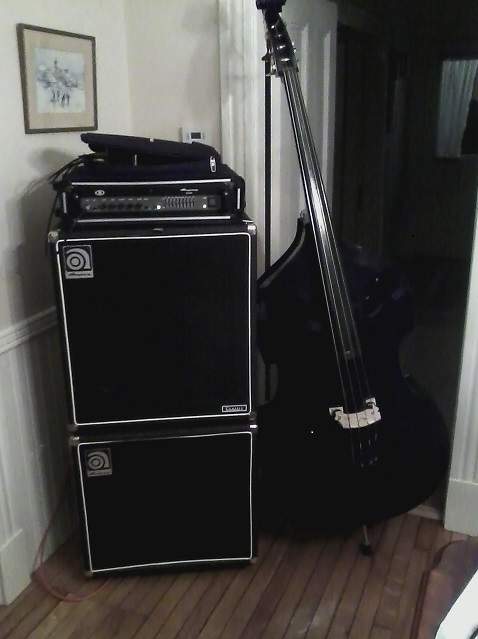
I have a 410 115 Ampeg rig, it sounds great. I've tried each cabinet alone and put the 410 on the bottom too, It sounds best with the 115 on the bottom. The 15 is rated at 200 watts. My brain would be mush before I blew the 15, so overpowering the 15 can't be an issue. If I had my druthers, I'd replace the 410 with another 115, the 15E just sounds perfect with my big bass. I like the tall stack so that I can hear the notes clearly. Using two cabs allows me to play a lot louder without the basses body feeding back.

I ran a GK 700 with a Avatar TB153 & 410 set for years & I got a lot on complements on my sound.
Including my band members.
Getting older & playing smaller gigs now, so I am using
a pair of newer Acoustic 210 neo's. They sound great & are light.
PS, I have ran the 210 with the 15, they work well together too.
Including my band members.
Getting older & playing smaller gigs now, so I am using
a pair of newer Acoustic 210 neo's. They sound great & are light.
PS, I have ran the 210 with the 15, they work well together too.
Last edited:

I'm pretty new to the cabinet and head game. Always been a combo guy. I currently have a an acoustic bn410 (I know it's poopoo but it was super cheap) and I've been thinking of pairing an acoustic bn115 with it. Turns out the neo series really don't sound that bad.
Now this is just for fun to see if I like the multi cabinet rig and itll only cost me around 400 bucks between the two cabinets. One was on clearance and I'll pick the second up used. If I do like it in going to go to a better, preferably American made product.
I have noticed everyone seems to advise against 410/115 combo. Why? Teach me oh wonderful talkbass members. GAS is taking hold and I wanna buy stuff!
It's based primarily on marketing myths, is part of the reason.I'm pretty new to the cabinet and head game. Always been a combo guy. I currently have a an acoustic bn410 (I know it's poopoo but it was super cheap) and I've been thinking of pairing an acoustic bn115 with it. Turns out the neo series really don't sound that bad.
Now this is just for fun to see if I like the multi cabinet rig and itll only cost me around 400 bucks between the two cabinets. One was on clearance and I'll pick the second up used. If I do like it in going to go to a better, preferably American made product.
I have noticed everyone seems to advise against 410/115 combo. Why? Teach me oh wonderful talkbass members. GAS is taking hold and I wanna buy stuff!
Another reason is that this pairing is typically very prone to blowing speakers, specifically, the 15.
Marketing departments would have you believe that a larger diameter driver has inherently more low end than a smaller diameter one. This is simply not the case. While larger diameter drivers are usually the ones used for subwoofers, this has way more to do with cost and simplicity (one large speaker instead of several smaller ones for the same cone area) and the fact that the drawbacks of large diameter drivers (namely frequency dispersion in the upper mids and highs) don't matter for subwoofer frequencies.
Full range bass guitar drivers are not subwoofers. They're woofers. They need to produce mids and highs as well as lows. How much of every frequency a bass cab has depends on the design of the individual driver and the cab it's in way more than the size of the driver. For example, the SVT-410HLF has way more low end than many 15" cabs, while having less midrange. Because it was specifically designed to pump out massive low end. Adding a 15" driver to a 410 is not necessarily going to result in any more low end. And if the 15" is of comparable quality to the 410, it won't be loud enough to make that much difference anyway, as a 410, all else being relatively similar, has about twice the speaker area of a comparable 15 (there are super 15"s there that can and will blow crappier 410s out of the water, but a premium 15 cab with a crappy 410 is an unlikely pairing). This is especially the case because if you're primarily using the 410 for mids and highs and the 15 for lows, you have the opposite of the right amounts of speaker area for that purpose. Mids and highs take less energy to produce and are louder to the human ear than lows are. Hence why the fEarful designs of two/three way cabs use a singe 6" driver for the mids (and highs, if there's no tweeter) if they have a single 15" subwoofer driver for the lows, as that's all that's necessary for a balanced sound.
This leads us to the second problem: power. Say you have a 400 watt amp and two cabs of equal impedance. In this scenario, 200 watts would be going to each cab. In the case of a 410 and 115, with the 410, the power is split further between the 4 drivers, so each gets 50... whereas the single 15 faces the full brunt of 200 watts. If the drivers are of comparable quality, the single 15" is going to run into its limits way before any of the drivers in the 410 do, leading to potential for blown speakers. While sure, you can still destroy speakers with matched cabs, it's a bit less likely because with two 410s or two 15s or whatever, both your cabs will handle about the same amount of power and be the same volume.
Lastly, when you match cabs, it's easier to predict the sound of the two cabs together. If you already like how one cab sounds, another one just like it will simply be more of that sound.

Say for argument's sake the OP had an 800 watt amp. If the cab was capable of handling 300 watts and it's splitting an 8 ohm load with a second cab, it will get equally 400 watts. So the cab is technically underpowered to receive the additional 100 watts which could cause in speaker damage. I may be wrong on this, just playing devil's advocate.I think that is maybe just the Rumble! I have a Rumble combo, and it can really Rumble depending on where it is. I keep the bass control rolled right off for this reason. In different rooms it sounds very different.
15'' drivers aren't slower.
I've been told to turn down before I've played a note. Some people see a bass and get nervous.
OP's 410 is an 8 ohm cabinet. A second 8 ohm 115 isn't going to be underpowered, and the concept of underpowering a cab is a myth anyway.


I'm pretty new to the cabinet and head game. Always been a combo guy. I currently have a an acoustic bn410 (I know it's poopoo but it was super cheap) and I've been thinking of pairing an acoustic bn115 with it. Turns out the neo series really don't sound that bad.
Now this is just for fun to see if I like the multi cabinet rig and itll only cost me around 400 bucks between the two cabinets. One was on clearance and I'll pick the second up used. If I do like it in going to go to a better, preferably American made product.
I have noticed everyone seems to advise against 410/115 combo. Why? Teach me oh wonderful talkbass members. GAS is taking hold and I wanna buy stuff!
I’m not of a bent that you can’t combine them, but usually, the 410 has a higher wattage rating, which means you have some unused capacity when paired with the 115.
The other thing to consider is when used together, both cabs will get the same amount power from the amp, unless you happen to have a stereo amp. Regardless, In most cases, the amount of decibels coming from the 410 will exceed those from the 115 per watt, making it likely you will not hear the 115.
There was a poster here within the last week that puts the 15 on top and says he can hear his stuff better.
It's based primarily on marketing myths, is part of the reason.
Another reason is that this pairing is typically very prone to blowing speakers, specifically, the 15.
Marketing departments would have you believe that a larger diameter driver has inherently more low end than a smaller diameter one. This is simply not the case. While larger diameter drivers are usually the ones used for subwoofers, this has way more to do with cost and simplicity (one large speaker instead of several smaller ones for the same cone area) and the fact that the drawbacks of large diameter drivers (namely frequency dispersion in the upper mids and highs) don't matter for subwoofer frequencies.
Full range bass guitar drivers are not subwoofers. They're woofers. They need to produce mids and highs as well as lows. How much of every frequency a bass cab has depends on the design of the individual driver and the cab it's in way more than the size of the driver. For example, the SVT-410HLF has way more low end than many 15" cabs, while having less midrange. Because it was specifically designed to pump out massive low end. Adding a 15" driver to a 410 is not necessarily going to result in any more low end. And if the 15" is of comparable quality to the 410, it won't be loud enough to make that much difference anyway, as a 410, all else being relatively similar, has about twice the speaker area of a comparable 15 (there are super 15"s there that can and will blow crappier 410s out of the water, but a premium 15 cab with a crappy 410 is an unlikely pairing). This is especially the case because if you're primarily using the 410 for mids and highs and the 15 for lows, you have the opposite of the right amounts of speaker area for that purpose. Mids and highs take less energy to produce and are louder to the human ear than lows are. Hence why the fEarful designs of two/three way cabs use a singe 6" driver for the mids (and highs, if there's no tweeter) if they have a single 15" subwoofer driver for the lows, as that's all that's necessary for a balanced sound.
This leads us to the second problem: power. Say you have a 400 watt amp and two cabs of equal impedance. In this scenario, 200 watts would be going to each cab. In the case of a 410 and 115, with the 410, the power is split further between the 4 drivers, so each gets 50... whereas the single 15 faces the full brunt of 200 watts. If the drivers are of comparable quality, the single 15" is going to run into its limits way before any of the drivers in the 410 do, leading to potential for blown speakers. While sure, you can still destroy speakers with matched cabs, it's a bit less likely because with two 410s or two 15s or whatever, both your cabs will handle about the same amount of power and be the same volume.
Lastly, when you match cabs, it's easier to predict the sound of the two cabs together. If you already like how one cab sounds, another one just like it will simply be more of that sound.
Awesome explanation. I should have read your before posting mine.well stated.

I really don't see a problem. At all. 15s are great for low end if a little inarticulate, whereas 410s are punchy and articulate as hell. But, depending on manufacturer, can be a little thin on lows. It's a good investment IME
This has been repeatedly debunked.I really don't see a problem. At all. 15s are great for low end if a little inarticulate, whereas 410s are punchy and articulate as hell. But, depending on manufacturer, can be a little thin on lows. It's a good investment IME
This has been repeatedly debunked.
I did say IME. I think it does a good job. YMMV.

Because of the persistence of the "underpowering" myth (in the sense of "powering a cabinet with an amp whose power delivery is below the power handling of the cab results in the cab being destroyed, because of square waves and the cone stopping mid-air and black magic, or something") and the fact that the word is most thrown in by believers in that myth, what you meant, which is correct per se, would be better expressed with "the cab has a lower power handling". It flows less but has less potential for misunderstanding.Say for argument's sake the OP had an 800 watt amp. If the cab was capable of handling 300 watts and it's splitting an 8 ohm load with a second cab, it will get equally 400 watts. So the cab is technically underpowered to receive the additional 100 watts which could cause in speaker damage. I may be wrong on this, just playing devil's advocate.

Could you explain what you mean by throw?There are a few complications that can arise by using two different cabs. As someone stated before, the 410 is gonna be louder, so you risk blowing the 15 as you try to balance them. I once tried to use my old Hartke 215 with my newer 810, only to find they were reverse phased and cancelled each other out. They were both Hartke, just different lines (vx and xl). Also the benefits are pretty minimal as neither will produce frequencies the other can't. The only effect speaker size has on sound is how wide of a throw they have. 10 S have a narrower throw than 15s. Kinda like the difference between a spot light and a lantern, though not as exaggerated.

I don’t care about the why, there’s not a chance in hell that I’m lugging 2 large cabs to any gig. YMMV
Unless, of course, they’re paying me per speaker.
Unless, of course, they’re paying me per speaker.

You do what you want, but if you think you can trust the two of them in the same room together ... well, I'll just say to make sure your valuables are locked up.
Mismatched sets create unpredictable sonic patterns, giving rooms inconsistent coverage. Plus they're thieving b@$÷@%&$.
Mismatched sets create unpredictable sonic patterns, giving rooms inconsistent coverage. Plus they're thieving b@$÷@%&$.

I mean the cone of sound a speaker produces. Larger speakers spread out sound a little more... sometimes... but only certain frequencies - it gets a little more scientific than I'm qualified to delve into. Larger speakers DO NOT produce lower notes with greater efficiency, however. Phil Jones Bass cabinets can produce dangerous lows using 5" speakers. There's even a warning on the back of some of their cabs about causing structural damage to buildings. I remember reading something about clusters of these little speakers being more efficient than larger speakers at moving air. Something about combined surface area vs mass if I remember correctly.Could you explain what you mean by throw?
I mean the cone of sound a speaker produces. Larger speakers spread out sound a little more... sometimes... but only certain frequencies - it gets a little more scientific than I'm qualified to delve into. Larger speakers DO NOT produce lower notes with greater efficiency, however. Phil Jones Bass cabinets can produce dangerous lows using 5" speakers. There's even a warning on the back of some of their cabs about causing structural damage to buildings. I remember reading something about clusters of these little speakers being more efficient than larger speakers at moving air. Something about combined surface area vs mass if I remember correctly.
View attachment 3048302
Man, I get peanut butter jelly when I see someone roll up with a Phil Jones
 one day!!!


