• TalkBass has been independent since 1998. Add your voice.
    Create a free account to reply to discussions, view embedded media, and browse with fewer display ads.
    Join freeLog in
    Want zero display ads or expanded classifieds tools? Compare plans.

5 string basses should be 35” scale

I have absolutely no use for a B string, However, I find myself greatly DESIRING one. I am casually researching five strings. From what I can determine by reading a few threads on Talkbass string gauge and construction can mitigate scale length. That said, when I do finally get a fiver it will probably ether be a Yamaha BB or an Ibanez SR.

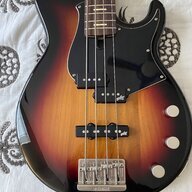
I have a BBP35 and I adore it. I did put Nordstrand PJ pickups in it. And it’s plek’d, I flip the saddle for the Low B. It’s clear and massive. It’s also Passive. Which is amazing.
 
  • Like
Reactions: el jeffe bass
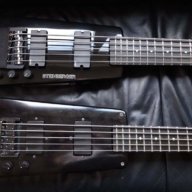
Plenty of 5er have weak B-String tone; the question is not about scale but rather on the density of woods. I own a '93 Streamer 5 with maple body, ovangkol neck/wenge fb and this guy is thunder pure; a 34" btw. Otherwise I went to Steinberger but that's another league ...
Steinberger L2-5 20.3.17b.jpg


'93 Warwick Streamer 5.jpg
 
A TI flat wound B string is a round core, Low tension string. It sounds, feels and plays fantastic on every 34" bass string I have owned.
Now take a higher tension, Hex core higher tension string and it feels even tighter.

One of the absolute best B strings you can put on a bass is a Tapered Sadowsky .125. The Sadowsky 5 string set is pure perfection and 34" is all that is needed. I have owned and played enough Sadowsky 5 strings to know that the B integrates seamlessly to the other strings.

35" is the absolute least contributing factor.
 
If I base my opinion on experience, it would be inconclusive, my brain tells me a longer scale will make the low B more defined and clear, let alone not rubbery.

Have you ever tried and heard a plucked or slapped low D on a Kubicki Factor Ex’s 36” scale on the 4th string? If so, you know what I mean.

Yet in practice that does not seem to consistently hold true, I have played several high end 35” scale basses, even my own and other 37” low B Dingwalls; that low B is not what I was looking for, floppy and rubbery. Yet as even the OP stated, the best 5th string feel and sound I found is on the EB Sr5, at 34” scale. I’m sure there are others as good or better, but I have not experienced them yet. I also recently tried the new Ibanez headless fanned fret designs, I tried the top of the line 5 string and the short scale (32”) 5 string. The low B on the short scale had better feel (not floppy or rubbery) more definition, clarity and sustain than on the full scale model at about 30% less $$$.

Go figure…
 
Last edited:
  • Like
Reactions: TrustRod
A bass guitar with a 35" scale does not guarantee that a low B won't play floppy. There are several other factors that determine floppiness(in no particular order): Neck stiffness, truss rod relief, fret dressing, string gauge, tuning pitch, and in particular the touch of the player. In fact I have played 35" basses that had B strings that were more floppy than some 34" scale basses I've played.
 
Last edited:
  • Like
Reactions: Bob Leton
I recently picked up a Lakland USA 5 string, and I agree that they do have it right. It is the best low B I have ever experienced on a bolt on bass.
 
I studied the Physics of Musical instruments in college, and this is absolutely the right answer. String sets for basses are typically designed with an arithmetic progression in string diameter - 45-65-85-105. This results in uneven tension. When extended to a 5th string, this thinking flat out fails. I like really light tension - 40-55-70-95 on a 4 string. A well matched B string for that set is a 130. If you’re playing a 105E, a 140 is what you need. The 120 or 125 in the set you bought is just a bad choice.

35 inch scale is a band aid for the fact that string companies don’t make matched sets - it helps the floppy B somewhat, but makes the other strings tighter as well. With well designed string sets, none of this would be necessary.

I buy single strings to get a well matched B string. It works very well on a 34 inch scale. With the right strings, a 34 inch scale bass is better for a 5 string - shorter necks are, by definition, stiffer. That difference is small, but it is there.

This is a very helpful and thoughtful post. I hate changing strings and reworking stuff like that, but it's time for me to consider a different gauge for my B string.
 
The gauge of your B string is very important. I once converted a 30" scale Rickenbacker 3000 bass to a 5-string, and added a Rickenbacker HB1 humbucker. I did a few other mods to the bass as well. The bass ended up in Japan when I foubd it online.
FB_IMG_1620862982120.jpg
 
Not because I'm a contrarian (actually, I am) but if I were ever to buy another 4-string it would be a 35" scale strung EADG. Possibly an Elrick or a Stambaugh. My hand size sits between small and medium but 35" is my preference. Why is it my preference? It just is. :thumbsup:

M. M.
 
In my experience, other than multi scale basses like Dingwall, scale length has little to do with how tight and focused your B string sounds. My Ken Lawrence has a 35" scale 5 piece neck and I would have to say that the B string on my single piece neck, 34" scale, Lull and Sadowsky basses actually sound tighter and more focused. One of the best B strings I've ever heard was on a 33.5" scale bass. In fact, I've definitely grown to prefer 34" scale over 35" and I doubt i will ever buy another 35" scale bass. If the only thing keeping from buying a Sadowsky is the 34" scale, I can assure you that their B string is as good as any I've heard, short of the Dingwall basses.
 
If you fret at the 12th fret, Now the vibrating portion of the string is only 17". Is that short section is going to flop around like a fish? No!

Once you start fretting up the neck the vibrating length of the string decreases. Obviously, It has almost zero effect on tension.
 
There are other threads about this. One in Luthiers Corner about how to get a good B on a 32” scale.

Pretty clear consensus:

1. It’s possible.
2. Use a .130 or a .135
3. Maple, Wenge or similarly stiff neck wood, and/or extra graphite stiffening rods.

The playability/feel is still debatable, of course, but the recipe above will create a low B on a short scale that will sound good and not have the issue that loose strings can have where they take a second to get to their true pitch, and lose punch as a result.
 
My point is that 34” is ideal for 4 strings. I have played wonderful 34” 5 strings, but none stand up the Lakland 35”

So you're argument stands on a single example of a single model?

Thems some mighty wide brush strokes.

I think you may have found your "the one" but that doesn't make it everyone's "The One"

You are entitled you your opinion, but I find my 28.5" Mikro low B to be totally fine for how/what I play and don't need to extend my neck another 6.5"...
 
  • Like
Reactions: TrustRod