
• TalkBass has been independent since 1998. Add your voice.
    Create a free account to reply to discussions, view embedded media, and browse with fewer display ads.
    Join freeLog in
    Want zero display ads or expanded classifieds tools? Compare plans.

5 string Ricken-Musicman Bass.

Then I started with the yellow. 2 solid coats, while the second one was still wet,starting at the edge added the red. Using a 3rd cloth ball, blended the red in from the edges. I used a separate cloth ball for red and yellow. Then I alternated adding more red on the edges and more yellow in the center. I wound up with 4 cloth balls, red, yellow, red blend, and yellow blend.
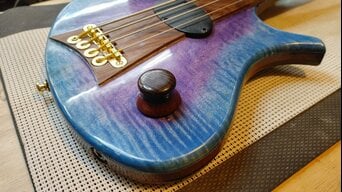
Somehow, you make it sound simple.
 
Having attempted a dyed burst (the one in my avatar pic) I will agree that it is simple and complicated at the same time. in theory it isn't terribly difficult. In practice, you either get it or you don't. But, his tips of working with it wet is good. I actually used water based stain instead of spirit based, but the theory works the same. And in my case, I found it best to actually wet the wood first before applying the stain. Not a ton, just enough that it isn't dry. When it is wet, you have a bit more control to move it around a bit, or blend it a bit, or whatever. And if you start getting too much color in the wood, you can just use plain water (or spirit, depending on your product) to pull some of the color back out.

Lots of great YT videos on this, check out "Big D Guitars", Derek does a lot of it and he's kind of the YT professor in this avenue.
 
  • Like
Reactions: Videojunkie
Test finish piece.

20221213_210350.jpg


3 coats in... this is still 'wet' from the last coat. My major concern is that the finish seems kind of "runny". I am a little worried that I will get some major drips if I spray this on a hanging guitar. As a water based dye was used, on the first couple of passes, I am really worried about any runs affecting the burst.

That grain tho...
 
Based on my test piece, it looks like a dozen coats is a good minimum.

Proposed finishing plan:
3 "sealer" coats, very light to fill grain/ hold the dye.
Lightly scuff sand with 400 to knock down bubbles
3 leveling coats.
Wet sand with 600
3 build coats
Wet sand with 800
3 top coats (maybe additional build coats)
Buff and polish.

I'm really starting to think that the rattle can VU really wants to be sprayed on a flat surface instead of hanging. Or I'm going to need to track down a sprayer of some kind...
20221215_164603.jpg
 
Based on my test piece, it looks like a dozen coats is a good minimum.

Proposed finishing plan:
3 "sealer" coats, very light to fill grain/ hold the dye.
Lightly scuff sand with 400 to knock down bubbles
3 leveling coats.
Wet sand with 600
3 build coats
Wet sand with 800
3 top coats (maybe additional build coats)
Buff and polish.

I'm really starting to think that the rattle can VU really wants to be sprayed on a flat surface instead of hanging. Or I'm going to need to track down a sprayer of some kind...
View attachment 4904472

I'm not familiar with the product you're using, but I might add 2 or 3 coats to each of your steps just to ensure build so you don't burn through in the final stages.
 
  • Like
Reactions: Videojunkie
I think I can work with this...
20221215_222300.jpg

Freshly sprayed obviously... a little bit of bleed, but the binding will get scraped at the end, so it's fine...

For the moment, the plan is to seal the colored maple, and then install the soon to be finished fretboard. Then finish the whole thing at one time.

I just didn't want anything untoward to happen to the burst...
 
One interesting feature about working with a water based finish, is that it dries really fast here. Which is both a blessing and a curse. Weather channel says the relative humidity is 65%, but it is also snowing. This stuff dries to the touch in about 20 minutes, and is hard after an hour.

Sanding seems best done after 24 hours though. But I am pretty sure that's a chemical process rather than humidity driven.
 
One interesting feature about working with a water based finish, is that it dries really fast here. Which is both a blessing and a curse. Weather channel says the relative humidity is 65%, but it is also snowing. This stuff dries to the touch in about 20 minutes, and is hard after an hour.

Sanding seems best done after 24 hours though. But I am pretty sure that's a chemical process rather than humidity driven.
That's a great looking burst! I thought you were applying the stain by hand? Or was that just on the body?
Edit: Nevermind, I looked back and see that you're spraying the clearcoat.
 
Last edited:
One interesting feature about working with a water based finish, is that it dries really fast here. Which is both a blessing and a curse. Weather channel says the relative humidity is 65%, but it is also snowing. This stuff dries to the touch in about 20 minutes, and is hard after an hour.

Sanding seems best done after 24 hours though. But I am pretty sure that's a chemical process rather than humidity driven.
Yes, that's how modern water-base polyurethanes work. It's a two stage process. Basically, the polyurethane is floating in the water in tiny micro beads, in two parts. There are resin beads and catalyst beads. As long as there's enough water, the resin and catalyst beads circle around in the mix and stay apart from each other.

When you spray or brush or wipe a water-base polyurethane onto a surface, you deliberately want to slop a layer of water on there, with the beads floating around in it. The water will take 5-15 minutes to evaporate off. While the water is evaporating, the beads are moving around into an even layer, coming into contact with each other. When the water is gone, the resin and catalyst beads merge together, and the chemical reaction begins.

Once the chemical reaction starts, it can't be stopped. How long it takes to cure depends on the brand and mix. Varathane Ultimate, which I use, dries to the touch in 30-60 minutes, and is fully cured in 12-24 hours. Some other brands are slower than that.

In my experience, humidity and temperature don't affect water-base polyurethanes very much. Humidity will affect the first stage, how long it takes for the water to evaporate off. Very dry will go in 5 minutes; very humid will be 15 minutes or more. High temperature will speed up the chemical curing; low temperatures will slow it down. But not drastically, or causing a problem.

To do wipe-on bursting like this, the skill is to keep enough water on there to flow the tinted poly beads around to where you want them....and then letting them sit there while the water evaporates off. Doing that evenly all around takes some practice.
 
@Bruce Johnson based on the consistency of the spray, I wonder if a pump spray bottle would work as an applicator? It would be a finer mist than the rattle cans are capable of. The rattle cans just kinda spit the finish out.

I am of course thinking in terms of those of us without spray booths and help systems.
 
Last edited:
@Bruce Johnson based on the consistency of the spray, I wonder if a pump spray bottle would work as an applicator? It would be a finer mist than the rattle cans are capable of. The rattle cans just kinda spit the finish out.
I've wondered about using a pump spray bottle to spray Varathane Ultimate. The problem is that it would be repeated bursts, and it may be too hard to get an even coat.

The thing about water-base polyurethanes is that you don't want to spray them in a fine mist. You want big drops of water (filled with micro beads) to go through the air and splatter on the surface. You don't want the water to evaporate as it jumps from the spray gun to the surface. I recommend spraying VU at very low pressure, 12 psi, with the fan turned almost off, using a cheap HVLP gun. You specifically don't want fine atomization. It's completely contrary to standard practice for spraying solvent-base polys or nitro lacquer. For those paints, you want fine atomization; a higher quality gun at 35+ psi. You want the solvent to evaporate in mid-air. That's why many experienced painters get frustrated with water-base polys. It requires a reverse of their known technique.

I haven't played much with Varathane Ultimate in rattle cans, but I'm suspicious how well it works. Rattle cans normally operate at about 60 psi, with a tiny nozzle. They must thin the VU down a lot to get it to spray. It's probably hard to get a layer of water to transfer across, thick enough to allow the beads to flow around and smooth out. If the beads hit the surface nearly dry, you get a rough pebbly surface, worse that orange peel. That's what you get when you try to spray it through a gun at 35 psi.