• TalkBass has been independent since 1998. Add your voice.
    Create a free account to reply to discussions, view embedded media, and browse with fewer display ads.
    Join freeLog in
    Want zero display ads or expanded classifieds tools? Compare plans.

5 string vs 4 string

What are the strings/tuning on that?

From low to high DAE string gauges 128 85 55 I tune it in fifth so I really don't lose any range.

31.18" scale
3/4" spacing at bridge
1.5" nut width
28 frets
basslines SPB quarter-pound pick-up
northern ash neck (bolt-on)
black walnut fingerboard
catalpa body

Not quite a novel instrument it does have its limits but I also play a 6-string so I think a 4-string bass is limited ;)
 
I actually got that too at my local music store. It's understandable in a way for me, because it is a little town and people don't even know 5 string basses exist. So if a beginner from that town wants a bass, they are most likely to go for a 4 string. The one Peavey 5 string at the shop had been hanging on the wall for 4 years with no takers (or so he told me)
 
Actually, I'd suggest a fiver or sixer to a beginner before I'd suggest a four-string bass. Beginners don't have that mental block telling them that six strings are "wrong", "too much", "not appropriate", or something to "graduate to" or "step up to".

And remember, none of us need any of it, so there are no "needs" to consider musically or otherwise. If he's not now playing something that requires or would benefit from a low B or can be made simpler positionally with the use of a low B, he will do so eventually unless his creative and musical development stalls prematurely. Best to start with a full toolbox.

I always hear the argument that a beginner should start with 4 string for various reasons but I've never heard anyone, until now, suggest more than 4 for beginners. Your perspective is very interesting though I can't say that I totally agree with you or even mutdeity for that matter. I believe that the number of strings a beginner bassist starts out with lies with the discretion of that bassist. That person has to play what feels comfortable for him/her.
 
I don't consider tabs crippling -- at least for me. I have had some of the best I know try to teach me how to read music and it just bounces off some 'read music' void in my head. I think tabs are great IMO.

They're great until you get asked to do a broadway play or some other gig where they will throw a sheet of music--with no tabs, mind you--in your face and expect you to read it.

Now, I'm not hating on tabs, I think they are great for what they are but they are limiting. You can only go so far by using those.
 
I always hear the argument that a beginner should start with 4 string for various reasons but I've never heard anyone, until now, suggest more than 4 for beginners. Your perspective is very interesting though I can't say that I totally agree with you or even mutdeity for that matter. I believe that the number of strings a beginner bassist starts out with lies with the discretion of that bassist. That person has to play what feels comfortable for him/her.

I remember I started on a 5 because I thought it was exotic:p
Now it feels INCREDIBLY weird to play a four, and my hands are so used to the B being there that I start thinking the E is B and start playing everything 1 string up. it takes me a while to get adjusted

I also find that it is really unstable to play a 4 banger without a thumbrest.

and the thing is, the B is not only a thumbrest thing as it used to be when i first started, it has become an integral part of my playing, and I feel like I'm choking when I want to hit that extra low note
 
They're great until you get asked to do a broadway play or some other gig where they will throw a sheet of music--with no tabs, mind you--in your face and expect you to read it.

Now, I'm not hating on tabs, I think they are great for what they are but they are limiting. You can only go so far by using those.

yeah, tabs are great until you join up with a the groups mentioned above (broadway, jazz band etc.)

I remember after playing 6 years of violin on strict treble cleff training, I learned bass by ear and tabs, and when I started playing with a school jazz band, I was horrifically shafted for the first month when I scrambled to erase the memories of treble and get bass clef ingrained in my mind
 
Your local shop owner is either a rabid fan of the four string or (more likely) has a lot of four strings hanging around that he can't get rid of.


I think this is pretty much the concensus here.

Call him on it and make him a discounted offer on his most expensive 4-string. Inventory that he cannot get rid of makes no money for the store.

Or make him a discounted offer for the 5-string since they are going out of style. Either way, spin it into a win-win situation for yourself.
 
Well, after 25 years of on and off playing, I decided to take the plunge and get a fiver. As I was not sure as to how I would like them, I bought an SX. I figured, if I didn't like playing a 5er, (the instrument quality aside for a moment) it would only cost me $129.00 to find out, as opposed to the close to two grand I was looking at for a higher end bass.
I've had it for two months, I'm still very much in the learning phase as my hands are still doing their own thing in and around the E and B strings... I find myself having to stop, relearn and move on.
Just my thought process in my purchasing decision... I hope it helps!
fishheadjoe
 
I'd say it depends on the music you're interested in. A 5-string is great for heavier music, especially if the guitar player is using a 7-string. A 5-string is also good for Jazz, because the low B gives you more options for chording and figured basslines below melodies.

I mainly play a 4-string, and find I have to think a little differently when I play a 5. My muscle-memory wants to pedal down on the B since I'm so used to the E being there. Sometimes I have to work to find better/more comfortable positions, which takes me out of the pocket a bit. I'm sure it would come more naturally if I played a 5-string more often. If you know you're going to use the extra string, get it from the start. You won't have to try and compensate later.

I'll echo what many of the others have said: sounds like your salesperson is handing you a line. He's more interested in pushing something on you than helping you get what you want. Five-string basses are here to stay. That said, there's plenty of groove available in a 4-string!
;)
 
I always hear the argument that a beginner should start with 4 string for various reasons but I've never heard anyone, until now, suggest more than 4 for beginners. Your perspective is very interesting though I can't say that I totally agree with you or even mutdeity for that matter. I believe that the number of strings a beginner bassist starts out with lies with the discretion of that bassist. That person has to play what feels comfortable for him/her.

You are right. It is up to the discretion of the player. On the other hand I would not make it my recommendation that someone start out with a 5 string. What is comfortable to a beginner is beside the point though. What aspects of playing an instrument on a beginner level are immediately comfortable?

You can look at my GAS list to know that I of all people am not the type of person to say "Well, Jaco only needed 4 strings". On the other hand getting familiar with the basics should always come before you have to start worrying about the considerations that go with playing extended range instruments.
 
Playing a 5-string and upwards requires a lot of advanced considerations in terms of technique. A beginner should be concentrating on gaining a solid grounding in technique.

LOL, the beginner has this to worry about regardless of how many strings his bass has. What that beginner won't have to do later is revisit those same issues (tho minimized to some small degree) somewhere down the road when he does eventually try a fiver. That's what we should be encouraging him to avoid.

I can't imagine telling a beginning pianist to use a 64 or 76-key instrument or a guitarist to use only five of his strings. Not a perfect analogy, I know, but it fits perfectly as a response to those who see the fiver or sixer as "extra" rather than "a bass". It's a bass. Not "another bass", or a "different" bass, or an "extended range" bass. All those terms are used only when we continue to standardize the four-stringer.

I posted this in a thread a while back. It applies here.

From Bass Player's Anthony Jackson Interview, part 1:

My feeling is: Why is four the standard and not six? As the lowest-pitched member of the guitar family, the instrument should have had six strings from the beginning. The only reason it had four was because Leo Fender was thinking in application terms of an upright bass, but he built it along guitar lines because that was his training. The logical conception for the bass guitar encompasses six strings. As regards the issue of "mastering the 4-string" before moving on to the six, consider that inasmuch as there is no point where one can be said to have "mastered" anything, to make this inane suggestion reveals the speakers to be idiots. As long as we remain seekers, never truly achieving our ultimate goals, we may as well start with the full basic blueprint and enjoy the expanded expressive possibilities of the extended range of the instrument. Of course, the undoubtedly famous-name superstars who utter this nonsense probably regard themselves as masters in their own right. So be it. For the rest of us, their attitude reveals them to be jealous, angry, and frustrated. Too damn bad.

Can't say it any better than this.


That person has to play what feels comfortable for him/her.

What aspects of playing an instrument on a beginner level are immediately comfortable?

Both of you already know that nothing is comfortable for a beginner, and few things are more difficult to get an experienced player to do than relive his old mistakes because he started on an instrument that didn't have six (or even five) strings. How many posts has either of you read where someone said they play a four because they "just can't get comfortable" on a fiver or sixer? That kind of thing had to happen earlier because of the way Leo designed the bass. Now it's completely avoidable.

You can look at my GAS list to know that I of all people am not the type of person to say "Well, Jaco only needed 4 strings". On the other hand getting familiar with the basics should always come before you have to start worrying about the considerations that go with playing extended range instruments.

It's. A. Bass.
 
Right now I am sticking with a 4 until I get comfortable finding and playing all the notes well then I might step up to a 5 string.
Or step DOWN to a 5er! ;)

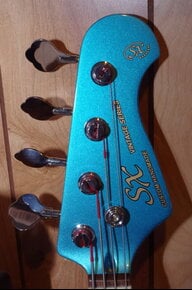
At any rate, I agree with you. But I would also suggest that anyone considering playing a 5er, get one as soon as financially possible, I got an SX SJB 4+1 for my first (now I have 2, one strung with flats) and use it occasionally to practice going back and forth and also to help you see what the extra string is/isn't good for for what YOU play.

A 4 string bass is always going to be the basic (sorry) instrument for me, but in Gospel, contemporary especially, I find that I need the B string too. I don't use it nearly as much as the other 4, but when I need it, it's nice to be able to just reach over and pull it rather than play a note up an octave while I'm mentally saying, "If I just had ONE more string!"

My first fretless was an active 5er because it was a deal I couldn't pass up. It has a rosewood fb and flats, and I am GLAD that my first fretless was a 5er! That is a very useful instrument!