• TalkBass has been independent since 1998. Add your voice.
    Create a free account to reply to discussions, view embedded media, and browse with fewer display ads.
    Join freeLog in
    Want zero display ads or expanded classifieds tools? Compare plans.

70s SVT Bench Test Results

And I also measured the preamp out. I fiddled with the EQ to get it as flat as possible, which incidentally was pretty much exactly noon for all knobs. The low frequency roll-off is the result of the output impedance of the preamp output interacting with the input impedance of my interface since it doesn't do that when only connected to the SVT's power amp.
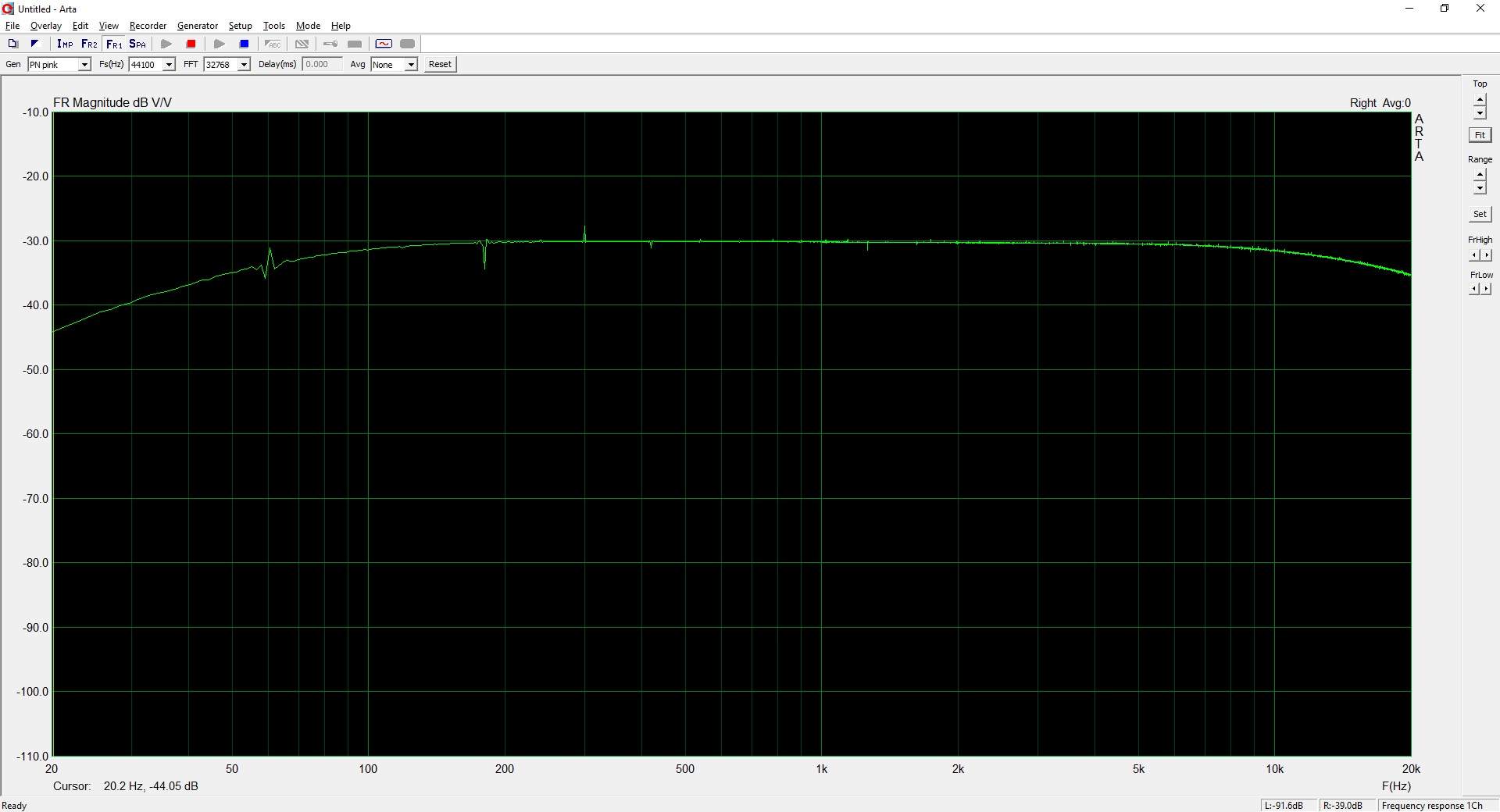

This thread reminded me about an old TB thread that never went too far, IIRC. Someone posted an LTspice model of the SVT preamp section, and my copy says 2009 on it. It could easily be much older, since I've switched computers a few times over the years and 2009 might just be the copy date. Anyhow, I just ran the model with Vol at ~90%, swept from 20-20KHz, and got this:

SVTPre_V5.png


Which looks very close to your measured results. I'll have to take a good look at the model later and see if fresh eyes show any mistakes or things that could be improved. In true nerd fashion, I'm much more interested in that aspect than in SVTs per se...
Yel_wink.gif


But seriously, thanks for doing the work and even more so for posting it here!
 
Last edited:
Good work, I wonder what the output would be with fresh tubes. You took the output from the divider. I'd like to see the response from a mike in front of the speaker to see what's real world relevant.
 
Hey, we're smarter than usually given credit for! Fish is good for your brains, right? :D

Yeah, I've crossed paths with Michael Wall occasionally over the years.

I used to have to back him up from time to time in the mid Seventies. He was known as the “Singing Newfoundlander” in those days. Came across him again in our local village paper. Apparently he did well “Down Under” and now goes by the name “The Newfie King."
 
  • Like
Reactions: Mark Reccord
This thread reminded me about an old TB thread that never went too far, IIRC. Someone posted an LTspice model of the SVT preamp section, and my copy says 2009 on it. It could easily be much older, since I've switched computers a few times over the years and 2009 might just be the copy date. Anyhow, I just ran the model with Vol at ~90%, swept from 20-20KHz, and got this:

SVTPre_V5.png


Which looks very close to your measured results. I'll have to take a good look at the model later and see if fresh eyes show any mistakes or things that could be improved. In true nerd fashion, I'm much more interested in that aspect than in SVTs per se...
Yel_wink.gif


But seriously, thanks for doing the work and even more so for posting it here!
Ya, the preamp is near flat by itself. Could have sworn it measured flatter than that, though.
 
Man, thanks for doing all that research, Mark! Very informative. I'm curious about why the difference, too. Ch 2 looks like how it sounds on my 69, though. Don't know why it measures like mine sounds and ch 1 doesn't, but I'll be interested in what you find out.

I think @beans-on-toast may be on to something with tolerances and drift in the components in the tone stack. It might well be within the tolerances. I should also note that the scale used in BGM's plots makes this look more extreme than it actually is.


This thread reminded me about an old TB thread that never went too far, IIRC. Someone posted an LTspice model of the SVT preamp section, and my copy says 2009 on it. It could easily be much older, since I've switched computers a few times over the years and 2009 might just be the copy date. Anyhow, I just ran the model with Vol at ~90%, swept from 20-20KHz, and got this:

SVTPre_V5.png


Which looks very close to your measured results. I'll have to take a good look at the model later and see if fresh eyes show any mistakes or things that could be improved. In true nerd fashion, I'm much more interested in that aspect than in SVTs per se...
Yel_wink.gif


But seriously, thanks for doing the work and even more so for posting it here!

Yeah, that's pretty close agreement. I'd like to see the ltspice schematic and part models to see how it was done and how it was loaded at its output, particularly.

Good work, I wonder what the output would be with fresh tubes. You took the output from the divider. I'd like to see the response from a mike in front of the speaker to see what's real world relevant.

That's an entirely more involved and difficult set of tests. :D

I wonder how many players max out the volume level on their SVT's. Not something that I do.

Regular occurrence for me. :D

These scans line up with my impressions of every SVT I've ever played. What's wrong with flat? I actually like it that way.

Nice work! This confirms my suspicion from looking at the schematic, that the SVT was intended to be a high fidelity amplifier.

This certainly aligns with what I know about Ampeg's history and the guys who designed it. But it also suggests that there are other things going on that aren't captured by steady state frequency response plots (ie distortion and transient behaviour). I can set my GK MB500 so that it's flat on that analyzer but it still sounds different than the SVT even at pretty low levels despite identical frequency response plots. It's worth keeping in mind that one measurement doesn't tell the whole story.

FWIW, we measured over 300w from both channels, at just over 4% THD.

Link Removed
Pretty sure mine did approximately the same the last time I tested it. I am going to give it a check-up and some new tubes soon and I'll redo the power tests. Got a bunch of things ahead of that in the queue so it might be a while. :D
 
Last edited:
Yeah, that's pretty close agreement. I'd like to see the ltspice schematic and part models to see how it was done and how it was loaded at its output, particularly.

Here's the thread in question: SVT LTSpice Model (geek content) and a question for users The loading conditions are essentially about the same as your test rig's, more or less.
Yel_wink.gif


I'll be happy to take a stab at modeling the whole shebang with the power amp section attached eventually, but I'm going to be crazy busy with other things for a while, looks like.
 
All 6550 equipped svt's I've had on my bench, over 10 now, have put out right around 270 watts at the point of any clipping seen on my oscilloscope. I hold line voltage at 120 with my variac so I can compare tests from different days etc...

My 6146 equipped 70 does about 340 or so Before clipping. Just to share my findings.

IIRC that's about what my '75 did (270W) with a set of Winged C 6550s.
Very interesting about the 6146s.
 

Latest posts