

Enjoy the benefits of a premium membership!
Upgrade Account
-
TalkBass has been independent since 1998. Add your voice.
Create a free account to reply to discussions, view embedded media, and browse with fewer display ads.
Join free Log in
Want zero display ads or expanded classifieds tools? Compare plans.
You are using an out of date browser. It may not display this or other websites correctly.
You should upgrade or use an alternative browser.
You should upgrade or use an alternative browser.
a different kind of low pass filter
- Thread starter bdplaid
- Start date
More options
Who Replied?
righto. I should get some time tomorrow to dust off the m box... I found the high res setting too bright, and also sweeping all the way down to 100hz was pretty useless.
if you swap the 470 ohm resistors too 1k you reduce the sweep range. also swapping the 100nF caps for 22nF makes the high res only about a 4dB peak (much more like a bright pickup loaded by a vol pot) and the low res actually softens the knee a little instead of creating a peak.
if you swap the 470 ohm resistors too 1k you reduce the sweep range. also swapping the 100nF caps for 22nF makes the high res only about a 4dB peak (much more like a bright pickup loaded by a vol pot) and the low res actually softens the knee a little instead of creating a peak.
OK, I recorded some stuff today. But first, here's the circuit.
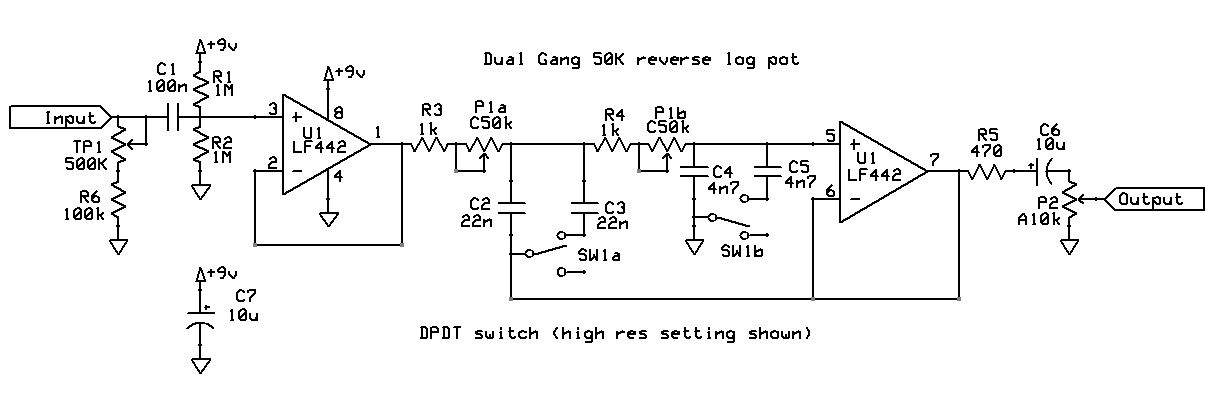
The key to this working as a sweepable resonant peak and therefore emmulating pickups with hotter winds, is to tame (actually the propper word is "damp") the existing resonant peak so the input of the filter is as linear as possible into the treble region. So I added the trimpot and the 100k resistor to the front end. This way you can tweak the input impedence from 80K to 270K. Without TP1 and R6, the input Z is 500k. If you know what Z you want, you can also just ignore the trimpot and its earth resistor, and choose two equal resistors that are double the impedance you want. Then sub R1 and R2 for these. (This 2nd method would lead to slightly quieter operation BTW.)
If I'm honest, the preamp I built the other day has a different front end as I'm also trying out a design idea for a pickup mixer that boosts slightly at the mid point of the blend pot to counteract that slight loss of presence you get from phase cancellation. It also features a tilt switch that disconnects the battery (without pop) when I put it upright in a guitar stand. Both features inspired by the number of questions people ask about these topics around here. But that's another story. The filter is exactly like this one.
I managed to squeeze the circuit onto a 9x9 piece of protoboard.

So it fits nicely between the blend and tone pots.
You may have noticed that this is actually a P bass, but as you'll see, it's routed with two pretty standard alnico jazz bass single coils.
I probably should have put some titles on the vid, but anyway, I hope you can see what I'm doing with the tone pot. I start with the vol at max, the blend in the middle and the tone maxed as well. After a few notes I roll back the blend to favour the bridge pickup about 60/40. After this I only tweak the filter. First in hi-res mode, I gradually roll it down to about 1/3, then switch it up to lo-res mode and gradually roll it back up to max.
The 2nd half of the vid is pretty clear - open A's and D's with tone sweep. First high res then low.
Enjoy!...
Oh, and please listen with some good headphones or speakers.
The key to this working as a sweepable resonant peak and therefore emmulating pickups with hotter winds, is to tame (actually the propper word is "damp") the existing resonant peak so the input of the filter is as linear as possible into the treble region. So I added the trimpot and the 100k resistor to the front end. This way you can tweak the input impedence from 80K to 270K. Without TP1 and R6, the input Z is 500k. If you know what Z you want, you can also just ignore the trimpot and its earth resistor, and choose two equal resistors that are double the impedance you want. Then sub R1 and R2 for these. (This 2nd method would lead to slightly quieter operation BTW.)
If I'm honest, the preamp I built the other day has a different front end as I'm also trying out a design idea for a pickup mixer that boosts slightly at the mid point of the blend pot to counteract that slight loss of presence you get from phase cancellation. It also features a tilt switch that disconnects the battery (without pop) when I put it upright in a guitar stand. Both features inspired by the number of questions people ask about these topics around here. But that's another story. The filter is exactly like this one.
I managed to squeeze the circuit onto a 9x9 piece of protoboard.
So it fits nicely between the blend and tone pots.
You may have noticed that this is actually a P bass, but as you'll see, it's routed with two pretty standard alnico jazz bass single coils.
I probably should have put some titles on the vid, but anyway, I hope you can see what I'm doing with the tone pot. I start with the vol at max, the blend in the middle and the tone maxed as well. After a few notes I roll back the blend to favour the bridge pickup about 60/40. After this I only tweak the filter. First in hi-res mode, I gradually roll it down to about 1/3, then switch it up to lo-res mode and gradually roll it back up to max.
The 2nd half of the vid is pretty clear - open A's and D's with tone sweep. First high res then low.
Enjoy!...
Oh, and please listen with some good headphones or speakers.
Last edited:


Very tidy work there sir. I think you've done a nice job of tuning the circuit to where the effect is subtle rather than gimmicky. Well done. Another thing for me to try out now 
effect is subtle rather than gimmicky
Thanks mate. That's exactly what I was going for. With the original ciruit, the resonant peak was too high in high res mode to be really useful. The 4dB peak is much more realistic - more typical of a standard pickup being loaded by a couple of 250K pots. And the low res setting is more like a standard tone control, but with a steeper slope of course, so you can roll of treble without killing the mids.

Nice job! Personally I would like a bit more peaking in the low damping setting. Well, maybe a lot more since I hear almost no difference between the two positions, but that is what personal choice is all about. It is a kind of tone control that makes sense for people who want something better than a traditional passive tone control but are happy with the EQ capabilities they have elsewhere in their signal chains and don't need yet another 3 band EQ on their bass. Thanks for sharing!!
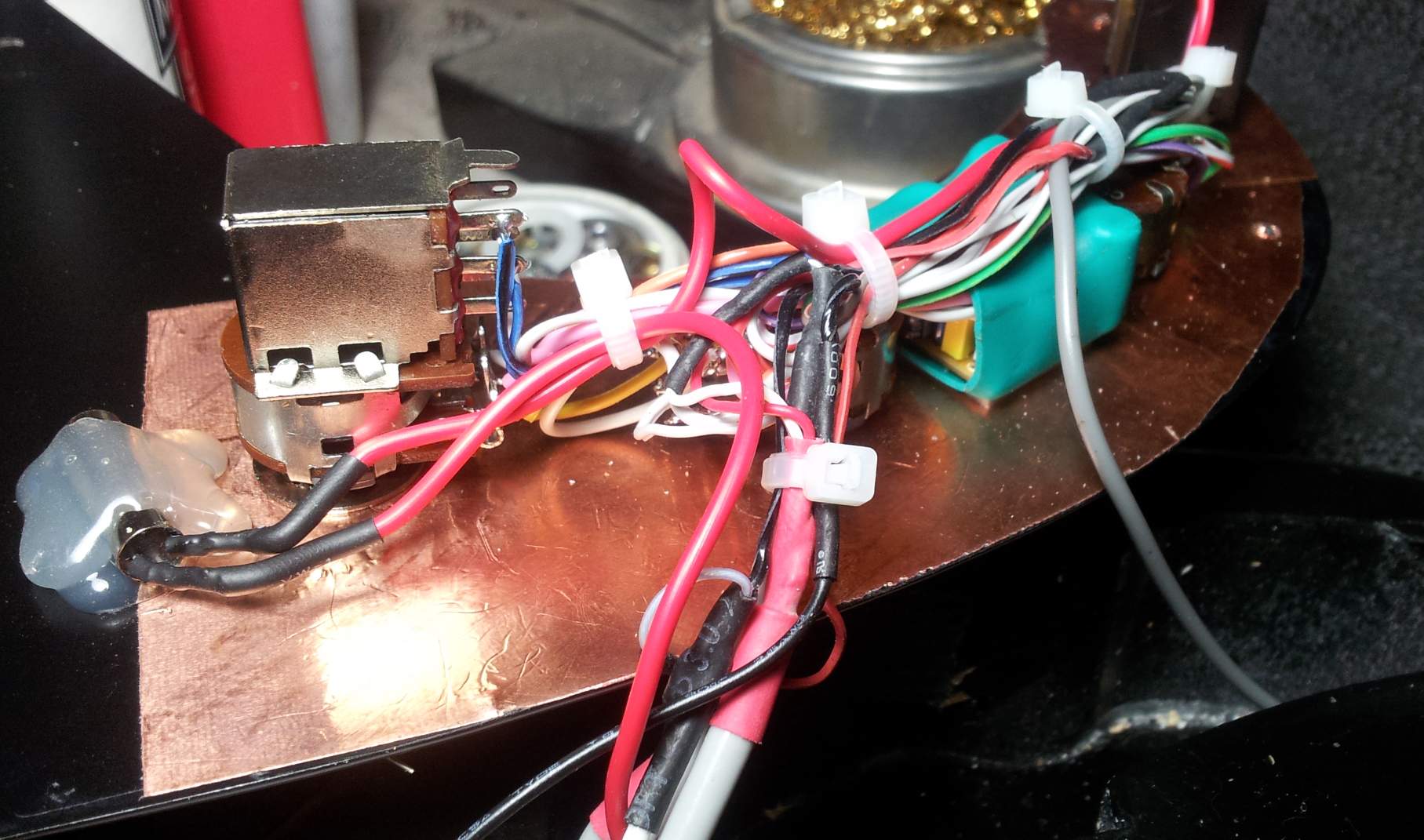
It is amazing how such a simple looking circuit can generate so many wires, eh?
It is amazing how such a simple looking circuit can generate so many wires, eh?
I hear almost no difference between the two positions
Yep the difference is subtle, and perhaps I'll tweak those caps a little more after I play a few gigs and rehearsals with it. When playing you can really "feel" the difference in responce. The bass has a hard finish on the fretboard and it takes some taming, especially with those bright Elixyr strings on there. For the moment though, I'm happy. I guess I could list some values for C2-C5 that offer different resonant peaks without changing the sweep range.
This bass was pretty much useless to me. It was a cheap parts bass I put together some years ago and never liked the tone. I was using it as a tester for various pickup winds and preamp ideas for a while, then I wired it passive VBT and left her at my mates place so I could cycle there for song writing sessions.
It is amazing how such a simple looking circuit can generate so many wires, eh?
yeah. 13 wires just to that tiny circuit board! For prototypes, I use the "rainbow" ribbon cable and peel off the different colours. But there's only ten colours so I have to use a nikko pen to make a black stripe on a few to make up the numbers!
Plus the wiring around the blend pot is a little crazy as I have some experimental hum-cancelling coils in this bass as well...
Last edited:
OK, I recorded some stuff today.
Thanks for posting up some clips, and all the circuit info! I'm really enjoying reading this thread

The clips sound great, I like the tone a lot. I also kind of like the subtle peaks. They're there, but not severe. Very useful and musical. I suppose in an ideal world a 3-way toggle with "flat/robbiek peaks/wal peaks" would be super awesome, but I have this sneaking suspicion that I just said something crazy
I'm amazed at how much range a lot of the filter preamps seem to have on the sweep; seeing things from like 100hz to 10khz seems like more range than a person would need, but without using one myself I couldn't really be sure.The more I look into LPF-based preamps the more I think I have no use for typical 3-band EQ's.

OK, I recorded some stuff today. But first, here's the circuit.
Wow, nice! I like how that sounds over the stock tone control.

Passinwind
I know nothing.
- Dec 3, 2003
- 23,079
- 46,050
- Disclosures
- Designer/Toaster Tech @ Passinwind Electronics
FWIW, I am just about to do an onboard preamp test build with a conventional bass and mid control format and a variable resonance low pass section for highs. I decided to avoid reverse taper dual pots and optimized for two 10K linear duallies. So the resonance pot yields cut-only from noon to full counterclockwise, with a fairly minimal but probably still audible variation in slope. Going clockwise from noon yields progressive boost up to around a 7-8dB resonant peak, for the moment at least. Frequency sweep is nominally 1.5KHz-8.8Khz for peaks or 3dB down points, with what I expect to be the sweet spot of 1.8K-3.8KHz occurring at sweep settings from 10 to 2 o'clock. Seems reasonably intuitive to me, but there are many tuning and switching options available in my design if I find a need for them. Board size is 2.2" x 1.6", and current consumption at idle is less than 1mA, using one dual and one single opamp.
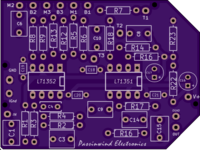
The LPF section format is much like @RobbieK's, with a few fairly substantial detail changes that I may or may not get into later. I hardly ever use classical filter alignments and that is again the case here. I didn't bother to breadboard a prototype, I just did a board layout and ordered three testers right off, as I often do these days. Here's how the unstuffed board looks:
And the modeled response curves for settings as labeled:
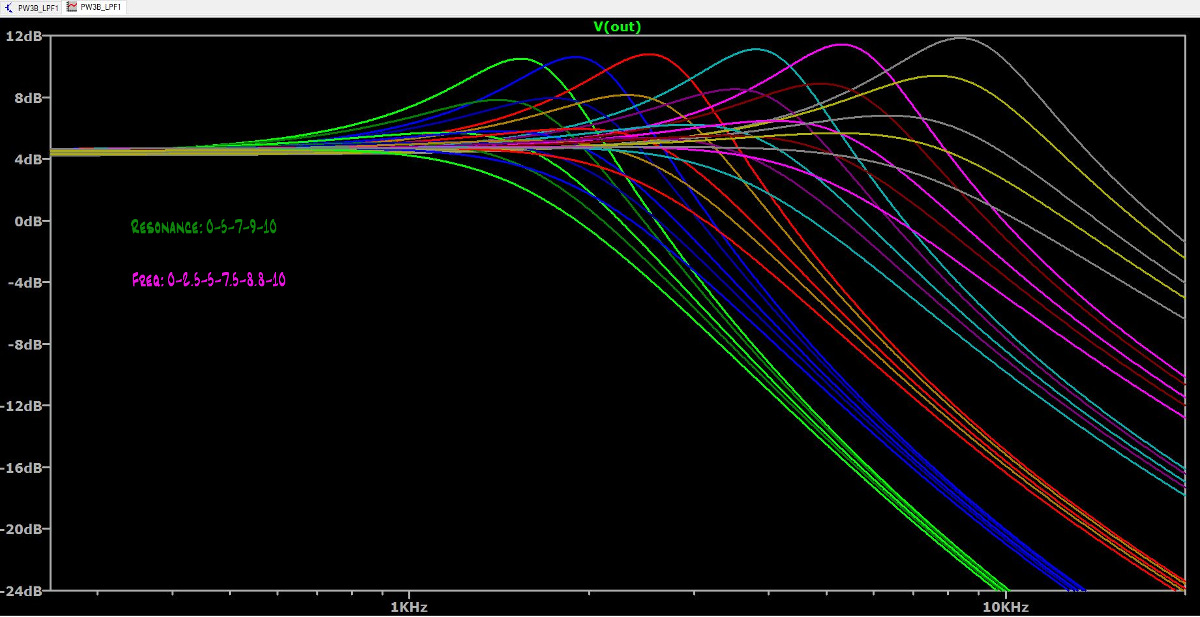
The models showing interaction with the switched frequency mid control (not shown) look very promising, as highly integrated interactivity is generally a higher priority for me than control independence.
I hope to have the first one built and installed in my Travis Bean fretless sometime early next week. As always, nothing to sell here at this time, this is just to scratch an itch I've had for quite a while and finally got around to acting on.
The LPF section format is much like @RobbieK's, with a few fairly substantial detail changes that I may or may not get into later. I hardly ever use classical filter alignments and that is again the case here. I didn't bother to breadboard a prototype, I just did a board layout and ordered three testers right off, as I often do these days. Here's how the unstuffed board looks:
And the modeled response curves for settings as labeled:
The models showing interaction with the switched frequency mid control (not shown) look very promising, as highly integrated interactivity is generally a higher priority for me than control independence.
I hope to have the first one built and installed in my Travis Bean fretless sometime early next week. As always, nothing to sell here at this time, this is just to scratch an itch I've had for quite a while and finally got around to acting on.
Last edited:
I hardly ever use classical filter alignments
Me neither. I can't see (well hear, really!) the point of a bass guitar eq that is perfectly flat and symmetrical like a studio desk eq. I'd rather have a filter that is musical sounding and intuitive to use than one that looks great on paper.
there are many tuning and switching options available in my design if I find a need for them.
Last year I pared back my design to just a single knob that actually adjusts the resonance and frequency at the same time. And similar to you it only sweeps the treble region. Low Q / low freq to high Q / high freq, across about two octaves. It is very like sweeping between series and parallel.
I put the filter in a couple of my basses and have been gigging and touring with it for about a year. It's brilliant. I call it a "treble voicing filter". It is especially cool with a stingray pickup.
Good luck with your design!
The LPF section format is much like RobbieK's
Cheers but I can't take any credit for this. It's just a straight implementation of a common Sallen-Key filter topology.
Passinwind
I know nothing.
- Dec 3, 2003
- 23,079
- 46,050
- Disclosures
- Designer/Toaster Tech @ Passinwind Electronics
Cheers but I can't take any credit for this. It's just a straight implementation of a common Sallen-Key filter topology.
I know, but I wanted to leave a few crumbs without actually posting my schematic right now, plus give a shout out to someone who actually followed through and built one and shared the results.
Your comment about making things feel intuitive really rings true, and is something I've often had to learn the hard way. I'm shooting for one knob that feels like boost/cut and one that does frequency sweep in the range we commonly think of a treble control as being. All the parts are sitting on my bench now, so it shouldn't be long before I know if my design choices were on point or not.

since its a bass circuit C1 should be at least 1uf
Actually, with a 500k input z, I doubt you'd get a noticable roll off until the input coupling cap is below 50nF, maybe less.
But you are welcome to use a 1uF if you like. If it's a polarised cap, make sure the negative leg is on the pickup side.
I built a number of Anderton's projects a bit over 30 years ago as outboard units, including two of the Super Tone Controls, and I've been using them ever since on all kinds of instrument signals.
It's hard to reflect all the things they can do in just a few words. And I'm sure there are many things I haven't even tried yet.
I do like the option to primarily have the LP part for bass, as the OP suggests, which can sound marvelously deep when the cut off is turned down low.
However, I think I would feel limited to have only the LP filter onboard and only adjust the cutoff frequency. I suppose it's conceptually appealing, but I find it musically limiting. Bear in mind my only electric bass for most of these 30 some years has been a Ripper, which has both a standard tone and a Q-filter midrange cut. So I'm used to having that flexibility onboard in a passive bass (and now in all three of my passive basses.)
I tried that out last night on my SX P, keeping both tones all the way up and just using the LP section with no resonance. It has some good sounds but I found it less musically capable than the combination of Q-filter and standard tone, except maybe when it comes to a deep dub tone. Also far less useful than having access to the full control set on the Super Tone Control.
I built up all the features on the Super Tone Controls and would profoundly miss the BP and HP portions being able to be mixed in and also very much miss the resonance control. Even if I want a deep, dubby tone, I always seem to have the BP and HP sections providing at least a hint of tone, even if it's at -15 dB or -12 dB. It just strikes me as sounding better, so YMMV.
Also, the resonance is really cool in the low mids to fatten the tone or up in the 1.5 to 2K range to add bite. Even if I'm mainly using the LP part, the resonance control can fatten up the tone in ways I can't get without it. Definitely a cool feature.
Lastly, if you use it as an outboard, the bipolar power is not an issue. You can build a simple battery power supply box with two 9Vs and a DPST switch to turn it on and off. Indeed, most of the Anderton designs can handle +/- 18V and I've mostly run them off an AC powered supply running that voltage, as it gives more headroom.
I hope that's helpful.
Otto
It's hard to reflect all the things they can do in just a few words. And I'm sure there are many things I haven't even tried yet.
I do like the option to primarily have the LP part for bass, as the OP suggests, which can sound marvelously deep when the cut off is turned down low.
However, I think I would feel limited to have only the LP filter onboard and only adjust the cutoff frequency. I suppose it's conceptually appealing, but I find it musically limiting. Bear in mind my only electric bass for most of these 30 some years has been a Ripper, which has both a standard tone and a Q-filter midrange cut. So I'm used to having that flexibility onboard in a passive bass (and now in all three of my passive basses.)
I tried that out last night on my SX P, keeping both tones all the way up and just using the LP section with no resonance. It has some good sounds but I found it less musically capable than the combination of Q-filter and standard tone, except maybe when it comes to a deep dub tone. Also far less useful than having access to the full control set on the Super Tone Control.
I built up all the features on the Super Tone Controls and would profoundly miss the BP and HP portions being able to be mixed in and also very much miss the resonance control. Even if I want a deep, dubby tone, I always seem to have the BP and HP sections providing at least a hint of tone, even if it's at -15 dB or -12 dB. It just strikes me as sounding better, so YMMV.
Also, the resonance is really cool in the low mids to fatten the tone or up in the 1.5 to 2K range to add bite. Even if I'm mainly using the LP part, the resonance control can fatten up the tone in ways I can't get without it. Definitely a cool feature.
Lastly, if you use it as an outboard, the bipolar power is not an issue. You can build a simple battery power supply box with two 9Vs and a DPST switch to turn it on and off. Indeed, most of the Anderton designs can handle +/- 18V and I've mostly run them off an AC powered supply running that voltage, as it gives more headroom.
I hope that's helpful.
Otto
Now that I'm thinking of it again, that state variable filter would make a cool design for an onboard preamp. You would probably want 6 controls: master volume, LP, BP and HP levels, center frequency and resonance. I think that could be tolerable with three stacked controls.
Edit: that last bit won't work. The center frequency is already a ganged pot. So probably at least four controls would be needed.
Otto
Edit: that last bit won't work. The center frequency is already a ganged pot. So probably at least four controls would be needed.
Otto
Last edited:
Actually, with a 500k input z, I doubt you'd get a noticable roll off until the input coupling cap is below 50nF, maybe less.
But you are welcome to use a 1uF if you like. If it's a polarised cap, make sure the negative leg is on the pickup side.
I always use poly film caps or bipolars on the front end. I make a lot of preamps on breadboards and when I plug in 1uF+ caps on the front there is more 'oomph' in the bass
more 'oomph'
You should try either biasing your preamp so that there's no need for coupling caps, or run your pickups and input-side pots to your bias voltage instead of earth. That way you can put a (non-polar) cap in there and have a test switch wired across it to short it. Switching back and forth will be a great way to hear any difference. Use a push-button on-off to really test your ears!
If you are a bassist who likes the combination of slapping and bass boost, a well chosen rolloff (HPF) may save you a lot of re-cones. And on loud gigs, will probably make your rig more efficient. The actual corner of that HPF is dependant on both the cap, and the preamp input z.
I have made several preamps over the years that don't have coupling caps, but I usually end up with some low roll-off below 30Hz built in somewhere.
FWIW, the trimpot and 100k resistor at the front end of this is optional, and is really to tame the existing resonant peak of a pickup should you decide to connect it directly to the preamp. If there's a blend pot in there, or a 250k vol (for bypass switching), or you are using an overwound series humbucker or something, a 500K input z is fine and you can leave out the trimpot and 100k all together. The idea is to get as much linear resonse into the treble from the pickup as possible to get the best sweep from the filter. If you put this in a P bass say, I'd recommend wiring the pickup in parallel, running the pre with an input z of perhaps 100k, and running say 6dB of gain in that first stage.
The circuit I posted is simply a starting point. I made something very similar at first, but this thread is 18 months old. As I mentioned, I've been gigging a derivative of this filter in one of my main basses (a stingray parts bass), and it's great. But it's just one part of a bigger design.
oomph is subjective depending on amplifier, acoustics, bass setup, circuit design.. I tend to get the sound I want with a larger input cap. I made a SVF for a bass and got the best sound when I plugged in a 4.7uF bipolar
Passinwind
I know nothing.
- Dec 3, 2003
- 23,079
- 46,050
- Disclosures
- Designer/Toaster Tech @ Passinwind Electronics
oomph is subjective depending on amplifier, acoustics, bass setup, circuit design.. I tend to get the sound I want with a larger input cap. I made a SVF for a bass and got the best sound when I plugged in a 4.7uF bipolar
At what input impedance? As Robbie says, that makes a substantial difference. Here's a model of rolloff in the circuit I mentioned up thread, which has a nominal input impedance of around 130K Ohms:
At 30 Hz the difference between 100nF (blue) and 1uF (red) is ~ 0.2dB. For my design targets with a 4 string standard tuned bass, I opted for a 100nF polypro cap rather than a 1uF polyester one, not that the dielectric really matters much in this case, beyond the differing size constraints. The small bit of rolloff helps put the bass control peak where I want it when using bass boost, it also reflects design choices for two other coupling caps in later stages. So as usual, and as you say, it just depends.
Last edited:


