I never understood why they decided to stick a typical Fender headstock on this. I always thought Coronados were ugly just cause of that head. Its a hollowbody, you have to have a 2+2 headstock. To me it always looked like someone stuck the neck of a different bass on a nice enough looking hollowbody.

Enjoy the benefits of a premium membership!
Upgrade Account
-
TalkBass has been independent since 1998. Add your voice.
Create a free account to reply to discussions, view embedded media, and browse with fewer display ads.
Join free Log in
Want zero display ads or expanded classifieds tools? Compare plans.
You are using an out of date browser. It may not display this or other websites correctly.
You should upgrade or use an alternative browser.
You should upgrade or use an alternative browser.
A New Fender Coronado Bass?????
- Thread starter birdman14
- Start date
More options
Who Replied?
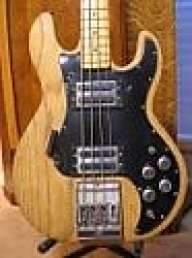
Ummm....maybe because it's a Fender, and everyone else uses a 2 + 2 headstock?
Seriously, if you were a guitar company revisiting a design you hadn't used in over 40 years, what better way to put your stamp on your new product than by using an iconic headstock design? An immediate identifier that separates you from everyone else? A design you have sued to prevent others from using?
Yes, it is different from everyone else's semi-hollowbody design. That was obviously the point. Yes, it will take some getting used to.
In time, it won't seem so odd. The reaction will be "Oh, that's the Fender he's playing onstage".
You have to admit they're shrewd!
.
Seriously, if you were a guitar company revisiting a design you hadn't used in over 40 years, what better way to put your stamp on your new product than by using an iconic headstock design? An immediate identifier that separates you from everyone else? A design you have sued to prevent others from using?
Yes, it is different from everyone else's semi-hollowbody design. That was obviously the point. Yes, it will take some getting used to.
In time, it won't seem so odd. The reaction will be "Oh, that's the Fender he's playing onstage".
You have to admit they're shrewd!
.

Kyle, the more you will play it, the more you'll be amazed by the overall quality of this little beast! 
Yes: the two volumes "interfere" each other! But it's a design philosophy. In this way works also the typical Les Paul/335 and lots of others. If you just decrease a bit one volume, the corresponding pickup will decrease and the other will be louder; if you go further down, the mute then will happen for both. Just learn how to live with this...
But, if you think, it makes sense: you decrease both pots equally; then you increase the one you want to solo with, just to make an example... yes it's way different from a jazz bass, uh? V.
Yes: the two volumes "interfere" each other! But it's a design philosophy. In this way works also the typical Les Paul/335 and lots of others. If you just decrease a bit one volume, the corresponding pickup will decrease and the other will be louder; if you go further down, the mute then will happen for both. Just learn how to live with this...
But, if you think, it makes sense: you decrease both pots equally; then you increase the one you want to solo with, just to make an example... yes it's way different from a jazz bass, uh?
V.
I have the same issue with both the Coronado guitar & the Coronado Bass-
The controls are in an awkward place.
The pickguard is in the way for starters, but even if it was removed or shortened they aren't comfortably placed for me.
The original ones had the controls placed differently.
But hey if it works for someone else--great.
But I think that the controls are poorly placed due to poor planning.
I haven't see the Starcasters yet, but I have played an original Starcaster guitar before. I don't own it, but I've played one.
I'm interested in the re-issues.
The controls are in an awkward place.
The pickguard is in the way for starters, but even if it was removed or shortened they aren't comfortably placed for me.
The original ones had the controls placed differently.
But hey if it works for someone else--great.
But I think that the controls are poorly placed due to poor planning.
I haven't see the Starcasters yet, but I have played an original Starcaster guitar before. I don't own it, but I've played one.
I'm interested in the re-issues.
if you take off all these little "disasters", you would not have anymore a Coronado but a more modern, completely anonimous axe!!!
In another example: the Standard Jazz bass only has 20 frets; a cumbersome and non ergonomic neck/body joint; a body design that prevents you from just putting it to rest against a wall (it will immediately dive to the floor!); a pretty large and not angled headstock; neck diving at any time. Now, fix one by one all of these issues: what will you end up with, in the end? A modern Peavey, Ibanez, Yamaha etc.... But 100% of the trad. J players fans would not buy it for sure.
Same thing for the traditional Fender headstock on the Coronado: change it and you'll just only have the next anonymous hollowbody (plenty out there: please, leave the Coronado alone!)
 V.
V.
In another example: the Standard Jazz bass only has 20 frets; a cumbersome and non ergonomic neck/body joint; a body design that prevents you from just putting it to rest against a wall (it will immediately dive to the floor!); a pretty large and not angled headstock; neck diving at any time. Now, fix one by one all of these issues: what will you end up with, in the end? A modern Peavey, Ibanez, Yamaha etc.... But 100% of the trad. J players fans would not buy it for sure.
Same thing for the traditional Fender headstock on the Coronado: change it and you'll just only have the next anonymous hollowbody (plenty out there: please, leave the Coronado alone!)
V.So how do you explain the change in the control locations?if you take off all these little "disasters", you would not have anymore a Coronado but a more modern, completely anonimous axe!!!
In another example: the Standard Jazz bass only has 20 frets; a cumbersome and non ergonomic neck/body joint; a body design that prevents you from just putting it to rest against a wall (it will immediately dive to the floor!); a pretty large and not angled headstock; neck diving at any time. Now, fix one by one all of these issues: what will you end up with, in the end? A modern Peavey, Ibanez, Yamaha etc.... But 100% of the trad. J players fans would not buy it for sure.
Same thing for the traditional Fender headstock on the Coronado: change it and you'll just only have the next anonymous hollowbody (plenty out there: please, leave the Coronado alone!)
So how do you explain the change in the control locations?
Me? I am not a bass designer!!! You should address the question it to Fender!!! If it was myself, I wouldn't have touched anything from the original! The more you distanciate a reissue from the original the less the appeal!!!
And... the changed controls' location is the minimum: look at...
-the bridge and how different it is from the original;
-the "natural" face of the headstock vs. the original black (or, if not black, matching the body color)
-the heavy wood block inside that was missing on the original
-the elephant ear tuners vs. the lollipops on the original
-the pickups, different from the original
-the pickguard that did not exist at all!!!
-the rod adjustment that on the reissue is at the headstock
-the thumbrests that (thank to God!) they did not put on the reissue
Nevertheless, even if with these peculiarities, the current Coronado still keeps a good dose of appeal; it does to me at least...
You have to admit, anyway, that one thing is to slightly change the controls position on the top (that does not give troubles at all to me, btw!) but a completely different issue would be if you'd change the headstock shape from the classic Fender to anything like 2+2!!!!
Staying on the popular Jazz Bass axe, you can still buy today something that is pretty... "twin" to the original design: various '62 or newer reissues; stacked or 3 pot versions. But OTOH you can also buy something a lot different from the basic: more frets, active electronics, modern tuners, slightly different body, bridge etc. still the basic fundamental design of the axe is there: you can still be sure you own a Fender Jazz bass.......
I mean: if the reissue was completely faithful to the original, maybe I would have been happier; but I don't mind also this "modernized" version of an axe that is still evidently recognizable as a Coronado.
Or maybe... I don't exactly see the point you want to evidence to me....???

It's interesting that the major "disappointments" with the Coronado is that it isn't the same as the original. The original didn't take off for good reasons. Fender addressed many of them in this modern player design. I bought mine for what it IS, not for what the Coronado used to be. I've only played one set on stage with it (just got it last Thursday) and liked it fine. I'll get busy with it next weekend and get a better feel for how it gigs.
Well, I am not disappointed myself in the least (otherwise l would not have spent 822 euro): if Fender improves a bass as for performance I am the first to be happy, even if would I find a vintage one I would be even happier. Or may be not, who knows! The things I would have preferred kept as the original are basically cosmeticals: don't care for the pots placement but for the missing lollipops yes! Where is the improvement using the traditional tuners instead than the lollipops? And the adoption of a rather stock bridge instead than the beautiful original? And which improvements do we have with the use of natural painting instead than the black face for the headstock? I like the center block because this fights the feedback and the neck diving...
In a few words: I like and treasure my new Coronado big time; but addressing the weak structural points should not have mandatorily meant modify the cosmetics. I simply think that the lollipops and the original bridge, with the added paint job for the black headstock face would have an additional final cost of what: 30, 50 euro more? I would have spent that anyway and surely also the other customers... my 2 c
In a few words: I like and treasure my new Coronado big time; but addressing the weak structural points should not have mandatorily meant modify the cosmetics. I simply think that the lollipops and the original bridge, with the added paint job for the black headstock face would have an additional final cost of what: 30, 50 euro more? I would have spent that anyway and surely also the other customers... my 2 c

hi,
some owner of an original Coronado bass here that had to shim the neck pocket to get a decent action ?
thanks
some owner of an original Coronado bass here that had to shim the neck pocket to get a decent action ?
thanks

RustyAxe is right, but 'addressing the disappointments' results in a new bass, not a better one. So why use the old 'cosmetics'? Why not a complete redesign? I have an old original Coronado, played a new one and it was a disappointment, not the cosmetics but the character and tone. For that money I would prefer a cheaper JC bass, but hmm, I already have one too...
I played a Coronado in store yesterday and out sounded great. Anyone gigging these yet? Impressions?

People always ask why change the reissues from the originals. In my opinion which no one asked for, they do this to prevent people from relicing them and trying to pass off the new versions as an original vintage piece. Same reason they put routing holes in the bodies.


