
There are more complex overtones with a full scale, but no one can tell the difference between my Mustang or my P-Bass in the band mix. Slapping is a little tougher on a shortie too.

Enjoy the benefits of a premium membership!
Upgrade Account
-
TalkBass has been independent since 1998. Add your voice.
Create a free account to reply to discussions, view embedded media, and browse with fewer display ads.
Join free Log in
Want zero display ads or expanded classifieds tools? Compare plans.
You are using an out of date browser. It may not display this or other websites correctly.
You should upgrade or use an alternative browser.
You should upgrade or use an alternative browser.
Any disadvantages to short scale basses?
- Thread starter RockNRollRanter
- Start date
More options
Who Replied?

I just got my vader short scale bass a few days ago and besides that is has totally different pickups and design, than my other basses, it has a different attack than my 34" scale basses. With the preamp engaged I can almost make it sound like a synth or even upright sounding...I think I understand what the bloom sound is now. So to me I notice a different attack even with tight tension compared to a long scale.
No.is there a downside to short scale basses?
I've played 34" scale for the last 45 years and never gave short scale a second thought, then I joined a 60s band and got GAS for a violin bass (30" scale) so bought one despite my concerns that I wouldn't like it.
There are no downsides to it (and I love it). At first it felt like a toy compared to any of my 34" basses but certainly doesn't sound like one. It has a short narrow neck with tight string spacing and just cries out to be played with a pick. It weighs about 7.5lbs so I can play it all night and not notice the weight.
I have only played one gig with a 34" scale since getting it last May, that was as a guest bassist with a Uke band.
There are more complex overtones with a full scale, but no one can tell the difference between my Mustang or my P-Bass in the band mix. Slapping is a little tougher on a shortie too.
^^ this pretty much sums it all up
Hey, guys. Let's get this over with: I'm a girl. I have small hands. I can manage on a 34", but I feel my abilities might be better translated on a short scale bass. And maybe my left hand won't ache quite as much after playing something like "Face the Face" or a similar stretch-on-the-really-low-frets song.
However, I'm wondering...is there a downside to short scale basses? I'm particularly wondering about sound. Is anything impacted by the shorter neck? Should I learn to deal with a 34"?
Discuss, friends.
For me there are some small disadvantages. I use most of the time 34" regular Precisions and sometimes medium scale (Rickenbacker) and short scales (Squire Precision 30" and Epiphone Rivoli). Because of the lower string tension the term "precision" is gone. Accurate tuning is not so easy, if you tend to "hang on" the strings with your grip hand, which is no problem on long scales. But hey, listen to isolated McCartney Beatles bass tracks on Höfner basses.
There is no difference for tuning. This is Bull Crap.For me there are some small disadvantages. I use most of the time 34" regular Precisions and sometimes medium scale (Rickenbacker) and short scales (Squire Precision 30" and Epiphone Rivoli). Because of the lower string tension the term "precision" is gone. Accurate tuning is not so easy, if you tend to "hang on" the strings with your grip hand, which is no problem on long scales. But hey, listen to isolated McCartney Beatles bass tracks on Höfner basses.

a short scale is cool too.no issues at all.i played a Fender Mustang for about a year while i transitioned from guitar to bass.i miss my little pony.


All depends on string choice.There is no difference for tuning. This is Bull Crap.
Any scale with the wrong strings can have tubing instability problems.
Putting long scale strings on a short scale can result in outer wrapping going round the tuning pegs.
Wrong tension, slipping( instability), shortened string life, etc come from this.
Of course thats operator error for using the wrong strings, but it could happen.
Here's a sideways thought - if lower positions are a problem, consider a 5-string with a low B. It allows you to play "first position" up in the middle of the neck without the same reach required.
That's a good solution only if you are willing to put the time in to really learn the 5. By that I mean not only learning to implement the B in everything you do (otherwise there's no reach advantage) but going back and relearning every song you know. Some people this isn't much of a challenge. I wish I was one. For others like myself it never felt natural at all and really changed the way I played for the worse.
Not that I'm disputing what you're saying, but IME it's not as easy as it's made out to be in threads like this regarding moving to a medium or short scale.
That's a good solution only if you are willing to put the time in to really learn the 5. By that I mean not only learning to implement the B in everything you do (otherwise there's no reach advantage) but going back and relearning every song you know. Some people this isn't much of a challenge. I wish I was one. For others like myself it never felt natural at all and really changed the way I played for the worse.
Not that I'm disputing what you're saying, but IME it's not as easy as it's made out to be in threads like this regarding moving to a medium or short scale.
I guess I'm one who adapted easily to the transition. One of my goals in learning a 5 was to be able to go back and forth between 4 & 5 easily, and I've achieved that goal with a lot of practice and live experience. Maybe I've just forgotten how hard it was
 .
.
I guess I'm one who adapted easily to the transition. One of my goals in learning a 5 was to be able to go back and forth between 4 & 5 easily, and I've achieved that goal with a lot of practice and live experience. Maybe I've just forgotten how hard it was
I think it's harder in the OPs case because she's not comfortable on a 4 already. So her approach to a 5 string wouldn't be the same as everyone else's. Someone learning on a 5 can simply revert back to playing like a 4 like they did for years if they get lost in rehearsal or on stage. In her case she'd be going back and redoing everything.
I suppose she wouldn't know unless she tried it.
True, and I'm not saying that it isn't a good solution. Just that it's not as easy as it seems on the surface.
Agreed that it isn't easy, but it has advantages that go beyond just shortening scale - it's a valuable skill if you ever need those low notes. I appreciate that it's off-topic, but thought I'd throw it out there. Thanks for the feedback.
here is no instability if three full wraps can be achieved on the posts.All depends on string choice.
Any scale with the wrong strings can have tubing instability problems.
Putting long scale strings on a short scale can result in outer wrapping going round the tuning pegs.
Wrong tension, slipping( instability), shortened string life, etc come from this.
Of course thats operator error for using the wrong strings, but it could happen.
Last edited:
Man if it works for you that's great. I never had such luck.nt
here is no instability if three full wraps can be achieved on the posts.
I ended up letting a great bass go because these problems.
Still kicking myself over that.
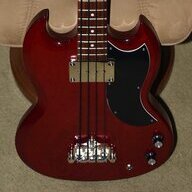
The only disadvantage I've run across with short scale basses, the limited string options, as compared to long scale basses. The sounds, and playability with short scales, no disadvantages here.

The only disadvantage I've run across with short scale basses, the limited string options, as compared to long scale basses. The sounds, and playability with short scales, no disadvantages here.
For all practical purposes, and for 99%of the people, 99% of the time? ^This^. And even then, you have to get pretty exotic in your choice of strings these days, to find something in a long scale string, that you can't get in a short scale set. And, your choice of basses are pretty limited, if you want a 5 or 6 stringed one. Other than that? No real problem. Yes, it's easier to get into "string trouble/tension trouble" with a short scale bass - if you want to get into alternative tunings; BEAD might give you some problems, for example (and yes, I know some people do it successfully - I'm just sayin'...). But, if you just want to play a bass tuned EADG? Pay your money, and pick one that makes you happy; I have 6 of 'em, and I have no complaints...

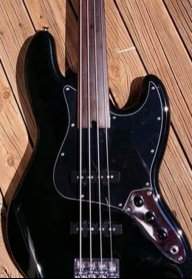
There is no difference for tuning. This is Bull Crap.
Actually there is a difference due to the lower string tension. When a low E is flat by 5cents on a shorty there is much less movement required to bring the string up to tune than on a full scale. With machine heads of the same tuning ratio a 1/4 turn on the shorty will bring the pitch up a lot more than a 1/4 turn on the full scale. It's simple physics as the increase in tension made by a certain amount of turn on the tuning peg results in a higher percentage of total tension of the string than on a longer scale string of the same gauge. Good strings with good machine heads and accurate tuning should ensure that there is little difference to the stability of tuning once at pitch but a shorty is still more sensitive to tuning movements than on a long scale.


