• TalkBass has been independent since 1998. Add your voice.
    Create a free account to reply to discussions, view embedded media, and browse with fewer display ads.
    Join freeLog in
    Want zero display ads or expanded classifieds tools? Compare plans.

Any disadvantages to short scale basses?

Hey, guys. Let's get this over with: I'm a girl. I have small hands. I can manage on a 34", but I feel my abilities might be better translated on a short scale bass. And maybe my left hand won't ache quite as much after playing something like "Face the Face" or a similar stretch-on-the-really-low-frets song.

However, I'm wondering...is there a downside to short scale basses? I'm particularly wondering about sound. Is anything impacted by the shorter neck? Should I learn to deal with a 34"?

Discuss, friends.

Long scale bass envy. It's nasty.
 
I just wanted to state for the record - my medium scale PRS bass which I used exclusively for over 20 years on 25 albums, and is still active in my studio arsenal and has NEVER had medium scale strings on it. I have always used D'Addario standard long scale strings exclusively - and have never had a problem. This particular bass is 32.5" scale and the headstock is 2 X 2 but they work perfectly for me. In the last batch of strings D'Addario sent me, I had them send a few sets of mediums to try out. So, for the first time ever, I will be trying out some medium scale string sets on my soon to be 20 medium scale basses, which ALL have long scale strings on them. Be happy to report back, not sure what all the fuss is about. I certainly wouldn't recommend or try long scale strings on a 30" short scale - but for medium scale they work fine for me, and always have.

View attachment 758100

As far as the "tone" not being right as one poster suggested using long scale strings on a medium scaler - thanks for the chuckle.

If you want to talk tone - think about Stanley's shorter scale Alembics and Jonas's Medium scale custom Warwick. Do you really believe two of the most accomplished players in the history of the instrument - would play shorter scales if they were losing anything substantial tonally? Certainly something to think about, especially knowing that their "star" status gives them complete and total access to any holy grail long scale instrument ever made.
You do lose substance in tone when you go shorter. Stanley and Jonas do too. They may just be looking for that kind of tone though. But I mean Stanley had like 100 basses. I'm sure he has ever flavor under the sun.
 
  • Like
Reactions: AlexanderB
I've been playing standard 34"-scale basses for about 30 years now. Bought my first short-scale (30.5") last year: a '69 Les Paul Bass

BB264579-DFAD-44E6-885C-E0C017F0EC6A_zpshqpjtpyf.jpg


F002F886-5FF1-4A92-B9BA-400CF41A3466_zpsdopsjhso.jpg


It took no time at all to adjust to it. I can go back and forth between my 34" Fenders and the Les Paul without thinking twice.

As far as downsides? String selection is much more limited. And you really want to use short-scale strings if you can. The other issue (as a few people have mentioned) is low string tension. I found I needed to increase the string gauge dramatically in order to get the same feel I'm used to. But once you figure all that out, you're good to go.
 
Best short scale ever. Aria Pro II CSB B&G. A little over 32 inches with a narrow bridge so the string fanning is lessened. It still gives a deep resonant tone.View attachment 757884

I have always lusted after these Cardinal basses but couldn't budget one in. It turns out that Ibanez made a copy of them for a while. I bought one of those but the quality wasn't so good.

So I took off the neck, did the frets and some other detail work, and am putting it on a Squier Precision Bass body. Its lacquer is in the other room drying now.

I have observed in the New Wave days that the smallest girls often had gigantic Jazz Basses. Probably some kind of statement or something. But I'm getting up in age and getting more interested in comfort.

I won't say "Play what you want" because that's just stupid.
 
Last edited:
View attachment 757700
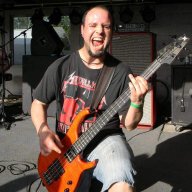
This guy seems to get along fine with a short-scale... if that's what you need, go for it. :thumbsup:
I have seen Stanley play many times but never realized that was a short scale Alembic until I read about it. Gene also played a custom (can't remember the name) short scale bass for almost the first decade of Kiss. The only issue I have heard is lower string tension and muddy tone. I have noticed that early 60's Gibson EB SG basses can still be had for really good prices and that is probably why. There are long scale versions, but those seem to be fairly rare. I remember reading Ozzy's crazy train was recorded with a short scale SG bass and there is definitely something different about that bass sound.
 
There are plenty of high quality short scale basses being made now a days, and ranging in prices too. I play Birdsongs, and recommend them to anyone who is interested in a shorter scale that still sounds big. I think we are beyond the "any issues with short scales" era. A well made bass is a well made bass, regardless of scale, and like I said there are plenty available in all sizes now.

Hope you find the bass for you!
 
  • Like
Reactions: Groove Doctor
The comments about string selection don't really matter to me.

I mail order all my strings, as local stores generally offer almost no short scale strings. But who cares when they're 72 hours away, and at lower prices? Order a set and a backup set, and you have no issues.

And if you're a flats player who likes old strings as I do, you install ONE set of strings and you'er good with those strings for the next 20 years or so. String availability is not a factor.
 
Short Scale Basses Are For Short People,
And as we all know...

Short People Got No Reason To Live

They got little bitty hands, And little bitty eyes
They walk around Tellin' great big lies
They got little noses, And tiny little teeth
They wear platform shoes On their nasty little feet

They got little baby legs That stand so low
You got to pick 'em up Just to say hello
They got little cars that got beep, beep, beep
They got little voices Goin' peep, peep, peep
They got grubby little fingers, dirty little minds
And they're gonna get you every time

057912
 
  • Like
Reactions: lewink and Lo-E
Someone here mentioned a Thunderbird and its thin neck...I've always adored the look and sound of the 'bird. There's an Epi at the local music store so I may just try it out.
If you do, be sure to try it on a strap. T-birds are very cool, but they hang in such a way that the reach to the first frets can be pretty far. They look awesome and sound great, but they're not for everybody.

If a slender neck is what you crave, Ye Olde fender Jazz bass is a proven design (and available in medium and short scale as parts basses or Fender Japan issues) and Ibanez SRs are very skinny, too. Maybe not as sexy looking as a T-bird, but more comfortable to play IMO.
 
I have always lusted after these Cardinal basses but couldn't budget one in. It turns out that Ibanez made a copy of them for a while. I bought one of those but the quality wasn't so good.

So I took off the neck, did the frets and some other detail work, and am putting it on a Squier Precision Bass body. It's lacquer is in the other room drying now.

I have observed in the New Wave days that the smallest girls often had gigantic Jazz Basses. Probably some kind of statement or something. But I'm getting up in age and getting more interested in comfort.

I won't say "Play what you want" because that's just stupid.
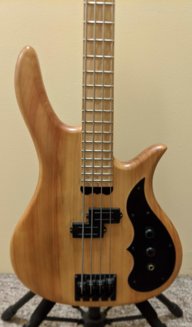
Keep an eye out for these basses. They are out there. I got the one in the picture from the U.S. for $150. I am sure it was a closet queen because there was very little wear. The big thing was a big gouge out of the body. You can see on the picture a dull area where the right wrist would be. It was about a quarter inch deep and about 2 inch long. I experimented with nail polish to find a close match, then built up layers of polish then sanded to shape. This was before the final polishing.
 
To Everyone saying "scale length doesn't make a difference in sound", I'm sorry but you don't know what you're talking about. (not that there's a ton of people here claiming that, but for those who are...)

It completely does. In fact it has more effect on the sound and resonance of your notes than whatever woods you make it out of, or whatever hardware you have.

Try playing a 35" or 36" Scale bass and then tell me how it compares to a standard or short scale bass. If you can't hear a night and day difference, your tone deaf.

Carl thompson, among other great builders, will tell you up and down what a difference scale length makes in the sound of an instrument. Whether or not the difference is good or bad is all opinion.

Of course it makes a difference. The room you play in makes a difference. Where along the string you strum/pick makes a difference. Pickup height makes a difference. That's the thing. There are enough factors OTHER than scale length such that it's ridiculous to claim that it alone will make a night and day difference. How many people say their Mustang sounds just like a Precision? What about the Squier Jaguar Special? What if we tried to apply science, recorded a 34" bass, swapped on a 30" conversion neck, and then recorded it again? Oh, but wait, if we used the same gauge strings, the tension would be less. That's another variable. Maybe we can get thicker strings to provide the same tension, but now the change in string gauge is another new variable. So how can we scientifically say that scale length makes such a difference? How can you change scale length on a bass, without saying the difference in sound is also influenced by string tension or gauge? It's well accepted that given the same bass, changing the string gauge makes a pretty noticeable difference.

You completely missed the point I and others were trying to say, which is that at the end of the day, you really can't tell, and things like strings, pickups, and pot values, are probably more important. While the sound clips are long gone, I encourage you to read this thread and see the conclusions people made about what sounded like what.
 
Of course it makes a difference.

You completely missed the point I and others were trying to say, which is that at the end of the day, you really can't tell...

I think that it's not so much that you can't tell, as that you optimize the sound in the format you choose and that's your sound. Following my own advice, I have a roundwound Precision and a flatwound Precision, and they both sound delicious in very different ways. The 32" Precision is coming up soon. My Bronco is a little thin but I'll deal with that later.
 
  • Like
Reactions: Ballin'bass
I think that it's not so much that you can't tell, as that you optimize the sound in the format you choose and that's your sound. Following my own advice, I have a roundwound Precision and a flatwound Precision, and they both sound delicious in very different ways. The 32" Precision is coming up soon. My Bronco is a little thin but I'll deal with that later.

You said it better!
 
On TB it usually goes something like this for advice:.

(q)What bass should I buy?
(a) Go to the bass shop and try any number of basses until you find one that's "right" for you.

(q) I found a bass I love....but it's a shortscale...is that o.k.?
(a) No......you should have bought a longscale Fender Precision...what the hell's the matter with you?

(q) I have nerve and tendon damage and can't play a longscale without enduring pain of some kind...is it just me?
(a) Yes..it's just you. Everyone on the planet can play a longscale and you're no exception. If you were buying a bicycle it would be the same thing. Everyone can ride a large frame.
Which is why when shopping for bicycles or golf clubs, size doesn't matter. You buy the biggest model out there and force yourself to adapt. Because the majority rules.
If it's shoes, you buy size 14 no matter how short you are.

(q) So why do I need to try a multitude of basses if a longscale Fender P is all I need?
(a) Because we said so.
 
On TB it usually goes something like this for advice:.

(q)What bass should I buy?
(a) Go to the bass shop and try any number of basses until you find one that's "right" for you.

(q) I found a bass I love....but it's a shortscale...is that o.k.?
(a) No......you should have bought a longscale Fender Precision...what the hell's the matter with you?

(q) I have nerve and tendon damage and can't play a longscale without enduring pain of some kind...is it just me?
(a) Yes..it's just you. Everyone on the planet can play a longscale and you're no exception. If you were buying a bicycle it would be the same thing. Everyone can ride a large frame.
Which is why when shopping for bicycles or golf clubs, size doesn't matter. You buy the biggest model out there and force yourself to adapt. Because the majority rules.
If it's shoes, you buy size 14 no matter how short you are.

(q) So why do I need to try a multitude of basses if a longscale Fender P is all I need?
(a) Because we said so.

ZenG, You crack me up!!! .........lol
 
I'm short bloke, stubby little fingers. If I pick up a bass that has 45-105 strings on it I will find it really difficult to play.
30 years ago I tried 30-90 strings. That suited me perfectly.
At the moment I'm using D'Addario EXL190.
And I also changed strap height so my plucking hand is at belt level, minor changes to neck angle so it's just a little bit easier to get to higher or lower frets.
Here is a test: Play a low F on the E string. Consider strap height and position of bass, that's pretty much it for me.
If I can play that note and it's octave comfortably, I'm ready to rock.
 
Of course it makes a difference. The room you play in makes a difference. Where along the string you strum/pick makes a difference. Pickup height makes a difference. That's the thing. There are enough factors OTHER than scale length such that it's ridiculous to claim that it alone will make a night and day difference. How many people say their Mustang sounds just like a Precision? What about the Squier Jaguar Special? What if we tried to apply science, recorded a 34" bass, swapped on a 30" conversion neck, and then recorded it again? Oh, but wait, if we used the same gauge strings, the tension would be less. That's another variable. Maybe we can get thicker strings to provide the same tension, but now the change in string gauge is another new variable. So how can we scientifically say that scale length makes such a difference? How can you change scale length on a bass, without saying the difference in sound is also influenced by string tension or gauge? It's well accepted that given the same bass, changing the string gauge makes a pretty noticeable difference.

You completely missed the point I and others were trying to say, which is that at the end of the day, you really can't tell, and things like strings, pickups, and pot values, are probably more important. While the sound clips are long gone, I encourage you to read this thread and see the conclusions people made about what sounded like what.

Oh my god Dude. No I didn't miss your point. The fact that the string tension increases is PRECISELY WHY it makes a huge difference. Duh. If you change the string gauge just because you change the scale length, then you are skewing the results of the test. The fact that the tension rises and the string vibrates over a longer distance is precisely why extra long scale basses sound different. :banghead:
To me, it sounds like you've never actually personally compared scale lengths back to back, using the same strings,etc. I have, and I own 34, 35 and 36 inch scale length basses and my gf has a medium scale. Besides the fact that they have varying pickups and such, they all wear the same strings and there is definitely an inherent tone and response in certain scale lengths, regardless of other factors. There's also a reason why so many high quality 5 and 6 string basses have extra long scales, because the b string needs to be more taut in order to ring clearly. Regardless of pickups or strings. This same physical principle applies to all basses.

And if you think "a lot of people think their jag sounds like a precision" is a valid argument, it's not. Most people are, in fact and through no fault of their own, tone deaf and not suited to judge such things.

Again, I reiterate. Play even just a 35" vs a 34" back to back with the same strings. Even though they are different basses, you will notice more clarity in the extra long scale bass, every time, unless you are tone deaf. I'm sorry but this isn't a matter of opinion, is physics.
 
I'm actually less comfortable on a short scale bass, and my left hand tends to cramp during a long gig played on one. It may be partly based on the ergonomics of the basses - most of mine are hollow-bodies and some are neck-heavy, which can be hard on your fretting hand - but more obvious is a set of muscles that have adjusted to a 34" scale (and upright bass) over 50 years of playing. Obviously OP doesn't have that issue, I'm just addressing the presumption that a shorter neck is inherently easier to play. Like a lot of things, it depends on your circumstances and you need to give it all a chance to know what you prefer...