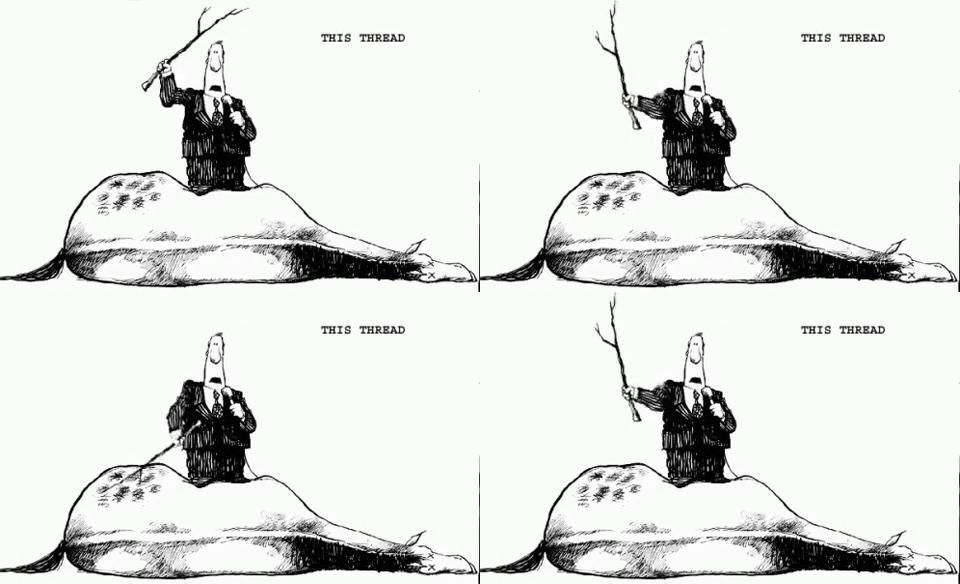
Some days I wish there was a dislike button.
Thanks @agedhorse and @Passinwind for bringing the goods.
Even though their explanations were above my pay grade, at least they offered more than a curt dismissal.

TalkBass has been independent since 1998. Add your voice.
Create a free account to reply to discussions, view embedded media, and browse with fewer display ads.
Join free Log in
Want zero display ads or expanded classifieds tools? Compare plans.
Some days I wish there was a dislike button.
Thanks @agedhorse and @Passinwind for bringing the goods.

Speaking of people having no clear understanding of a Watt…
How come a lemon gets soft and juicy as it ages and a lime gets hard and dry and physically smaller as it ages? Shouldn't they age the same since they are both sour citrus tree fruits? Asking for a friend.

The Eden WTX amps do not have a processor anywhere onboard.Ok. Again, every class D combo bass amp Im aware of has a digital power section. Give me some examples of class D combo bass amps with analog power sections. Thanks

Hopefully OP has figured out that the question was not conflicting facts but incomplete comprehension.Ok. Again, every class D combo bass amp Im aware of has a digital power section. Give me some examples of class D combo bass amps with analog power sections. Thanks
How come a lemon gets soft and juicy as it ages and a lime gets hard and dry and physically smaller as it ages? Shouldn't they age the same since they are both sour citrus tree fruits?

There kinda is - I find the "ignore" list a great way to filter out folks who are too stubborn/argumentative to spend time on.Some days I wish there was a dislike button.
Thanks @agedhorse and @Passinwind for bringing the goods.


Some people can't hear a difference between analog and digital, you are clearly one of those people. Im sure you prefer streaming music to vinyl too
Andy, I know it would be a bit of work but in the long run it could save you time if you were able to do a post that explains, as much as is possible in laymans terms, the workings of the most popular amp types. When posts like this come up one of us could simply quote or link your thread and save you having to type the same things over and over again. Just a thought.No, this is not true.
Virtually EVERY class D amp is analog, non-linear (using PWM as a modulation mechanism). I have designed many bass amps (way more than 3) and they are all analog, non-linear power sections. I have also designed many bass amps (way more than 3) that use all analog, linear power sections. I have also designed bass amps using both SMPS and non-linear line frequency analog power supplies.
This is completely wrong on so many levels. Their description of "class D" actually has nothing to do with class D but is describing SMPS which is entirely different.
No, it's not clear cut at all. Class AB is not necessarily better for wide bandwidth audio (ie. full range), there are class D amps today that are far better than class AB, though if you go back 20+ years that may not be as true).
Name one.
Combo amps w/ analog power sections... Shuttle's, ShuttleMax's and Countour 500, but there's also the Shen "LT" series that were used for uprights and other acoustic applications.
When done well, few if any can tell the difference in double-blind testing. IF they know what they are playing then obviously their eyes will tell the difference (marketing).
IMO, this is an insulting statement.
Because they DON'T!!!
I disagree with this, I have't seen it to be true on any class of amp.
Except that you don't understand how the AC input power ratings are derived and why it's done this way, that's why you are confused and accusatory. Actually, your description of audio ratings are also incorrect. When you post stuff like this, I encourage you to do some (real) research and learn about it before posting.
I have discussed this before but it seems that it needs to be "refreshed"...
The AC input power is required by safety agency standards, and it's required to be the greater of the power consumption at 1/8-rated audio power into the lowest or most demanding load, or if intended for crest factor, than that higher number MAY be used. This is entirely independent of the amplifier class.
Why is it done this way? Because 1/8-rated audio power represents the average internal thermal loads that the amplifier will see under long term (ie. continuous) use when presented with an average full range signal driven to the point of clipping. There are a whole series of thermal tests that are performed on the amp during certification to insure that no component exceeds its safe working temperature (as defined in the standards). There are also additional thermal tests that are done at a series of higher power levels (called abnormal operating conditions) as well as a third series of thermal tests conducted under fault conditions.
For some companies in the pro audio world (and I do this to some extent as well), they will specify AC power consumption at 1/8-rated power (mandatory) as well as 1/4, 1/3, 1/2 and maximum rated power, this data is used for other reasons mostly related to branch circuit calculations and feeder or generator dynamic capacity in fixed and large portable installations.
I've rarely seen a curt dismissal from them except in the events where people ask a question, get an accurate answer from an actual expert in the field, and then want to argue more.Even though their explanations were above my pay grade, at least they offered more than a curt dismissal.

Up next, what works best? Regular clothespins, or the springy kind?

When it comes to watts at least. Was watching a video with the President of Boss talking about the new Boss Katana bass amps. Him and the interviewer were saying that while the 60 watt 1x10 and 160 watt 2x10 amps sounded low in watts, you have to account for the fact that you need 5 times the watts for a digital Class D amp to match an analog A/B amp. So using Class D ratings equivalency, that would make the 1x10 a 300 watt amp and the 2x10 an 800 watt amp?

class D does NOT mean DIGITAL !!! FYIOk, I have asked 3 people and none have replied, maybe you can help. Name me at least one Class D combo bass amp that has an analog power section rather than digital.

I know, but for lack of a stickie or a really good answer to this and the "heft" comparison here we go again.
@mbell75. The first time I compared a solid-state amp to a tube amp I was surprised by how much louder the solid-state amp was. I have repeated the experiment many times over the years and the tube amps have yet to win the SPL battle.
I believe my collection currently includes 32 amps (tube, hybrid, and solid-state).
I currently own amps with solid state output sections ranging in power from 360W to 2,500W.
I own tube amps with output sections ranging from 12.5W to 427W.
The volume the tube amps make falls in line with these power ratings: 12.5W, 30W, 100W, 200W, 300W, 400W etc. But there is variation between the amps at each of these power ratings. At 100W my Hylight era Hiwatt DR103 is clearly the loudest. I don't actually know which of my 200W tube amps is the loudest, but I am reasonably certain my Matchless Thunderchief puts out less power than all of my other 200W tube amps. In the 300W category, my Ashdown CTM300 is slightly louder than my vintage SVTs. In the 400W category, my Ashdown 427 is top dog.
At the lowest end of the solid-state spectrum, my GK 2000RB is rated for 360W per channel at 4 ohms and my 700RB is rated for 380W at 4 ohms. Both are a bit louder than my 300W tubes amps, but not quite as loud as the big Ashdown 427. All of my class D amps are louder than the GKs.
Wasnex, can you compare/contrast your amps with regards to transient delivery? And, is there a standard measurement for this that amps can be contrasted with? I see these threads (and others) and for me, still can't really get the answers I'm looking for but I think I know better what the question is: how do amps handle transients, and you hit on this in your post above.That's still only part of the puzzle. Different amps with the same power rating can have different burst power ratings. So one amp might start to clip right at the RMS rating and another amp may be able to produce clean transients that are significantly higher than the RMS rating. Since music is dynamic, higher burst power often relates to higher SPL.
As far as how an amp transitions into saturation, that is more dependent on designer intent than amplifier topology. My Hiwatt DR103 seems designed to produce max clean power. It's noticeably louder than my other 100W tube amps, but I would not say the output section clips in a particularly pleasing manner. For pushed bass tones I would choose either my Matamp GT120, Matchless Thunderchief, or possibly my Mesa D180.
Some solid-state amps are designed to produce pleasing distortion. My GK RB series amps get compressed and makes a nice grind when pushed hard.
In my experience, many tube amps don't even make their clean power rating. From the bench tests I have come across, Orange AD200Bs do not make 200W clean, SVTs generally do not make 300W clean, and Mesa 400s and 400+s don't even make 300W clean.
Also as tube amps approach their clean power rating they tend to get compressed before the break over into OD. Some people perceive a compressed signal as louder, but I seem to key more off of the ability to produce clean transients when I am playing bass.
So even though I love my tube amps, if I were forced to choose only one amp, it would probably be a hybrid with a big solid-state output section.

excellent question.How come a lemon gets soft and juicy as it ages and a lime gets hard and dry and physically smaller as it ages? Shouldn't they age the same since they are both sour citrus tree fruits? Asking for a friend.
 i too have a friend who would like to know why that is.
Hopefully OP has figured out that the question was not conflicting facts but incomplete comprehension.

I prefer CD to both:Some people can't hear a difference between analog and digital, you are clearly one of those people. Im sure you prefer streaming music to vinyl too

I think you are mistaken.
PCM or PWM do not require digitization of the signal; there are no D/A or A/D converters in most class D bass amps.
Maybe you're thinking of modeling amps?
The Eden WTX amps do not have a processor anywhere onboard.
I think many amps do use a processor to control the PCM or PWM, but that doesn't really make the amp digital because the signal remains in the analog domain the entire time.
Hopefully OP has figured out that the question was not conflicting facts but incomplete comprehension.
@agedhore alluded to the variety of amps that he personally has designed.
Given the success of MANY of those amps; the unspoken inference is that there are LOTS of ways to get great sounding gear.
Just go with what sounds good.
Class D is NOT digital. It means it uses Transistors instead of the older component type of Tubes/Valves. Transistors are PRE digital tech, common post WW2 electronics. Integrated Circuits (which is where things get "digital") are a later tech way of miniturizing and replacing many networked transistors (and the massive heat problems they would cause).
Nope, none that I have seen.Some of the newer, miniaturized, ultralight new type D amps (maybe the Eliot Elf
?) likely have digital components.
Very different design choices. The GK is much brighter and many players associate this with "quicker and more dynamic", but in fact this is a perception and is not shared by all players.For example, I a/b tested a Mesa Subway D-800 with a GK Backline 600. Since I was in a store I couldn't unleash a volume war, but, using the same speaker I noticed that even at lower volumes the GK seemed to produce louder transients, while the Mesa felt compressed. I haven't seen this explained as of yet.
Much thanks to you and Agedhorse and Passinwind and many others who tolerate ignoramuses like me who struggle to articulate themselves about this.
Raz

Some people can't hear a difference between analog and digital, you are clearly one of those people. Im sure you prefer streaming music to vinyl too