• TalkBass has been independent since 1998. Add your voice.
    Create a free account to reply to discussions, view embedded media, and browse with fewer display ads.
    Join freeLog in
    Want zero display ads or expanded classifieds tools? Compare plans.

asked to leave Sansamp at home next time

#1 is kind of where we are. I explained it is essentially the same sound as the SVT they just removed (to clean up the stage look). He said that's not necessary because "we can do anything from the computer that the pros do". I understand his point. But, he is not a pro, and struggling with the bass indicates he is struggling with his board. One of the other bass players brings a tone hammer, and another used this same sansamp. In fact I just bought it from him. And yeah, I don't really want to take a hard line. Just shocked to meet such resistance from a newbie with a Mac.
Noob and Mac and "we can do anything with the computer the pros do" pretty much said all that needs to be said to me. Which is to say: Apple fanboy drank the Kool-Aid.

He sounds typical of many newbies who only know one thing or way to do something and it's become the only "correct" thing to use or way for them. These are the type of people who tend to tell you something "doesn't work" or "can't be done that way" when they really should be saying "I don't know how to do it that way."

Good luck with that one.
 
Last edited:
  • Like
Reactions: tbplayer2
As for the ducking kick /bass trick. It can work well to have comp on bass keyed from kick.

It then knocks back the bass slightly when kick hits. Done right this doesn't create an audible drop in bass levels just allows the kick hit to be punchy & clear while the bass is still full in the mix.

I do this often & i' m a bass player remember. I find when down right the net result is I can have the bass louder in the mix without fighting the kick drum & you end up being clearly able to hear both

Could you explain how to do this correctly? What gear is needed and how does it need to be set up? The way you explain it sounds great.
 
  • Like
Reactions: tbplayer2
cue the "actually" wars!

not really, the more esoteric elements of this stuff are outside my experience; still, i understood parallel compression ("new york" compression) to be a specific thing that had nothing to do with using the side chain controls.

below the threshold of the one copy you get both tracks at full volume, making things +3dB louder than they would otherwise be. above that threshold the uncompressed track gets louder than the compressed track, so you no longer get that 3dB boost.

the wiki calls it "upward compression", where it makes the quiet parts louder rather than turning down the loud parts.

Now I see what you meant; I've never known someone to use parallel compression that way, but I'm used to working on rock and pop stuff which is very in-your-face in mix style.

On a drum bus I'd typically use something like the SSL G, and the parallel track is never under threshold and can be grabbing snare, kick or toms hits by as much as 6dB on an aggressive rock track; it sounds really dirty and pumpy solo'd, but blended with the general drum bus adds a an incredible amount of punch and excitement to the overall sound.

I have an indie/folk style project coming up, I'll have to give upward compression a try on one of those mixes.
 
  • Like
Reactions: tbplayer2
Could you explain how to do this correctly? What gear is needed and how does it need to be set up? The way you explain it sounds great.

Any compressor plugin with a sidechain function will work.

You first route the kick signal to an aux bus; make sure to set the bus for no output, otherwise you'll be doubling the kick signal.

Put the compressor on the bass channel and set the side chain (or "key") to the aux bus you've routed the kick to; the compressor will then "duck" the bass signal whenever it "sees" the kick in the aux bus :thumbsup:

You'll usually want fast attack and fast release settings on the compressor, and adjust the threshold to taste; a few dB will sound pretty natural, but you may actually want a "pumping" effect for a more electronic/dance track which will be closer to 6dB.
 
Last edited:
Could you explain how to do this correctly? What gear is needed and how does it need to be set up? The way you explain it sounds great.
You need a compressor with a side chain input and you send a signal from say the kick to to the compressors side chain input or key input as sometimes referred to.
The compressor will now react to the side chain source - the kick , instead of the bass , so it'll only engages when the kick hits. I'd try a medium to medium /fast attack time but not the fastest setting
And a fairly fast release. Maybe 2:1 or 3:1 ration & the threshold so it only does 2-4 db gain reduction

These are just generic ballpark settings to start it can vary a lot based on gear - source etc...

This trick is used heavily in dance / electronic / dubstep music but more of an extreme audible sense there.

It's often used in pop / rock / metal music as well but in a more subtle way where you don't really hear it you just have a little more space for stuff. If that makes any sense. Again it can be subtle and doesn't always work.

For some rock , well really metal examples
I know that this was employed on the kick/ bass guitar on the Pantera albums Vulgar Display of Power & Far Beyond Driven

Their sound is a bit extreme though as the drums are super clicky to begin with bit it's an example I can think of at the moment that isn't dance music.

Here's a quick video on it as well:
 
Pissing off the sound guy is an incredibly stupid thing to do. No experienced player would do that. At the very least you would want to find out what he thinks the problem is and tinker with the Sansamp.

I have owned my Sansamp since 1996 and as much as I love it for recording, I have always thought the scooped sound did not work for live playing.

You don't need a compressor since the FOH will most likely have and use one.

Just trust your sound guy.
 
Last edited:
I have owned my Sansamp since 1996 and as much as I love it for recording, I have always thought the scooped sound did not work for live playing.
depends on the gig and how you run it obviously, but for a whole heck of a lot of people it works perfectly for live playing.
Just trust your sound guy.
a guy who says "what is that?" when he sees a BDDI does not earn any trust.
 
Sound engineer says "I'm having trouble with the bass. What is that thing? (Referring to Sansamp BDI). Let's leave it out next time, he says.

I'm running bass -> DI -> FOH. My bass is Ibanez GSR200, provided DI is Whirlwind IMP2. I replaced it with my Sansamp with settings to " SVT Style" from the book.

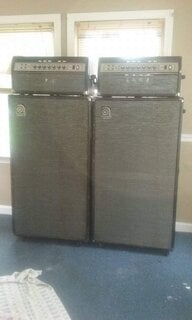
Playing at a fairly large church in rotation for 5 years or so . Sound guy is new to FOH, 2 months maybe. He worked the monitor board before that. They recently removed the Ampeg SVT and 8x10 to "clean up the stage" and replaced it with a Whirlwind Imp2 DI box. Previous engineer was an experienced, paid pro and was always happy with my sound through the amp's effected DI out. I'm not a flashy player; just want to sit tight and sound good.

My bass is not the greatest, and going direct through a $50 Di doesn't help. So I brought the Sansamp, in lieu of the SVT. New sound guy told me they are running EQ and 2 software compressors on the bass channel that "make it sound awesome". One to smooth out my volume, and one to hide the bass behind the kick drum.

Also on stage are acoustic, lead, and rhythm guitars each with their own large pedal board, keys, loop, custom drums designed for the auditorium, and 4 vocals.

And I'm asked to leave the Sansamp at home, and use the DI.

So the question for the sound pros; What is your preference Sansamp Bass DI, or Imp2 DI?

I'd appreciate your suggestions.
I always use my own DI but here's the thing. Most engineers will want a clean, not wet signal from the bass. He's not picking on you - he wants that from all the band. Life is full of compromises though & in this case you need some give & take. They have removed the bass amp which compromises your sound but you have replaced with FX that compromises the engineers sound. I would suggest you ask for another channel & give him both & he can side chain the wet signal.Spend a bit of with him & get a sound you can both live with. Having bad blood with the FOH guy ends with you getting a poopie sound.
 
Not actually being there is a huge disadvantage to provide help to the OP. Here are some talking points:
  • Perhaps it is simply inexperience on the part of the sound tech
  • Perhaps the bass channel on the house mixer is set to sound good with a simple DI bass signal
  • I once owned a VT Bass Deluxe (?). The SVT setting on it was quite dirty, not a tone I personally would use in a Sunday morning band
  • The great tone in your IEMs is probably not that great in the FOH
  • Walking out front and playing your bass by itself only works if you truly know what your bass needs to sound like soloed.
  • Utilize a virtual sound check if you can, mute the recorded bass and play along, comparing the Sansamp to DI only
  • If the sound team is using a Digital mixer, then they most likely have a preset they are using on the bass channel set for a DI bass signal, and the Sansamp probably will never sound good through it.
  • Having played bass in church for almost thirty years, and going direct most of those years, simpler is almost always better.
  • Through the years, I have used many great preamp style DI pedals, and the bottom line is most church sound people can't deal with them, no matter how nice the pedal is.
  • I suggest buying the best quality DI box you can afford, just a DI box, no tone shaping, and go with that in a church setting. Most of the time (not always) anything beyond that is a waste.
  • Try to keep the sound crew's good side, you will be glad you have.
 
  • Like
Reactions: tbplayer2
The secret of the Sansamp is as follows: !!!ALWAYS BLEND YOUR DIRECT SOUND IN!!!. When the blend is at full the BDDI can be very mid shy and compressed, so blending in some of your direct bass sound will put some of the mids and dynamics back in. that's what sound men have a problem with lack of definition in the mids. And if you think about it, most great bass recordings have both amp and di at the same time. By blending these tones together that's what you are essentially getting. Put the blend at 50% as a start.

that said, i had a 'pro' soundguy once tell me that he couldn't get a good tone with my rig...

Active PJ into an Ampeg tube DI into an Ampeg SVT CL with an 810... sorry bro if you can't make that sound good...

and it wasn't a volume thing either.
 
Last edited:
My advice would be to set the BDDI up at home. Find some audio with a bass tone you like run it into a mixer along with your bass and the BDDI, use the eq on the BDDI to match the bass tone. I think you will be surprised how unsuitable the tech21 SVT eq setting are. I never found a tone reasonable for FOH without knocking back the bass and treble settings to at least 9 o'clock or using a lot of clean blend.
 
That tells me your sound guy doesn't know jack. :banghead::crying::crying:
Which is honestly not surprising for many church "techs".
Any "barely functioning" FOH guy I know should be able to work with either one. I have both units, and have used both. If you want to use the Sansamp (or any other preamp style DI for that matter) when I'm running sound?? Bring it on!
Jack who?
 
  • Like
Reactions: tbplayer2
I normally play Stingray 5ers (mostly with a pick -and don't change anything for fingerstyle-) thru' my SansAmp RBI in pretty agressive OD settings for what I normally see, and still get nothing but praise sound guys, almost no EQing needed on FOH. Considering a 1 to 10 scale on any knob my settings are:

DRIVE: 6-6.5%
PRESENCE: 0 (this control is boost only, 0 is flat)
BLEND: 7-7.5
BASS: 5
MID: 4
TREBLE: 4
 
  • Like
Reactions: tbplayer2