• TalkBass has been independent since 1998. Add your voice.
    Create a free account to reply to discussions, view embedded media, and browse with fewer display ads.
    Join freeLog in
    Want zero display ads or expanded classifieds tools? Compare plans.

AudioKinesis 112 Cab

Status
Not open for further replies.
I'll be wringing out the Shuttle 9 with my Thunderchild soon, hopefully in the next 10-12 days. I'm very interested in comparing it to my LMII, which Ken said goes very well with this terrific cab. So far the S9 has relegated my beloved LMII to backup status; we'll see if that continues :smug:

Cool! I bet that will sound great... a bit more punchy and bright that the LMII would be my guess.

My F500 has also related my LMII to backup over the last couple years, but it sounds VERY good with this cab to me.
 
Cool! I bet that will sound great... a bit more punchy and bright that the LMII would be my guess.

I can EQ the S9 to sound very, very close to my LMII with, as you guessed correctly, more clarity.

Every now and then I bring out my LMII to re-A/B with the S9. I always think I'll rediscover the LMII magic and set aside the S9 for awhile. The result has always been to put the LMII back into the "standby closet" :)
 
Duke says you can stack them at 90 degrees to each other for near 180-degree dispersion.

I would assume that would also be true of any stack of two identical cabs (i.e. increased midrange dispersion if you pointed them away from each other).

Certainly you can do it with any two identical cabs, but with the Thunderchild the sound will be especially uniform. You see, from about 1.5 kHz up, the system is -6 dB at about 45 degrees off-axis, relative to the on-axis sound. So with a pair stacked at 90 degrees, along the axis half-way between the two (where we're 45 degrees off-axis of each one) they'll sum to approximately "flat" (-6 dB plus -6 dB = 0 db, if we're in phase). Also the nearly square footprint makes such stacking a little easier than a rectangular footprint would.
 
Certainly you can do it with any two identical cabs, but with the Thunderchild the sound will be especially uniform. You see, from about 1.5 kHz up, the system is -6 dB at about 45 degrees off-axis, relative to the on-axis sound. So with a pair stacked at 90 degrees, along the axis half-way between the two (where we're 45 degrees off-axis of each one) they'll sum to approximately "flat" (-6 dB plus -6 dB = 0 db, if we're in phase). Also the nearly square footprint makes such stacking a little easier than a rectangular footprint would.

Makes sense!
 
Top one upside down or is it less important since they're pointed so radically different? I'm guessing less important but still a good idea.

KO

IMO, purely personal preference.
The reason to put the tweeters as close together if they are in the same plane (geometrically) is to reduce sound wave interference & cancellations.
If they are aimed in different directions, this won't happen or not enough to be audible.

Also, IMO, with the dispersion characteristics of this horn/tweeter, I'd just stack them normally (facing the same direction with horns together in the middle of the stack) unless you're trying to cover a really wide audience.
I think you'd get better woofer coupling that way.

I'm no acoustical engineer, so take this with as many grains of salt as necessary.
 
Certainly you can do it with any two identical cabs, but with the Thunderchild the sound will be especially uniform. You see, from about 1.5 kHz up, the system is -6 dB at about 45 degrees off-axis, relative to the on-axis sound. So with a pair stacked at 90 degrees, along the axis half-way between the two (where we're 45 degrees off-axis of each one) they'll sum to approximately "flat" (-6 dB plus -6 dB = 0 db, if we're in phase). Also the nearly square footprint makes such stacking a little easier than a rectangular footprint would.

If I understand what y'all have said, two of these cabs stacked with their horns at 90-degrees to one another would yield uniform dispersion and a 6dB increase in SPL; in addition to the SPL increase, is there also a perception of increased bass response with two stacked cabs?

When I play venues with no bass in the PA, I like to stack two cabs with one facing toward the audience, and the other turned 90-degrees to provide a balanced signal across the stage toward my bandmates.

I'd love to hear how the Thunderchild would sound when used like this.
 
.....Also, IMO, with the dispersion characteristics of this horn/tweeter, I'd just stack them normally (facing the same direction with horns together in the middle of the stack) unless you're trying to cover a really wide audience.
I think you'd get better woofer coupling that way.....

That would be definitely how I would run two of these if I ever used two together.
 
By bass cab standards the horizontal dispersion throughout the range is very wide. But running them at the angle being discussed could be useful on a very tight stage if the bassist and drummer can't position themselves well relative to each other. I've played a few gigs where I've done this with dual cabs just to feed the drummer.
 
Has anyone had the chance to try one of these with an Epifani UL502 yet? Thoughts on that combination?

Hey Bernie! My 502 was long gone prior to the arrival of the Thunderchild. IMO, the wattage output, the size and weight, the voicing (super deep, polite low and upper mids, bumped mid mids.. that head has a voicing a bit like a 'W') would not be the optimum for the little 4ohm Thunder Child. I'm sure it would sound find, but the smoothness of the ThunderChild in the upper mids, and the small 4ohm box and nice round low end favor (again IMO) a brighter, tighter, 400-500 watt micro head.

Given my experience with the LMII and F1/F500, any of those heads, the Shuttle 6, the GKMB500/Fusion, the SWR HeadLite, etc. would sound great and drive the cab to 'full volume'.

Edit: And... my appreciation of this cab and its unique design and performance grows by the day. Absolutely fantastic single cab solution for many gigs and contexts. Superb design and performance IMO.... by FAR the best small cab I've ever experienced (based on size, weight, low end performance, voicing, quality construction, max SPL, and the ability to generate true low end at surprising volumes with no compression or quashing).

I've made my first real change in gigging rigs in quite a few years. My current gigging set-up for the two locations in which I gig (I have two full sets of gigging rigs so I never have to fly with instruments or amps):

1) Road rigs: Bergantino AE410/Markbass F500 (Large gigs), Thunderchild/F500 (smaller gigs/tough load ins).... Alleva-Coppolo LM5.

2) Home/driving rigs: Bergantino AE212/F500 (Large gigs), Thunderchild/F500 (smaller gigs, tough load ins).... Sadowsky NYC Ash/Maple Vintage with singles.

So, after about a decade, no more Epifani UL, and after 3 years or so, the nice little Schroeder 115L+ is also gone (to my buddy Wilbyman, who is digging it for his tone goals!). I don't change often (although enjoy trying stuff), so this is quite a move for me!
 
Hey Bernie! My 502 was long gone prior to the arrival of the Thunderchild. IMO, the wattage output, the size and weight, the voicing (super deep, polite low and upper mids, bumped mid mids.. that head has a voicing a bit like a 'W') would not be the optimum for the little 4ohm Thunder Child. I'm sure it would sound find, but the smoothness of the ThunderChild in the upper mids, and the small 4ohm box and nice round low end favor (again IMO) a brighter, tighter, 400-500 watt micro head.

Given my experience with the LMII and F1/F500, any of those heads, the Shuttle 6, the GKMB500/Fusion, the SWR HeadLite, etc. would sound great and drive the cab to 'full volume'.

Edit: And... my appreciation of this cab and its unique design and performance grows by the day. Absolutely fantastic single cab solution for many gigs and contexts. Superb design and performance IMO.... by FAR the best small cab I've ever experienced (based on size, weight, low end performance, voicing, quality construction, max SPL, and the ability to generate true low end at surprising volumes with no compression or quashing).

I've made my first real change in gigging rigs in quite a few years. My current gigging set-up for the two locations in which I gig (I have two full sets of gigging rigs so I never have to fly with instruments or amps):

1) Road rigs: Bergantino AE410/Markbass F500 (Large gigs), Thunderchild/F500 (smaller gigs/tough load ins).... Alleva-Coppolo LM5.

2) Home/driving rigs: Bergantino AE212/F500 (Large gigs), Thunderchild/F500 (smaller gigs, tough load ins).... Sadowsky NYC Ash/Maple Vintage with singles.

So, after about a decade, no more Epifani UL, and after 3 years or so, the nice little Schroeder 115L+ is also gone (to my buddy Wilbyman, who is digging it for his tone goals!). I don't change often (although enjoy trying stuff), so this is quite a move for me!
Thanks, Ken! Your input to this thread has been invaluable.
 
Hey Bernie! My 502 was long gone prior to the arrival of the Thunderchild. IMO, the wattage output, the size and weight, the voicing (super deep, polite low and upper mids, bumped mid mids.. that head has a voicing a bit like a 'W') would not be the optimum for the little 4ohm Thunder Child. I'm sure it would sound find, but the smoothness of the ThunderChild in the upper mids, and the small 4ohm box and nice round low end favor (again IMO) a brighter, tighter, 400-500 watt micro head.

Given my experience with the LMII and F1/F500, any of those heads, the Shuttle 6, the GKMB500/Fusion, the SWR HeadLite, etc. would sound great and drive the cab to 'full volume'.

Edit: And... my appreciation of this cab and its unique design and performance grows by the day. Absolutely fantastic single cab solution for many gigs and contexts. Superb design and performance IMO.... by FAR the best small cab I've ever experienced (based on size, weight, low end performance, voicing, quality construction, max SPL, and the ability to generate true low end at surprising volumes with no compression or quashing).

I've made my first real change in gigging rigs in quite a few years. My current gigging set-up for the two locations in which I gig (I have two full sets of gigging rigs so I never have to fly with instruments or amps):

1) Road rigs: Bergantino AE410/Markbass F500 (Large gigs), Thunderchild/F500 (smaller gigs/tough load ins).... Alleva-Coppolo LM5.

2) Home/driving rigs: Bergantino AE212/F500 (Large gigs), Thunderchild/F500 (smaller gigs, tough load ins).... Sadowsky NYC Ash/Maple Vintage with singles.

So, after about a decade, no more Epifani UL, and after 3 years or so, the nice little Schroeder 115L+ is also gone (to my buddy Wilbyman, who is digging it for his tone goals!). I don't change often (although enjoy trying stuff), so this is quite a move for me!

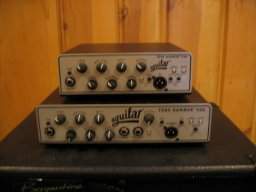
Sounds like Duke hit the 'target niche' he was aiming for in a very impressive way -- "Congrats to you Duke!".
 
IMO, purely personal preference.
The reason to put the tweeters as close together if they are in the same plane (geometrically) is to reduce sound wave interference & cancellations.
If they are aimed in different directions, this won't happen or not enough to be audible.

Also, IMO, with the dispersion characteristics of this horn/tweeter, I'd just stack them normally (facing the same direction with horns together in the middle of the stack) unless you're trying to cover a really wide audience.
I think you'd get better woofer coupling that way.

I'm no acoustical engineer, so take this with as many grains of salt as necessary.
With the cabs at 90 degrees the HF horns have little overlap in coverage, so there's no need for inverting the top cab. For that matter there's no need when aimed the same direction once you get 20 feet or so away from the cabs, but closer than that the horn outputs won't be integrated on the vertical plane, and that would be especially problematic where you're standing while playing. With the longer bass wavelengths woofer coupling occurs in either orientation.
 
Lee,

Have you done an A/B comparison between the Thunderchild and your Tri112L? I would imagine that they sound pretty similar, even though the Thunderchild is a good bit lighter.

I haven't done that--I'll try to pull that off after the first of the year. Seasonal music is challenging me, and the 112 is kept at church. I'd like to do that, and in the empty sanctuary is a good place to crank 'em up. I like to make the people in the offices get that concerned look on their faces. :eek:
 
I haven't done that--I'll try to pull that off after the first of the year. Seasonal music is challenging me, and the 112 is kept at church. I'd like to do that, and in the empty sanctuary is a good place to crank 'em up. I like to make the people in the offices get that concerned look on their faces. :eek:

Look forward to the direct comparison. I remember the Tri112 has having quite a bit of lower mid bump, and a less full real low end than the Thunder Child, but it has been a while.
 
Look forward to the direct comparison. I remember the Tri112 has having quite a bit of lower mid bump, and a less full real low end than the Thunder Child, but it has been a while.

Yep, I owned a Tri112L (which I loved BTW) for quite a while and we also had one at the Seattle GTG that Duke came to. The Thunderchild can also get a lot more aggressive in the highs if desired, IMHO. The weight difference is actually only something like 3 pounds IIRC.
 
Status
Not open for further replies.