• TalkBass has been independent since 1998. Add your voice.
    Create a free account to reply to discussions, view embedded media, and browse with fewer display ads.
    Join freeLog in
    Want zero display ads or expanded classifieds tools? Compare plans.

Auditioning Drummers - E-kits

How the band is trying to present the music is a big factor. If a band is up there trying to sound "like the record" i.e. all the instruments sound as produced and big as a recording, yet they have to play at restaurant dinner volume, then it actually makes sense to use an e-kit so you can have the massive drum sound coming out of the PA, even though the audience can talk over it. To me, that is as cheesy and cringy as it gets. Might as well just bring a karaoke machine.
The alternative is to use an acoustic kit (assuming you're going for acoustic drum sounds, not electronic drum sounds of course) with a drummer who knows how to get a great sound quietly and you adapt the material to playing the tunes at that volume so it sounds like you meant it. I'd wager pretty much any audience would rather hear that than the aforementioned approach. Even if they don't really know the difference, people know when something is corny.
 
I played in a band in the late 80's where the drummer bought a full Simmons kit. And as one does played everything from occasionally decent venues to mostly bars and dives with crap PA/monitoring on multi-band bills. Good times trying to set that kit up in 10 minutes and with just a line check at best. I remember quite a few gigs where all I could hear was "clickity clack" coming off the sticks on the pads.
The late 80s was almost half a century ago. My bass rig today is almost a quarter of what my rig then weighed, and is equivalent.

Times change.
 
If a drummer is known to use an e-kit they are looked at as amateur by most musicians. it will limit their potential to get hired IMO.

Maybe; maybe not. E-drums definitely have some advantages. I could see a gig environment where the potential advantages of E-drums are desired and there are not enough E-drummers available for all of the work. For example, I could see E-drums being the preferred choice in pit orchestras for some theater productions.

I double on bass guitar and upright bass. I consider them distinctly different instruments. To some extent, IMHO we should view acoustic drums and E-drums as distinctly different in a similar fashion. It's not reasonable to assume that every good drummer can be a good E-drummer. Success relies significantly on a natural interest and a willingness to do the required work to figure out how to get good results.

Additionally, IME, E-drums can work really well in some musical settings and far less well in others. We actually made E-drums work for jazz combo. However we understood and accepted the compromises. The alternative would have been to bring amps and acoustic drums rather then simply doing the job, which was to play jazz background music during cocktail hour and dinner. I sometimes jokingly called this, "Music to be ignored to." The primary reason we were usually there was to provide either a feature show or dance music. Normally when the service was just for background music, we brought amps and acoustic drums rather than setting up a full PA.
 
  • Like
Reactions: sean_on_bass
How the band is trying to present the music is a big factor. If a band is up there trying to sound "like the record" i.e. all the instruments sound as produced and big as a recording, yet they have to play at restaurant dinner volume, then it actually makes sense to use an e-kit so you can have the massive drum sound coming out of the PA, even though the audience can talk over it. To me, that is as cheesy and cringy as it gets. Might as well just bring a karaoke machine.
The alternative is to use an acoustic kit (assuming you're going for acoustic drum sounds, not electronic drum sounds of course) with a drummer who knows how to get a great sound quietly and you adapt the material to playing the tunes at that volume so it sounds like you meant it. I'd wager pretty much any audience would rather hear that than the aforementioned approach. Even if they don't really know the difference, people know when something is corny.
Would that it were true, but I’m confident that cover band audiences - and more importantly booking managers - want to hear the songs like they sound on the radio. Or on Spotify, I guess.

A band that specializes in adapting popular songs to their own musical style is very interesting but is effectively an originals band from an employability standpoint.
 
  • Like
Reactions: Wasnex
How the band is trying to present the music is a big factor. If a band is up there trying to sound "like the record" i.e. all the instruments sound as produced and big as a recording, yet they have to play at restaurant dinner volume, then it actually makes sense to use an e-kit so you can have the massive drum sound coming out of the PA, even though the audience can talk over it. To me, that is as cheesy and cringy as it gets. Might as well just bring a karaoke machine.


A lot of cover bands aspire to play as close to the recording as possible. Plenty of threads on TB arguing for and against.

I built my first IEM-based system around 1995. We used E-drums and had no instrument amps on stage. The system went up fast and reduced the total weight of our equipment by more the 75%. We started getting more job request due to our ability to keep the volume down. I frequently asked people what they thought of the sound. Most responses were favorable. The most negative response I got was, "You sound too much like a CD." I knew it was intended as sort of a slag, but high quality sound was actually one of my design goals ✅.

For clarification, I don't think everything needs to be played note for note, but I generally prefer for the sound to be as close to studio quality as possible. IMHO a loud concert that sounds awful sucks, regardless of how well the musicians perform! Happens way too often IME.
 
E-kits have a place. As a drummer of 40 years, I've owned and gigged both acoustic drums and various e-kits. For small clubs (or areas with noise ordinances) they can be a Godsend. But, if you aren't accustomed to playing with an e-kit, I can see why you would hate them (especially with sub-optimal monitoring).

I can coax decent sounds out of any modern medium-grade kit, BUT most of the factory presets are designed to sound good through a set of headphones, NOT a PA (most kits are severely underdamped for use with a PA). I've spent hours tweaking our drummer's e-kit to get it to sound good through our PA. They are not plug-and-play by any means.

I will say that once they have been correctly tuned (and with a good PA), they are pure thunder.
 
Last edited:
I double on bass guitar and upright bass. I consider them distinctly different instruments. To some extent, IMHO we should view acoustic drums and E-drums as distinctly different in a similar fashion.

Yes, electric bass and acoustic bass are different instruments, but are essentially using the same science of a string vibrating to make noise - one vibrates a wooden top, the other vibrates a magnetic field.

Electronic drums are far more distantly related from an acoustic drum. An acoustic drum also uses vibrations - of a head and a shell, and the response of a drum is directly related to the force applied, and the sound will vary wildly based on that force.

Electronic drums have no connection to that science. It’s simply conversion of digital data to a triggered sound.

Again, there are places for them. But asking drummers who spend decades honing their craft to switch for the sake of volume erases all the work it took to learn how to control that volume. If it’s the only way to make a gig volume appropriate you’re dealing with drummers who never learned (or just don’t enjoy) how to minimize volume on an acoustic set. It can be done and it can be done without killing the vibe.
 
When I first got into music 50+ years ago, my brother and his friend's band practiced in our basement. I was just a kid and it was a special moment in my life that inspired me to play music.

I started out playing drums on a very cheap, poorly constructed acoustic drum set I borrowed from a neighbor friend and drove my parents crazy. I also learned to play piano on our old out of tune piano in the patio of our home. My brother gave me his hand-me-down acoustic guitar he tried turning into an electric by adding a pickguard with pickups in it. It was a really lousy guitar with high action that had two broken strings and I could only play the remaining (EADG) strings. I learned all of McCartney's "bass" lines from playing along with my brothers' Beatles 45's (not knowing I was playing bass, and not a guitar).

This is a long-winded way of saying that as I was growing up, I learned to play "music" on a wide variety of extremely cheap, difficult-to-play instruments. But it was all I had until I was old enough to work and buy my own instruments, I never let it deter me. I had a passion to play music with whatever was available.

This is all to say that it's not the instrument, but the musician that makes the biggest difference. As a pro, then semi-pro, then a weekender bass player, I spent the next 40+years playing bass in a lot of bands and learned a lot about what playing quality instruments means, so I totally understand the difference between cheap "toys" and expensive, quality drums (both electric and acoustic). I've owned a lot of both, cheap and expensive instruments over the years.

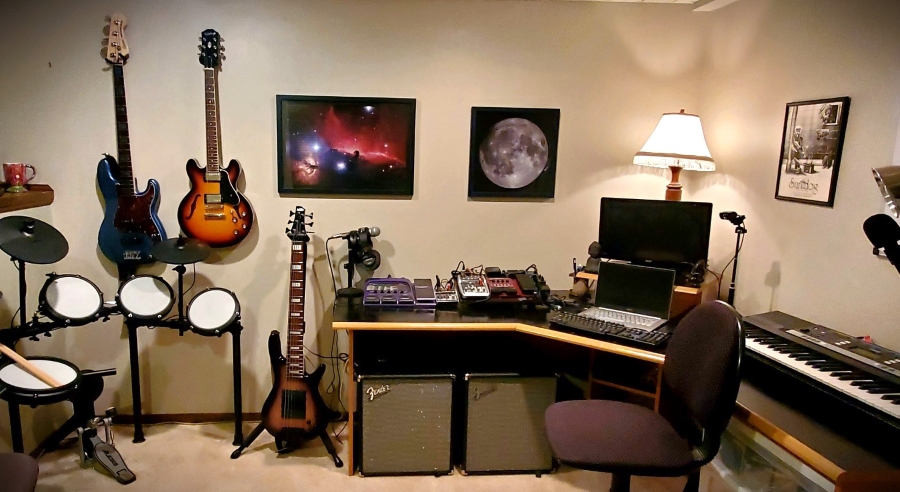
After I quit playing in bands and took time away from music, I decided to return to music, but this time with the idea that I would learn to play many instruments, because once again I wanted make music. I now spend most of my time in my music room writing and recording.

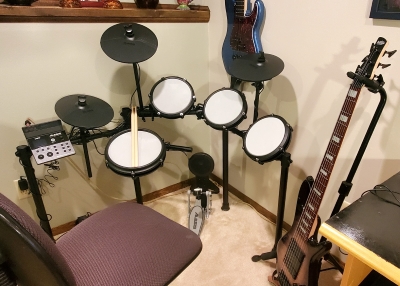
I wanted a drum set but I did not have space for an acoustic set, so I bought a cheap Alesis, "beginner" (Nitro MAX) e-kit. I had all the other instruments and the Alesis kit suited me just fine. The hardware is cheap but it gives me what I want/need when writing and recording...a drum set I can make music with. I know there are far better (quality and price) options, but I can make music with my cheapo Alesis kit and that's all that matters to me.

None of my instruments are high end, expensive models (be they guitar, bass, keys or drums) but like I learned when I was a child...I create music with what I have and even with what I have, it took a lot of patience in buying all my gear with which to play and record my music. On the rare occasion I gig, it's on bass anyway. In my studio I don't need anything else.

If I were a pro drummer, I'd want an acoustic kit, or a very high end e-kit. But I'm not, so what I have works for me.

Music-Room3.jpg


Alesis-Drum-Close-up.jpg
 
Last edited:
Yes, electric bass and acoustic bass are different instruments, but are essentially using the same science of a string vibrating to make noise - one vibrates a wooden top, the other vibrates a magnetic field.

Electronic drums are far more distantly related from an acoustic drum. An acoustic drum also uses vibrations - of a head and a shell, and the response of a drum is directly related to the force applied, and the sound will vary wildly based on that force.

Electronic drums have no connection to that science. It’s simply conversion of digital data to a triggered sound.

Again, there are places for them. But asking drummers who spend decades honing their craft to switch for the sake of volume erases all the work it took to learn how to control that volume. If it’s the only way to make a gig volume appropriate you’re dealing with drummers who never learned (or just don’t enjoy) how to minimize volume on an acoustic set. It can be done and it can be done without killing the vibe.


The piezo's are triggered off the vibration of the drum head, so harder strikes do translate into louder sound. I think a better analogy would be akin to a bassist playing with a limiter, versus without. The differences in plucking a string loud or soft are there, just not as much.
 
A lot of cover bands aspire to play as close to the recording as possible. Plenty of threads on TB arguing for and against.

I built my first IEM-based system around 1995. We used E-drums and had no instrument amps on stage. The system went up fast and reduced the total weight of our equipment by more the 75%. We started getting more job request due to our ability to keep the volume down. I frequently asked people what they thought of the sound. Most responses were favorable. The most negative response I got was, "You sound too much like a CD." I knew it was intended as sort of a slag, but high quality sound was actually one of my design goals ✅.

For clarification, I don't think everything needs to be played note for note, but I generally prefer for the sound to be as close to studio quality as possible. IMHO a loud concert that sounds awful sucks, regardless of how well the musicians perform! Happens way too often IME.
Yes of course, as I say, all depends on what kind of presentation you're going for. Obviously as a snobby musician, I'd rather hear a band, even a cover band, tailor the approach for the quieter setting as opposed to using stadium-sized sounds at dinner restaurant volume. Just always feels cringe to me. And I do believe audiences largely dig the more "real" presentation over the canned-sounding one, even if they can't identify the difference.
 
  • Like
Reactions: Wasnex
One of the working cover bands (30 to 40 gigs a year) I play in has been auditioning new drummers for the past few weeks. We narrowed an initial pool of 7 drummers down to the final 3. We've been holding auditions in a studio that has a house kit so the drummers don't need to bring anything other than sticks or, if they choose, can bring cymbals, snare or whatever they want. Most have brought their own cymbals but have used the house kit. One of the 3 finalists didn't bring anything and just used the house kit and house cymbals. He told us that he plays on an E-kit and no longer plays on an acoustic kit so warned us that he might be a bit loud since he's used to bashing his E-kit but being able to control the volume. We understood and while he was indeed a little on the loud side we were impressed with his playing. Once we determined he was to be one of the finalists we would ask back for a second round, we asked if he could bring his E-kit to the second round so that we could hear how things sound with his actual gear. He was happy to do so and we held those second round auditions last weekend.

The purpose of this thread is to ask about your experiences with E-kits. When we jammed with him using his E-kit, I was very "meh" about how it sounded. So much so that while I think he might be the most technically gifted of the 3 remaining drummers, our overall sound was...thin? I'm having a hard time coming up with the right adjective but to me our sound didn't have the weight and overall "oommph" that I'm used to. I especially had an issue with the high-hat and anytime he would try to do a pinched high-hat sound. It just sounded so artificial and not at all natural. My other bandmates all feel the same. So we offered the gig to one of the other guys but the whole thing got me wondering about E-kits in general and what some of you who have played with drummers using E-kits, think about them in live settings.
I’ve played with drummers the used E-kits, and pretty much agree with your assessment especially the hi hat as well as the cymbals in general. That said, in the FOH and properly mixed, sound a whole lot better than in a practice setting. One drummer used his real cymbals and hi hat and we were able to deal with getting them mixed in context.

My over all take is with a good FOH system, E-kits are really cool and a lot more flexible than a standard kit. Generally they don’t take as much space and easier to transport. If they sound a bit odd on stage, for me I find it’s not much different that going to IEM from a Live amp. It’s just something you deal to get the job done.

And finally, there are E-kits, and there are E-kits. There are good sounding ones and there are some that are really cheesy sounding. Quality matters.
 
  • Like
Reactions: DJ Bebop and Wasnex
My son worked sound for a band many years ago that was all IEM and had a drummer with a nice Roland kit. Since they were all IEM it sounded good to them. Because their PA had subs and such it sounded good to the audience as well. They did a lot of big wedding receptions and corporate events. Controlling the overall volume was critical, because of the bands' approach with the e-drums through their house system they got a lot of gigs.

I worked in a trio that had an e-drummer, another Roland kit. Nobody sang but the drummer had virtually a PA. He had two Yamaha 215 with horn columns, mixer and power amp to drive them. He would set the columns on either side of him at the back of the set. It sounded good like that. It was a lot of gear but sometimes I wouldn't bring a bass amp and would just plug into his drum PA. We would actually get a good mix that way 👍
 
Yes, electric bass and acoustic bass are different instruments, but are essentially using the same science of a string vibrating to make noise - one vibrates a wooden top, the other vibrates a magnetic field.

Electronic drums are far more distantly related from an acoustic drum. An acoustic drum also uses vibrations - of a head and a shell, and the response of a drum is directly related to the force applied, and the sound will vary wildly based on that force.

Electronic drums have no connection to that science. It’s simply conversion of digital data to a triggered sound.

Again, there are places for them. But asking drummers who spend decades honing their craft to switch for the sake of volume erases all the work it took to learn how to control that volume. If it’s the only way to make a gig volume appropriate you’re dealing with drummers who never learned (or just don’t enjoy) how to minimize volume on an acoustic set. It can be done and it can be done without killing the vibe.
In many ways bass guitar and upright fill different niches. There is a range of crossover where you might choose either and be fine with it. But there is also plenty of material where one would strongly favor one over the other. Just because you can play one of the well, does not mean your technique will translate to the other. In fact I use totally different fingering systems on bass guitar and upright. IMHO, the same logic is applicable to acoustic drums VS E-drums.

The distinction you are making about how the drum sounds are generated is irrelevant (IMHO). From a performance perspective, you strike a head or pad and you get a drum sound. Play two acoustic drums and you will likely need to adjust your technique in order to optimize performance. Play an acoustic drum and an E-drum and you will likely need to adjust your technique to optimize performance.

Additionally with E-drums you need gain new knowledge and additional skills in order to access and adjust different sounds, and tailor how they respond to touch. AFAIK modern E-drums have significant dynamic range---usually plenty for standard cover band repertoire. But you can't just plug up a E-drum set, play, and expect it to sound great. You have to dig into the interface and customize settings so it delivers the types of sounds you want and responds intuitively to your touch.

Asking a drummer to do something like play an E-kit should not be a problem. Either they agree to do it or they don't. If they don't agree, then they may loose the job opportunity. The choice is theirs so perhaps they shouldn't whine about it or poke fun of someone who is more open minded and receptive to trying new things. Believe or not, some drummers are actually interested in E-drums and enjoy using them...consider the drummer the OP did not hire. Someone else may snap that E-drummer up.

I do get it. There were times where I was asked to augment the percussion section rather than play bass and I hated it :rage:.

;)
 
  • Like
Reactions: DJ Bebop
Additionally, IME, E-drums can work really well in some musical settings and far less well in others. We actually made E-drums work for jazz combo. However we understood and accepted the compromises. The alternative would have been to bring amps and acoustic drums rather then simply doing the job, which was to play jazz background music during cocktail hour and dinner. I sometimes jokingly called this, "Music to be ignored to." The primary reason we were usually there was to provide either a feature show or dance music. Normally when the service was just for background music, we brought amps and acoustic drums rather than setting up a full PA.
Would bringing a snare, hihat, bass drum, and ride be that hard though even for a background gig? could even do it with less than that. the group would had sounded better and looked more legit for the client. Jazz on an E-kit is a non starter for me. i'd rather have no drummer at all on the gig.
 
In many ways bass guitar and upright fill different niches. There is a range of crossover where you might choose either and be fine with it. But there is also plenty of material where one would strongly favor one over the other. Just because you can play one of the well, does not mean your technique will translate to the other. In fact I use totally different fingering systems on bass guitar and upright. IMHO, the same logic is applicable to acoustic drums VS E-drums.

The distinction you are making about how the drum sounds are generated is irrelevant (IMHO). From a performance perspective, you strike a head or pad and you get a drum sound. Play two acoustic drums and you will likely need to adjust your technique in order to optimize performance. Play an acoustic drum and an E-drum and you will likely need to adjust your technique to optimize performance.

Additionally with E-drums you need gain new knowledge and additional skills in order to access and adjust different sounds, and tailor how they respond to touch. AFAIK modern E-drums have significant dynamic range---usually plenty for standard cover band repertoire. But you can't just plug up a E-drum set, play, and expect it to sound great. You have to dig into the interface and customize settings so it delivers the types of sounds you want and responds intuitively to your touch.

Asking a drummer to do something like play an E-kit should not be a problem. Either they agree to do it or they don't. If they don't agree, then they may loose the job opportunity. The choice is theirs so perhaps they shouldn't whine about it or poke fun of someone who is more open minded and receptive to trying new things. Believe or not, some drummers are actually interested in E-drums and enjoy using them...consider the drummer the OP did not hire. Someone else may snap that E-drummer up.

I do get it. There were times where I was asked to augment the percussion section rather than play bass and I hated it :rage:.

;)
In my neck of the woods (metro NY/NJ) I have never seen an electronic drumset live. I did a gig with someone who had one about 15 years ago and it was pretty lackluster. I don’t think people around here are losing gigs to e-drummers. I suspect when drummers show up to audition saying they only play e-drums, like the OP, they’re losing gigs because bands around here want real drums.

Oh, I do recall a north Jersey country band asked me to audition on e-drums and then said they use them for gigs. I declined to audition and I’ve seen them looking for drummers on and off for two years. There could be a ton of reasons why but I wouldn’t be surprised if being forced to play on e-drums is a factor.
 
  • Like
Reactions: Wasnex
@Core Creek

A bit of background on my experience with E-drums

Back around 1994 I was asked to build a system that would facilitate a 5-piece cover band traveling in a C21:

1770851160809.png

There is not enough room in this plane for a decent acoustic drum set. Some sort of nesting kit might work. But IME serious drummers tend to hate nesting kits as well.

The drummer in the band at the time proposed some sort of suit that you wore that had pads you played with your hands. He also proposed something like this:
1770852770408.png

:facepalm:

My impression is he made what I considered "unserious" suggestions in order to increase the chances that he would be able to play his regular drums most of time.

I rejected these idea as I thought it was important to have something that any drummer could understand and play more like real drums, even if they hated it.

The solution I chose:
1770851375968.png

A big part of my decision was due to how quickly the TrapKat can be set up and how compact it was when packed.


The original drummer wanted to send me a single stereo mix and control everything through the user interfaces of the TrapKat and Roland TD-7 sound module. The first tour did not go well because the drums sounded awful and were out of balance. I did what I could to help him make the adjustments, but everyone in the band was complaining, including the drummer. Eventually I told the drummer to STFU because it went exactly as I predicted and it could have been avoided if he would have allowed me to break the sounds out in a sensible way from the beginning.

When we got back I rewired the system to break the individual instruments out as much as possible. We still used one stereo mix because the mixer only had 16 channels. I think I had cymbals panned across the stereo mix. Bass drum, high hat, snare, and the toms had dedicated channels on the mixer. This set up worked way better, especially after I helped the drummer dial in some of the MIDI parameters so the sounds responded more intuitively.

After that, the original drummer made do and tolerated the TrapKat. However I suspect it may have been a factor in why he left the group. In particular one of the things he repeatedly brought up was the potential for repetitive stress injury from playing on pads. I acknowledged his concern and suggested that he use a light touch.

The second drummer loved the TrapKat and had a lot of fun with it. I had to teach him a bit about MIDI and how to access and adjust various menus. One of the things he really liked was that setup and tear down only took about 5 minutes. When he played real drums we frequently had to wait for him to finish tearing down, because he would wind up talking to audience members.

Audiences loved the TrapKat. They thought it sounded good and were curious about it. We had many top-brass military officials and high-level dignitaries from different nations come up after shows to discuss. We frequently invited them sit down and play around on the TrapKat a bit, and they had a blast. I don't ever remember DVs showing that sort of interest in real drums, but they seemed irresistibly drawn to the novelty of the TrapKat.


Problems:

The TrapKat did not do well outdoors in direct sunlight. The pad surfaces would get noticeably loose and cause problems with triggering.

On occasion part of the system would lock up and need the firmware to be reset, meaning all of the presets and MIDI parameters had to be dialed back in. This led to some stressful moments but never delayed the start any shows.

As mentioned previously, some audience members said we sounded too much like a CD.
 
Last edited:
As someone with a cheap e-kit, the thing I agree with most in this thread is that cheap e-kits suck for anything more than the most rudimentary practice. The high-hat is usually the worst offender and hardest to get right, but knowing that I'd have to invest quite a bit of $$ to get a better kit keeps me from taking the leap and learning drums. Which is a shame, since I kinda prefer drumming. An acoustic kit is out of the question for various reasons, though I have pondered used shells with a quiet kit setup like the Evans Db One.
 
  • Like
Reactions: Wasnex