• TalkBass has been independent since 1998. Add your voice.
    Create a free account to reply to discussions, view embedded media, and browse with fewer display ads.
    Join freeLog in
    Want zero display ads or expanded classifieds tools? Compare plans.

Double Bass Azola EUBs Megathread

I did some recording last night and it really does sound Fantastic. I might consider some thumper strings (might try those other ones you sent me) because I'm finding the G string a bit too thin sounding. It could be improved with raising the action... but the E and A are pretty nice where they are and I will likely have to trim a bridge foot and tilt the neck. OR I could just carve new a new bridge for it. I read somewhere a post by Francois where he's indicated an improvement in tone (Bass-max) with the use of a real DB bridge w/ feet cut down. I'll try new strings first and see how it goes.

One more thing... I'm getting a loud rattle/buzz from the headstock on the open G. I tightened all the screws etc but I sounds like it's coming right from the tuner on the G. Any suggestions? I'm hoping it will resolve itself after I re-string it.
 
I did some recording last night and it really does sound Fantastic. I might consider some thumper strings (might try those other ones you sent me) because I'm finding the G string a bit too thin sounding. It could be improved with raising the action... but the E and A are pretty nice where they are and I will likely have to trim a bridge foot and tilt the neck. OR I could just carve new a new bridge for it. I read somewhere a post by Francois where he's indicated an improvement in tone (Bass-max) with the use of a real DB bridge w/ feet cut down. I'll try new strings first and see how it goes.

One more thing... I'm getting a loud rattle/buzz from the headstock on the open G. I tightened all the screws etc but I sounds like it's coming right from the tuner on the G. Any suggestions? I'm hoping it will resolve itself after I re-string it.

I think I have the action set at 6-7 mm between the strings and the FB, at the end of the FB. I'd recommend lowering the neck angle. To do so loosen the tension on the strings and turn the neck shim screw 1/8 turn counter clockwise. I'm not sure if trimming the bridge is a great idea. As for your buzz noise.... There are allen head set screws at the base of each tuner. They will loosen up on occasion..... That is considered normal. You might want to keep an allen wrench in your gig bag for such occurrences. Let me know if the buzz still remains.
 
:)
Here's the result on my Carruthers.
EUB_004.jpg
 
The pickup in the TC video is the same as on my Bugbass. I think toward the end Steve was using some kind of proprietary pickup which was built inside the bridge. I wonder if anyone else knows about this. It sounds great. Way better than the Bassmax, in my opinion.


I'd like to know more about this! can you post a pic of yours? I'm all for upgrading mine wherever possible.
 
View attachment 702339 View attachment 702340
Here is the current configuration. Note the small gap between the bridge foot and the diaphragm on the fingerboard side of the bridge. That used to bug me, because it suggested the full signal was not getting picked up by the passive pickups [.....]
The original Azola bridge has metal washers glued under the feet, presumably to get metal-to-metal contact with the pickup, like the old Ampeg bridge. Your bridge looks different, but the glue blobs show that it too used to have these rings.

See the first picture in this thread about KK basses
KK Baby Basses; Hot Rodding The Pickups
 
Last edited:
  • Like
Reactions: jesperhansen
A piece of wire has less resistance--- theoretcally zero.
The pickup is the load on the input stage of the next device it's plugged into ( probably the preamp)
Ideally Zero, not theoretically (as long as theory does it's job well).

Francois is right, the load is in the input stage of the preamp (separately or as a first stage of a power amplifier). The piezo needs to deliver enough current for this load, but if the load is too high (the same as when the impedance is too low), it cannot deliver the current for the load and the voltage delivered drops to be able to deliver the current so that it fits to the load (Ohms law).
A piezo acts like a variable voltage source with a capacitor in series. If the capacitor is fully loaded, no current goes through it unless it gets unloaded a bit.
 
  • Like
Reactions: Francois Blais
Ideally Zero, not theoretically (as long as theory does it's job well).

Francois is right, the load is in the input stage of the preamp (separately or as a first stage of a power amplifier). The piezo needs to deliver enough current for this load, but if the load is too high (the same as when the impedance is too low), it cannot deliver the current for the load and the voltage delivered drops to be able to deliver the current so that it fits to the load (Ohms law).
A piezo acts like a variable voltage source with a capacitor in series. If the capacitor is fully loaded, no current goes through it unless it gets unloaded a bit.

So the pot was limiting the current, no loading taking place.
 
The pot wants more current than the piezo can deliver, so the voltage breaks down which changes the waveform. It does not happen around zero but the more the higher the amplitude gets. That also means if it sounds good if you play the bass softly it might get worse if you play your instrument louder.

The limiting factor is the characteristic of the piezo and so you have to adapt the following electronic circuit for a high impedance to keep the current low.

Pots with a resistance in the MegOhm range are not made and don't make sense, since they would be very sensible to electric noise. So do the current stabilization (with the impedance buffer) first and then throw in the volume pot after the loadable signal from the impedance buffer.
 
  • Like
Reactions: Francois Blais
he spiros came off my upright where they had been played on a daily basis for over a year.

The pickup may have something to do with it. The bug I have now is borrowed and is an older model with the metal plate under the bridge. I just bought one which is on its way to me. This one is a newer model with no metal plate and the pickup looks slightly different. I was assuming they would sound about the same but I should probably wait to hear the new one.

I am interested to hear what stings others are using on this bass.
Invalid Link Removed
Magento 2 Social Login Extension
 
Last edited:
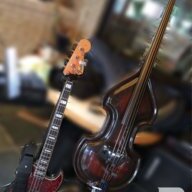
Hey all, I was noticing in this picture that the overall length of the Lightning Bug is pretty similar to the Bugbass II. Has anyone had both of these? It looks like the main difference is the slightly shorter string length and the smaller body size to fit in the case, but I'm wondering if the regular Bugbass would fit in the SKB rifle case he used for the Lightning?
12313807_1022927421098441_7884874980752031684_n.jpg