

Enjoy the benefits of a premium membership!
Upgrade Account
-
TalkBass has been independent since 1998. Add your voice.
Create a free account to reply to discussions, view embedded media, and browse with fewer display ads.
Join free Log in
Want zero display ads or expanded classifieds tools? Compare plans.
You are using an out of date browser. It may not display this or other websites correctly.
You should upgrade or use an alternative browser.
You should upgrade or use an alternative browser.
Double Bass Baby Bass megathread
- Thread starter nil
- Start date
More options
Who Replied?

Did you adjust your pickup heights? That's usually the cause for low volume (and poor sound). Still, the volume tends to be a bit lower than an electric bass.
I didn’t know how to do that! Thanks so much, that seems to have fixed both issues I was having in terms of sound.
Nobody I know uses the tone up at all all on diaphram pickup baby basses. They sound horrible unless that high end is attenuated.
Thanks, but I wasn’t clear. It was sounding terrible if I turned up just a little (anything but all the way down), but it’s better now.
I didn’t know how to do that! Thanks so much, that seems to have fixed both issues I was having in terms of sound.
How did you, or how do you adjust the height of the pick up on this bass?
@Ed Serrano sorry, I just saw this. The screws on the side of the bridge adjust the height/tone.

Hello everyone,
is there a way to make my baby bass sustain less? I own a KK baby bass which has a rather long sustain which normally is a good thing but also I've got some criticism from one band leader who prefers a more traditional sound. The KK baby bass has a wooden bridge and I was told that the wooden bridge is the reason for the sustain being longer than what it normally would it be on a baby bass.
I could probably get a metal bridge but I thought maybe there's another way to mute it, like people would mute an electric bass to shorten the sustain.
is there a way to make my baby bass sustain less? I own a KK baby bass which has a rather long sustain which normally is a good thing but also I've got some criticism from one band leader who prefers a more traditional sound. The KK baby bass has a wooden bridge and I was told that the wooden bridge is the reason for the sustain being longer than what it normally would it be on a baby bass.
I could probably get a metal bridge but I thought maybe there's another way to mute it, like people would mute an electric bass to shorten the sustain.

It’s not the wooden bridge but the membrane pickups that shorten the sustain. With a metal bridge you get a brighter sound and more sustain.


....."I can imagine that folks playing Latin music styles like Salsa or Merengue, who might use a Baby Bass to get "that percussive, thumpy sound," should find the Ninomute very effective".....
Not sure about the Baby Bass, it already sounds like that by default. My bridge was made by Steve Azola from Hard Rock Maple, (lost the aluminum one back in the 90s). It still thumps quite nicely.
Brilliant, thanks!
I see, so a metal bridge is the opposite of what I need. Thanks for the info.It’s not the wooden bridge but the membrane pickups that shorten the sustain. With a metal bridge you get a brighter sound and more sustain.
Would something like this work as well?
https://www.thomann.de/de/artino_pm_01_practice_mute_vn_va.htm?gad_source=1
https://www.thomann.de/de/artino_pm_01_practice_mute_vn_va.htm?gad_source=1

No need to buy a mute, you can just wedge foam between the bridge and the bridge guard (I just moved my afterlength mute for an example).
Different sizes and densities will vary the muting. If your string height is low the bass will naturally sustain more.
Yes, as long as you have a bridge guard on your BB, and the guard is right above the bridge.No need to buy a mute, you can just wedge foam between the bridge and the bridge guard (I just moved my afterlength mute for an example).
Different sizes and densities will vary the muting. If your string height is low the bass will naturally sustain more.
That mute seems to be for violins and violas.Would something like this work as well?
https://www.thomann.de/de/artino_pm_01_practice_mute_vn_va.htm?gad_source=1
For a cheap test, you could try:
https://www.thomann.de/intl/gewa_mute_tourte_double_bass.htm
Maybe that'd be enough for your need.
As far as I know that big rubber mute makes it harder to move the bridge, but then the vibration is reflected more into the string, making the sustain longer and the overall volume radiating from the top is reduced in general.
Mutes that damp the string vibration (Like the Ninomute or the foam on the vibrating part of the string) reduce the high frequency content, so the sound is changed, but the lower frequency content is almost unchanged. It gives the impression of a quieter sound, but mainly it is only softer n sound and sustains almost as long as without a mute.
It is always possible to stop the note earlier by hand, either lifting the left hand finger or muting an open string with the right hand. Doesn’t sound exactly the same, but hardly audible in a band context. Damped orchestra strings help to get closer to that sound too instead of using Spirocore.
Mutes that damp the string vibration (Like the Ninomute or the foam on the vibrating part of the string) reduce the high frequency content, so the sound is changed, but the lower frequency content is almost unchanged. It gives the impression of a quieter sound, but mainly it is only softer n sound and sustains almost as long as without a mute.
It is always possible to stop the note earlier by hand, either lifting the left hand finger or muting an open string with the right hand. Doesn’t sound exactly the same, but hardly audible in a band context. Damped orchestra strings help to get closer to that sound too instead of using Spirocore.
You are correct. I should not have assumed his KK is the same as my KK.Yes, as long as you have a bridge guard on your BB, and the guard is right above the bridge.
DoubleMIDI is right that technique is a large part of the sound. Setup also makes a big difference.
On my KK I was able to find a sweet spot by adjusting the neck angle and the tailpiece pressure.
If your strings are too low you will not get a good thump. With the strings higher the sound envelope changes and the initial thump will be more prominent than the sustained sound.
As far as strings, it depends how traditional you want to get.
The original Ampeg Baby Bass came with gut strings with gauges of 39, 45,47, 56.
The strings that shipped with my KK were not so great. Installing Spirocore solo gauge made a big improvement. I think these are the strings most commonly used on baby basses now.
I had Spirocore Solos put on my bass as well. One question: can I regulate the tailpiece pressure myself or is that something that I should let a luthier do? How much pressure I should e looking for and how do I measure it?You are correct. I should not have assumed his KK is the same as my KK.
DoubleMIDI is right that technique is a large part of the sound. Setup also makes a big difference.
On my KK I was able to find a sweet spot by adjusting the neck angle and the tailpiece pressure.
If your strings are too low you will not get a good thump. With the strings higher the sound envelope changes and the initial thump will be more prominent than the sustained sound.
As far as strings, it depends how traditional you want to get.
The original Ampeg Baby Bass came with gut strings with gauges of 39, 45,47, 56.
The strings that shipped with my KK were not so great. Installing Spirocore solo gauge made a big improvement. I think these are the strings most commonly used on baby basses now.
What do you mean by tailpiece pressure?
There is only lengthwise tension on both sides of the tailpiece.
The only pressure is on the bridge/top and that depends on string tension and string angle at the bridge.
Pressure goes down when the strings are more straight at the bridge and that can be made by a raised saddle. But I don’t know how easy that could be installed on a baby bass.
There is only lengthwise tension on both sides of the tailpiece.
The only pressure is on the bridge/top and that depends on string tension and string angle at the bridge.
Pressure goes down when the strings are more straight at the bridge and that can be made by a raised saddle. But I don’t know how easy that could be installed on a baby bass.
There is an adjustment available where the tailpiece attaches to the instrument. The instructions are from the old Ampeg manual but will show how it works. The bridge is fixed in height and position but by adjusting the string angle on both sides of the bridge I found my ideal setup.
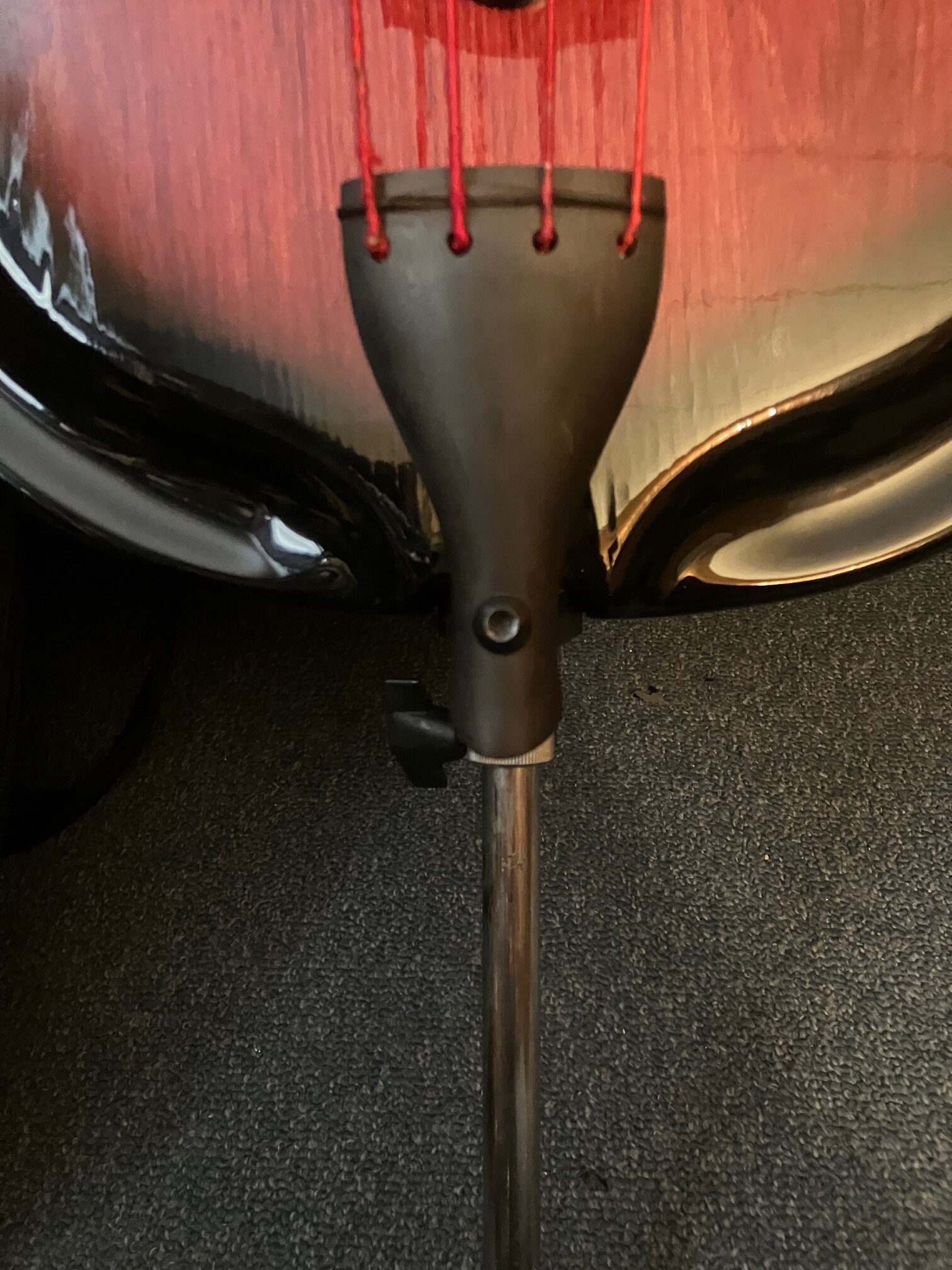
Attachments
Last edited:


