

Enjoy the benefits of a premium membership!
Upgrade Account
-
TalkBass has been independent since 1998. Add your voice.
Create a free account to reply to discussions, view embedded media, and browse with fewer display ads.
Join free Log in
Want zero display ads or expanded classifieds tools? Compare plans.
You are using an out of date browser. It may not display this or other websites correctly.
You should upgrade or use an alternative browser.
You should upgrade or use an alternative browser.
Bass DI for both active and passive basses
- Thread starter FunWithBass
- Start date
More options
Who Replied?

At church use Radial JDI with both, passive and active basses. Works great.
As others already mentioned, JDI is a passive DI that does not require power supply. The J48 is an active DI that require power supply via phantom power.
Radial J48 vs. JDI?
Here is a very nice discussion of the active versus passive DI issues (the J48 and JDI are top of the heap in each of these categories IMO), posted by Genz Benz engineer Agedhorse (in a recent thread discussing the general issues of active versus passive DI's.
Either can work very nicely. If you have a passive bass, in general, the active J48 has the edge. If you have an active bass (i.e., a bass with either active pickups and/or an on-board preamp), in general a passive DI like the JDI has some advantages.
*************
Here's a few rule of thumb tidbits that affect DI use and how to get better performance from such...
1. Generally, a passive bass will benefit from an active DI. The reason is the output impedance of a passive pickup is fairly highy (anywhere frfom 2k to 10k) and when combined with the typical input impedance of a passive DI (from 10k to 50k) can result in loading down of the pickups. The practical results of this are lower output from the instrument, and since a transformer is not a pure resistive load (there's a lot of inductance) this will interact with the pickups leading to a different frequency response. An active DI has a much higher input impedance which results in less interaction (for better or for worse). A passive DI works by transforming the impedance, along with this transform the voltage steps down and the current steps up in accordance to Ohm's law.
2. Still, a passive DI amy work with a pasive bass juust fine and MAY even product a "better" sound for some players in some situations. Definately worth a try before dismissing it outright.
3. An active bass (most) have low output impedances, and also have the "same" active electronics driving the output that an active DI has. An active DI typically has active electronics driving the primary winding of a passive transformer, often the same transformer that's in a passive DI. So an active DI will usually drive a passive DI with no problems.
4. An active bass with an active DI will work ok BUT you pay a penalty in noise floor because you have an added stage of electronics in line and the high impedance input is going to be a little noisier. There's also greater potential for RFI noise. Generally not my favorite way to go, but as I am famous for saying... "it depends".
5. An active DI that's designed into a quality amp may be one of two different topologies. Both types are designed knowing the internal grounding scheme of their associated amps, and generally work quite well driving long lines with a minimum loss of fidelity.
6. The best isolation is with a passive DI. All phantom powered active DI's, by the nature of being powered by the console, suffer a bit from isolation. Fully isolating means that phantom power is lost. The exception to this is the battery powered option of the Countryman 85, which is one reason this DI is a favorite (if that's your flavor of course).
__________________
Engineer: Genz Benz
As others already mentioned, JDI is a passive DI that does not require power supply. The J48 is an active DI that require power supply via phantom power.
Radial J48 vs. JDI?
Here is a very nice discussion of the active versus passive DI issues (the J48 and JDI are top of the heap in each of these categories IMO), posted by Genz Benz engineer Agedhorse (in a recent thread discussing the general issues of active versus passive DI's.
Either can work very nicely. If you have a passive bass, in general, the active J48 has the edge. If you have an active bass (i.e., a bass with either active pickups and/or an on-board preamp), in general a passive DI like the JDI has some advantages.
*************
Here's a few rule of thumb tidbits that affect DI use and how to get better performance from such...
1. Generally, a passive bass will benefit from an active DI. The reason is the output impedance of a passive pickup is fairly highy (anywhere frfom 2k to 10k) and when combined with the typical input impedance of a passive DI (from 10k to 50k) can result in loading down of the pickups. The practical results of this are lower output from the instrument, and since a transformer is not a pure resistive load (there's a lot of inductance) this will interact with the pickups leading to a different frequency response. An active DI has a much higher input impedance which results in less interaction (for better or for worse). A passive DI works by transforming the impedance, along with this transform the voltage steps down and the current steps up in accordance to Ohm's law.
2. Still, a passive DI amy work with a pasive bass juust fine and MAY even product a "better" sound for some players in some situations. Definately worth a try before dismissing it outright.
3. An active bass (most) have low output impedances, and also have the "same" active electronics driving the output that an active DI has. An active DI typically has active electronics driving the primary winding of a passive transformer, often the same transformer that's in a passive DI. So an active DI will usually drive a passive DI with no problems.
4. An active bass with an active DI will work ok BUT you pay a penalty in noise floor because you have an added stage of electronics in line and the high impedance input is going to be a little noisier. There's also greater potential for RFI noise. Generally not my favorite way to go, but as I am famous for saying... "it depends".
5. An active DI that's designed into a quality amp may be one of two different topologies. Both types are designed knowing the internal grounding scheme of their associated amps, and generally work quite well driving long lines with a minimum loss of fidelity.
6. The best isolation is with a passive DI. All phantom powered active DI's, by the nature of being powered by the console, suffer a bit from isolation. Fully isolating means that phantom power is lost. The exception to this is the battery powered option of the Countryman 85, which is one reason this DI is a favorite (if that's your flavor of course).
__________________
Engineer: Genz Benz

Roland GR 88
Commercial User
I vote JDI. It's simple, bombproof and has a few tricks up its sleeve. I use it for active & passive basses, piezo equipped acoustics and I like putting it between the head and speaker when recording tube amps.
Plus, they're made in Canada
Plus, they're made in Canada

If you still need EQ control/tone shaping, then get any stomp box style preamp/DI that you like - ie. tonehammer, sansamp, etc.
If you just need a plain DI, then I would recommend a countryman or radial for the best bang for your buck.
If you just need a plain DI, then I would recommend a countryman or radial for the best bang for your buck.


Amp as DI:
As far as I know, no current class D head requires a cab connected in order to use the XLR out as a DI. Aguilar TH350/500, Ampeg, Darkglass 900, G-K MB200/500/800 or MBFusion500/800, Mesa Subway, TC Electronic, etc.
If you already have any of the above, they can save you buying an extra and unnecessary piece of gear.
OTOH, if you have a specific need for a straight DI, or want one as a gig bag backup, I would consider almost all of those heads to be excessively large and expensive for the purpose.
The one standout that deserves consideration as a gigbag multi-tool is the MB200. Inexpensive, reliable, great EQ w/pre-post switch, lots of gain, capable of driving just about any cab at reasonable levels, active/passive switch, power amp input, etc. Best of all, there are active DI's that are larger!
Bass Preamp/DI:
Safest bets: The new Sansamp BDDI v2 with the mid control, the Mesa Subway preamp-DI and the Sadowsky are all rugged and simple, with great tone-shaping options and sounds that should please just about any bassist. The Mesa and Sansamp are better choices if overdriven sounds are a requirement. The Sadowsky leans toward modern, active tones, the Sansamp sits in the middle, and the Subway is a little more dark and old-school.
All three are simple to use, and have great-sounding DI outputs, a cut above the good-but-not-stellar DI in the G-K heads.
Pedalboard replacements: If you're looking for lots of features, the Zoom B3, Sansamp Bass Fly rig and the new G-K Plex preamp offer interesting extras, but they have a steep learning curve as a result. Ditto for the Radial Tonebone series and the EBS Microbass, Sheehan and Valvedrive pedals. The Zoom has the most effects, but the audio quality isn't as good as the others.
The Aguilar Tone Hammer is another tricky pedal to recommend, as it's quite coloured. People tend to love it or hate it. Another consideration with the more complex pedals is that early adopters of the G-K and BFR have been posting mixed reviews, and there have been noise and reliability issues reported by some users.
If the device is going to be shared by multiple bassists, and all I needed was a good bass DI, I would definitely stick with the Mesa, Sadowsky or Mesa.
Passive DI:
Let's face it- a lot of recorded bass tracks don't involve a bass amp. Give a bass player speaker emulation, tone or gain controls (from an amp head or a bass preamp), and quite often they'll actually make life harder for the folks at FOH.
Simple is good, and the Radial JDI is a bomb-proof industry standard. If you're a tone-weenie, you will find that it sounds noticeably better than more affordable passive DI's (including Radial's excellent Pro DI series), and it's more hi-fi than all but the very best active DI's. Distortion, noise, etc. are extremely close to a straight piece of wire. Because of the lower impedance compared to an active DI, it will round and darken the sound of passive basses very slightly, but in a way that sounds great.
One of the pluses of a passive DI, is that it is always there for you. Aside from leaving the pad or ground switches in the wrong setting, it's idiot and calamity-proof. It will work fine when phantom power is unavailable. This happens surprisingly often on the road- a lot of analog consoles don't like having active mics or DI's hot-swapped without turning off the 48V first.
Active DI:
OTOH, a really good active DI can sometimes preserve signal quality with oddball, difficult sources. Usually, this implies an acoustic instrument with piezo pickups but no internal preamp. If you want to reserve the last bit of fidelity in the sub frequencies with extended range basses or keyboards, an active DI is often recommended, although in most cases FOH will roll that stuff off anyway...
As long as there's a good passive box like the JDI hanging around as a failsafe, an active DI is a nice thing to have in your arsenal.
The Countryman 85 is an industry standard, and surprisingly, it's a few bucks cheaper than the JDI. But for the extra $20, I personally prefer the Radial J48. In fact, it's the cheapest active DI that I would recommend.
The Radial JDV or Firefly are a step up from the J48, but they're pretty expensive.
If you've got more than $200 USD to work with, the sleeper in an active DI these days is the Neve RNDI. No effects or extras, but the phantom-only RNDI is showing up at recording sessions as well as on stage, and at well under $300 USD, it's a steal compared to more expenses boxes.
Although the fidelity of the JDI and the Neve are pretty much as perfect as you can get, sometimes you want a "colour box". I would put the REDDI and Avalon in that category, but TBH, any "magic" they provide is extremely subtle. Unless you're a recording studio owner or playing stadiums, I don't see the point from a sound, price or portability standpoint.
As far as I know, no current class D head requires a cab connected in order to use the XLR out as a DI. Aguilar TH350/500, Ampeg, Darkglass 900, G-K MB200/500/800 or MBFusion500/800, Mesa Subway, TC Electronic, etc.
If you already have any of the above, they can save you buying an extra and unnecessary piece of gear.
OTOH, if you have a specific need for a straight DI, or want one as a gig bag backup, I would consider almost all of those heads to be excessively large and expensive for the purpose.
The one standout that deserves consideration as a gigbag multi-tool is the MB200. Inexpensive, reliable, great EQ w/pre-post switch, lots of gain, capable of driving just about any cab at reasonable levels, active/passive switch, power amp input, etc. Best of all, there are active DI's that are larger!
Bass Preamp/DI:
Safest bets: The new Sansamp BDDI v2 with the mid control, the Mesa Subway preamp-DI and the Sadowsky are all rugged and simple, with great tone-shaping options and sounds that should please just about any bassist. The Mesa and Sansamp are better choices if overdriven sounds are a requirement. The Sadowsky leans toward modern, active tones, the Sansamp sits in the middle, and the Subway is a little more dark and old-school.
All three are simple to use, and have great-sounding DI outputs, a cut above the good-but-not-stellar DI in the G-K heads.
Pedalboard replacements: If you're looking for lots of features, the Zoom B3, Sansamp Bass Fly rig and the new G-K Plex preamp offer interesting extras, but they have a steep learning curve as a result. Ditto for the Radial Tonebone series and the EBS Microbass, Sheehan and Valvedrive pedals. The Zoom has the most effects, but the audio quality isn't as good as the others.
The Aguilar Tone Hammer is another tricky pedal to recommend, as it's quite coloured. People tend to love it or hate it. Another consideration with the more complex pedals is that early adopters of the G-K and BFR have been posting mixed reviews, and there have been noise and reliability issues reported by some users.
If the device is going to be shared by multiple bassists, and all I needed was a good bass DI, I would definitely stick with the Mesa, Sadowsky or Mesa.
Passive DI:
Let's face it- a lot of recorded bass tracks don't involve a bass amp. Give a bass player speaker emulation, tone or gain controls (from an amp head or a bass preamp), and quite often they'll actually make life harder for the folks at FOH.
Simple is good, and the Radial JDI is a bomb-proof industry standard. If you're a tone-weenie, you will find that it sounds noticeably better than more affordable passive DI's (including Radial's excellent Pro DI series), and it's more hi-fi than all but the very best active DI's. Distortion, noise, etc. are extremely close to a straight piece of wire. Because of the lower impedance compared to an active DI, it will round and darken the sound of passive basses very slightly, but in a way that sounds great.
One of the pluses of a passive DI, is that it is always there for you. Aside from leaving the pad or ground switches in the wrong setting, it's idiot and calamity-proof. It will work fine when phantom power is unavailable. This happens surprisingly often on the road- a lot of analog consoles don't like having active mics or DI's hot-swapped without turning off the 48V first.
Active DI:
OTOH, a really good active DI can sometimes preserve signal quality with oddball, difficult sources. Usually, this implies an acoustic instrument with piezo pickups but no internal preamp. If you want to reserve the last bit of fidelity in the sub frequencies with extended range basses or keyboards, an active DI is often recommended, although in most cases FOH will roll that stuff off anyway...
As long as there's a good passive box like the JDI hanging around as a failsafe, an active DI is a nice thing to have in your arsenal.
The Countryman 85 is an industry standard, and surprisingly, it's a few bucks cheaper than the JDI. But for the extra $20, I personally prefer the Radial J48. In fact, it's the cheapest active DI that I would recommend.
The Radial JDV or Firefly are a step up from the J48, but they're pretty expensive.
If you've got more than $200 USD to work with, the sleeper in an active DI these days is the Neve RNDI. No effects or extras, but the phantom-only RNDI is showing up at recording sessions as well as on stage, and at well under $300 USD, it's a steal compared to more expenses boxes.
Although the fidelity of the JDI and the Neve are pretty much as perfect as you can get, sometimes you want a "colour box". I would put the REDDI and Avalon in that category, but TBH, any "magic" they provide is extremely subtle. Unless you're a recording studio owner or playing stadiums, I don't see the point from a sound, price or portability standpoint.
Last edited:
If you're looking for something very transparent, the MXR M81 is a solid choice. I switch between that and my Sansamp PDDI, although I haven't craved the MXR tone in a while. Still a rockin good DI and lives in my gig bag, just in case...
Doner Designs
Steve Doner
- Jun 2, 2012
- 5,784
- 6,819
- Disclosures
- Doner Designs is an alias for Steve Doner
One other thing to note on active vs passive - if you use a pedalboard or ANY device that can add a touch of gain in front of a passive DI box there is no longer any reason to use an active DI box. A low output passive bass going straight to a passive DI and with a long cable run can result in a weak signal which I think is the reason you hear the rule of thumb about passive box for active bass and vice-versa. Like all rules of thumb, you don't need to follow it if you know what you are doing.
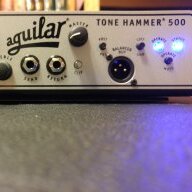
I will check that out. I must of overlooked that part. Thanks!You can run the TH500 without a speaker. It specifically mentions it in the manual. See the top paragraph on page 4 of the manual..

I am fairly certain you can use your TH500 as a DI, and it is built around the Tone Hammer DI preamp, so soundwise it should be the same as the DI pedal. Using the pedal myself, loving it!
Review of the Aguilar Tone Hammer 500 and DB212
Review of the Aguilar Tone Hammer 500 and DB212

Lots of suggestions....but....why does the WL want a different DI, what is he trying to achieve?
A radial JDI works OK, but a J48 will give you more level. As a FOH guy, I've worked with both, and either is fine (I own both), but if I get the choice, it's the J48. I just feel more secure not having to add a lot of gain that the JDI requires.
Ever tried the Cable Factory passive DI? It is based on the excellent Lundahl transformers. Info here: Link Removed
For a thousand reasons I love my Link Removed best, but I do also love my ART Pro Audio because the USB option is great for going straight to PC or Mac with no special drivers needed.



I don't believe I can run the head without a cab (like my GK will do), at least the TH500 manual doesn't mention that option.
Yes, you can. It's a class D head, so no problem.

My church uses either a Radial JDI, ToneHammer, or Rupert Neve DI.
If your church has the budget, get the Neve.
If not, the ToneHammer's pretty good.
If your church has the budget, get the Neve.
If not, the ToneHammer's pretty good.
Thank you for all that detailed information!At church use Radial JDI with both, passive and active basses. Works great.
As others already mentioned, JDI is a passive DI that does not require power supply. The J48 is an active DI that require power supply via phantom power.
Radial J48 vs. JDI?
Here is a very nice discussion of the active versus passive DI issues (the J48 and JDI are top of the heap in each of these categories IMO), posted by Genz Benz engineer Agedhorse (in a recent thread discussing the general issues of active versus passive DI's.
Either can work very nicely. If you have a passive bass, in general, the active J48 has the edge. If you have an active bass (i.e., a bass with either active pickups and/or an on-board preamp), in general a passive DI like the JDI has some advantages.
*************
Here's a few rule of thumb tidbits that affect DI use and how to get better performance from such...
1. Generally, a passive bass will benefit from an active DI. The reason is the output impedance of a passive pickup is fairly highy (anywhere frfom 2k to 10k) and when combined with the typical input impedance of a passive DI (from 10k to 50k) can result in loading down of the pickups. The practical results of this are lower output from the instrument, and since a transformer is not a pure resistive load (there's a lot of inductance) this will interact with the pickups leading to a different frequency response. An active DI has a much higher input impedance which results in less interaction (for better or for worse). A passive DI works by transforming the impedance, along with this transform the voltage steps down and the current steps up in accordance to Ohm's law.
2. Still, a passive DI amy work with a pasive bass juust fine and MAY even product a "better" sound for some players in some situations. Definately worth a try before dismissing it outright.
3. An active bass (most) have low output impedances, and also have the "same" active electronics driving the output that an active DI has. An active DI typically has active electronics driving the primary winding of a passive transformer, often the same transformer that's in a passive DI. So an active DI will usually drive a passive DI with no problems.
4. An active bass with an active DI will work ok BUT you pay a penalty in noise floor because you have an added stage of electronics in line and the high impedance input is going to be a little noisier. There's also greater potential for RFI noise. Generally not my favorite way to go, but as I am famous for saying... "it depends".
5. An active DI that's designed into a quality amp may be one of two different topologies. Both types are designed knowing the internal grounding scheme of their associated amps, and generally work quite well driving long lines with a minimum loss of fidelity.
6. The best isolation is with a passive DI. All phantom powered active DI's, by the nature of being powered by the console, suffer a bit from isolation. Fully isolating means that phantom power is lost. The exception to this is the battery powered option of the Countryman 85, which is one reason this DI is a favorite (if that's your flavor of course).
__________________
Engineer: Genz Benz

Ever tried the Cable Factory passive DI? It is based on the excellent Lundahl transformers. Info here: Link Removed
I haven't used that DI, but looking at the specs on teh transformer, the turns ratio is 3.5, which means the reflected impedance (square that ratio) will be 12.25 times the load impedance - for a 1kOhm input, the bass will see 12.25 kOhms - that's a very low input impedance to load a bass guitar with (it'll sound dull). Unless I'm missing something, I wouldn't buy that DI for use on a bass.

I will check that out. I must of overlooked that part. Thanks!
Yup, I used my TH head without a speaker as a DI, works great.
Another option to consider is the Broughton P15 - fabulous DI, amazing tone.


