• TalkBass has been independent since 1998. Add your voice.
    Create a free account to reply to discussions, view embedded media, and browse with fewer display ads.
    Join freeLog in
    Want zero display ads or expanded classifieds tools? Compare plans.

Bass "Rig" Education

If this is not the right forum, Mods feel free to move.

So as the level of playing increases, my "rig" needs to increase from a simple Amp Head and small cab stack. But I am one of those guys who likes to understand the whys and hows. I can find lots of information on the rigs of various bass players - Squire, Hill, Flea, etc and those are far beyond my needs. But I am looking for information on how things work together, What components do, how they link, etc. Anyone know of sources... online or physical material... I can get my hands on to learn.
Thanks ... oh, and whoever put together the AMP FAQs thread. It was a great start but just didn't go where I needed.
 
Okay, that's easy enough. Cable to Ampeg PF-500 Portaflex to a pair of Hartke cabs (410 and 115). As to whats lacking, I don't know as I am rather uneducated on things. I know the guitar player is using two wireless setups that merge and feed into two amps running two stacks. What I would like to do is learn enough about the whats and whys and hows to make an informed decision on what expansion is right for me.
 
There is a lot of variation in what works. People also tend to use a lot of approaches that may not work very well in various situations.

The cold hard fact is it is very rare to get really good sound, and when you do it's generally because a lot of random parameters came together to produce an unexpected gestalt that you probably won't be able to adequately explain. Because of this, performing live is often more about striking a compromise that everyone can accept, rather than achieving perfection.

The person who insists on perfection all the time is typically taking more than his/her fair share. In other words, making it better for one often means making it worse for everyone else. IMHO the priority should be on giving the audience the best possible experience.

Back in the glory days, some bands would run a literal wall of amps. Over recent years, more and more bands seem to be totally abandoning stage amps and using in ear monitors. These two approaches represent the opposite ends of the spectrum, and there are lot's of different approaches in the middle.

My last touring rig was rack based and had a 250W stereo power amp. I had a pair of Eden cabs: D410XLT and D210XLT. I could run either cab or both. Most of the time I ran only the D210XLT. It was placed vertically on top of my 16-space rolling rack with a spare CountryMan Type 85 DI lodged under the front edge of the cab to tilt it back to aim at my ears.

The D210XLT is a pretty efficient cab. With 250W, the calculated SPL is almost 127dB. I used this rig for all sorts of gigs, ranging from private parties for a dozen people, to full-on stadium gigs. Sometimes it wasn't quite enough, but I am not really willing to turn up any louder.

FYI: I wore ER15 or ER20 ear plugs for almost all performances. IMHO these greatly degrade the sound, but my hearing is still relatively good for my age despite a couple of decades of performing.

I like elevating my cab and tilting it to aim at my ears because I want a very clear and coherent sound that cuts through the mayhem on stage. Also I want to be able to monitor effectively with the rig turned down as low as possible, so it fights less with the PA. Some bass players like big fat pillowy lows and hate to hear the highs. My approach will not work for those people.

I would argue that people who like big fat lows tend blow out the house more. By this, I mean in order for them to hear well enough on stage, their rig may overpower the house mix.

Often the audio tech is interested in keeping the stage volume relatively low, so he/she can build a nice mix at a comfortable listening level for the audience. If the stage wash is too loud, the audio tech has two choices: 1. Turn up the mix so he can gain some degree of control over the sound. 2. Pull the sound sources that are too loud completely out of the mix. This second option prioritizes keeping the volume in check over sound quality.

A third option is to try and reinforce the sound. In other words, you try to dial in each channel so the PA merges perfectly with the stage wash. There is an art to doing this well, but in truth, it typically does not work as well as people think. The sound is usually way better if the PA is significantly louder than the stage wash.

Don't make the mistake of assuming that if your sound is only coming from your amp that it will sound good in the house mix. Your sound will tend to become darker and more diffuse as it travels over distance. If you amp is expected to push the room, I would argue that it needs to be adjusted to sound good in the house, and often the necessary changes are opposite of what the bass players wants on stage. Typically either the band leader or audio tech will go out into the house and call changes up to bassist on stage...turn up/turn down, adjust the lows, mids, highs, etc.

This is a really broad subject. There's is lot's more to write, but this post is already probably approaching TLDR territory, so I will stop here.
 
The PF-500 is a well-liked bass amplifier ("head"). If you haven't looked it over yet, here's the manual:
https://ampeg.com/data/6/0a020a413ffd5f43dc3a7c083/application/pdf/Owner’s Manual - English .pdf

Here's a link to the Harkte manuals:
Samson Technologies

The rated power output of the PF-500 is 300 Watts RMS into 8 Ω, or 500 Watts RMS into 4 Ω. This is vital information for when you start pairing speakers to the amp.
Depending on what model your Hartke speakers are, your 410 should be an 8 ohms load and capable of taking somewhere around 400 watts. In other words, you could use this on its own with your PF-500 just fine. Your 115 is also an 8 ohms load and capable of taking somewhere around 300 watts, also fine to use on its own with your amp. Connecting both cabinets to your amp puts the two cabinets in parallel to the amp, meaning the total load that your amp sees is 4 ohms, which is the minimum the PF-500 will be happy with. Don't add any more cabinets to this scenario!
You will find much debate here on TB regarding using a mixture of speaker sizes in a stack. There are some manufacturers that design speakers of different configurations to work together, and there are others that just want to sell you more product. This is one path you could look into. In general, there is agreement that you should have one cabinet that you like, and if you need more volume, get a second one of the same type. There is also a common myth that a bigger sized speaker goes deeper. Modern cabinet and speaker designs dispel this myth.

Your current rig actually on paper should be pretty potent. If you're asking how to get unreasonably loud to do combat with an overbearing guitarist, I'd say find a different guitarist. Life is too short to be deaf from such nonsense.

This may not be much, but learning about amplification does take time and some effort. You need to try different amps and cabinets to learn their characteristics and what you like or dislike about them.
 
Last edited:
Your current rig actually on paper should be pretty potent. If you're asking how to get unreasonably loud to do combat with an overbearing guitarist, I'd say find a different guitarist. Life is too short to be deaf from such nonsense.

........and that would be a never ending battle and or quest serving no one, first and foremost the audience.
 
  • Like
Reactions: SoCal80s
Okay, that's easy enough. Cable to Ampeg PF-500 Portaflex to a pair of Hartke cabs (410 and 115). As to whats lacking, I don't know as I am rather uneducated on things. I know the guitar player is using two wireless setups that merge and feed into two amps running two stacks. What I would like to do is learn enough about the whats and whys and hows to make an informed decision on what expansion is right for me.
Two stacks? Marshalls? What for, are you guys doing metal or related? What size venues are you playing?
 
  • Like
Reactions: Phaidrus
I cabs you are using seem more than adequate for your needs but I would up the amp power to 800 watts.
Our guitar player uses two seperate Marshall amps.
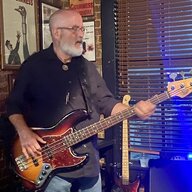
My rig on outside stage
20220806_183831.jpg
 
So as the level of playing increases, my "rig" needs to increase from a simple Amp Head and small cab stack.
Why? Are you happy enough with your sound? Most people change gear, or get new gear to address a perceived deficiency; is there some need you want to address? Otherwise, it sounds a little like you just have gear envy -- that you WANT some extra things to fuss with, like the guitar player. My advice is don't do that -- focus all that attention on something more productive, like learning to play better. Just IMHO, of course.
 
Okay, that's easy enough. Cable to Ampeg PF-500 Portaflex to a pair of Hartke cabs (410 and 115). As to whats lacking, I don't know as I am rather uneducated on things. I know the guitar player is using two wireless setups that merge and feed into two amps running two stacks. What I would like to do is learn enough about the whats and whys and hows to make an informed decision on what expansion is right for me.

I dont get it, you feel it’s lacking because you see other people have more gear? Or do you not like the sound of it?

what’s wrong with a “simple” head? And a stack of 4x10 and 1x15 is not small. You have a setup that has sustained pro players for decades.
 
Last edited:
Okay, that's easy enough. Cable to Ampeg PF-500 Portaflex to a pair of Hartke cabs (410 and 115). As to whats lacking, I don't know as I am rather uneducated on things. I know the guitar player is using two wireless setups that merge and feed into two amps running two stacks. What I would like to do is learn enough about the whats and whys and hows to make an informed decision on what expansion is right for me.
You will never need more than you have...ever. that is not a "small cab stack" that's a stadium rig. That setup will drown out a full pa.

Also, your guitar player is an idiot. He'll be deaf in the next 5 years. Probably sooner. So will you if you continue to play with him.


As the venue size increases, the PA increases. As the PA increases, on stage amps decrease. You only need enough to barely hear yourself over the cymbols. Or, nothing at all (which is the most common scenario. Has been for a good while now), and you hear everything through in ear monitors only.
 
Last edited:
[QUOTE="So as the level of playing increases, my "rig" needs to increase from a simple Amp Head and small cab stack. But I am one of those guys who likes to understand the whys and hows."[/QUOTE]

For most of us, understanding the whys and hows is a never ending process. There are thousands of articles - probably on Talkbass alone - that will get you started. As others have stated, what's the end goal?

Also, for a lot of us, we don't have a full blown road crew... the less gear to schlep to a gig while obtaining a sound we can live with is the goal.
 
If this is not the right forum, Mods feel free to move.

So as the level of playing increases, my "rig" needs to increase from a simple Amp Head and small cab stack. But I am one of those guys who likes to understand the whys and hows. I can find lots of information on the rigs of various bass players - Squire, Hill, Flea, etc and those are far beyond my needs. But I am looking for information on how things work together, What components do, how they link, etc. Anyone know of sources... online or physical material... I can get my hands on to learn.
Thanks ... oh, and whoever put together the AMP FAQs thread. It was a great start but just didn't go where I needed.
Bass into amp input via 1/4 mono instrument cable. Gain stage sets the level of the signal going into your pre amp. Your power amp amplifies your that signal, and sends current through the outputs in to your cabinets. Speakon, or 1/4 TS speaker cables connect your amp to your cabinets. Connect your cabinets together via the parallel jacks on the cabinets. The total load is divided when doing so. Two 8ohm cabs = one 4 ohm load. Two 4 ohm cabs = one 2 ohm load. One 8 and one 4 ~ 2.7 ohm.

As long as you don't go under your amps minimum, or if your amp has a load selector connect selected ohm, you're perfectly fine.
 
Last edited:
Okay, that's easy enough. Cable to Ampeg PF-500 Portaflex to a pair of Hartke cabs (410 and 115). As to whats lacking, I don't know as I am rather uneducated on things. I know the guitar player is using two wireless setups that merge and feed into two amps running two stacks. What I would like to do is learn enough about the whats and whys and hows to make an informed decision on what expansion is right for me.

Full stacks or half stacks? Two full stacks is unbelievably loud and pretty impractical for a normal gigging band, IMO.

It is important to understand whether your gigs will have a PA that supports bass, however given the MASSIVE stage volume you are dealing with I can’t see doing less than an 810 or pair of 410’s with your amplifier of choice on top. The good news is these big cabinets are cheap on the used market. If it were me (and I have been in this position before) I would grab a used Ampeg 810 and whatever type of amp I like the sound of. That should be plenty to keep up on stage and to cover FOH when there isn’t a PA to support you.
 
If this is not the right forum, Mods feel free to move.

So as the level of playing increases, my "rig" needs to increase from a simple Amp Head and small cab stack. But I am one of those guys who likes to understand the whys and hows. I can find lots of information on the rigs of various bass players - Squire, Hill, Flea, etc and those are far beyond my needs. But I am looking for information on how things work together, What components do, how they link, etc. Anyone know of sources... online or physical material... I can get my hands on to learn.
Thanks ... oh, and whoever put together the AMP FAQs thread. It was a great start but just didn't go where I needed.
My opinion is that if you were going to change anything, it'd be that 800w amps are more typical for "last amp you'll ever need" types of situations. But unless you are specifically encountering issues of the amp farting out at stage volume, you don't need it.

You've definitely got enough "stuff" up there with you on stage. The only thing you should be worrying about is, "does this sound good"? If the answer is yes, do not touch anything, even if you've got the guitarist in your ear about getting a new rig. If someone else doesn't think it sounds good, well that's a discussion that the two of you can have and you can see if you agree.

If you do begin to think you don't sound good, then that's maybe when you should consider whether it's due to your gear selection. But really, I think you should exhaust every possible opportunity without switching your gear out first-- consider your amp settings, playing style, the acoustics of the rooms you're playing in, etc. It might also be a situation where pedals could help you-- those are much cheaper and more convenient than a new amp or cabinet.

If it'd be of any value to you, this is my current thinking on amp rig setup:
I'm currently in the process of shifting to a new amp rig, and mine will be a Barefaced Super Compact cabinet (or two) with, most likely, a Mesa WD-800 amp. The idea I'm going for with this setup is to have a high powered amp (800w@4ohm) going into one (or two) of the Super Compacts, which are small at 1x12'' but have high power handling (600w each, or 1200w for a pair). They will get about as loud as any other cabinet, but are much smaller and lighter. In fact, I've only gotten one cabinet just because I've considered that I might only need one for the foreseeable future.
 
There is a lot of variation in what works. People also tend to use a lot of approaches that may not work very well in various situations.

The cold hard fact is it is very rare to get really good sound, and when you do it's generally because a lot of random parameters came together to produce an unexpected gestalt that you probably won't be able to adequately explain. Because of this, performing live is often more about striking a compromise that everyone can accept, rather than achieving perfection.

The person who insists on perfection all the time is typically taking more than his/her fair share. In other words, making it better for one often means making it worse for everyone else. IMHO the priority should be on giving the audience the best possible experience.

Back in the glory days, some bands would run a literal wall of amps. Over recent years, more and more bands seem to be totally abandoning stage amps and using in ear monitors. These two approaches represent the opposite ends of the spectrum, and there are lot's of different approaches in the middle.

My last touring rig was rack based and had a 250W stereo power amp. I had a pair of Eden cabs: D410XLT and D210XLT. I could run either cab or both. Most of the time I ran only the D210XLT. It was placed vertically on top of my 16-space rolling rack with a spare CountryMan Type 85 DI lodged under the front edge of the cab to tilt it back to aim at my ears.

The D210XLT is a pretty efficient cab. With 250W, the calculated SPL is almost 127dB. I used this rig for all sorts of gigs, ranging from private parties for a dozen people, to full-on stadium gigs. Sometimes it wasn't quite enough, but I am not really willing to turn up any louder.

FYI: I wore ER15 or ER20 ear plugs for almost all performances. IMHO these greatly degrade the sound, but my hearing is still relatively good for my age despite a couple of decades of performing.

I like elevating my cab and tilting it to aim at my ears because I want a very clear and coherent sound that cuts through the mayhem on stage. Also I want to be able to monitor effectively with the rig turned down as low as possible, so it fights less with the PA. Some bass players like big fat pillowy lows and hate to hear the highs. My approach will not work for those people.

I would argue that people who like big fat lows tend blow out the house more. By this, I mean in order for them to hear well enough on stage, their rig may overpower the house mix.

Often the audio tech is interested in keeping the stage volume relatively low, so he/she can build a nice mix at a comfortable listening level for the audience. If the stage wash is too loud, the audio tech has two choices: 1. Turn up the mix so he can gain some degree of control over the sound. 2. Pull the sound sources that are too loud completely out of the mix. This second option prioritizes keeping the volume in check over sound quality.

A third option is to try and reinforce the sound. In other words, you try to dial in each channel so the PA merges perfectly with the stage wash. There is an art to doing this well, but in truth, it typically does not work as well as people think. The sound is usually way better if the PA is significantly louder than the stage wash.

Don't make the mistake of assuming that if your sound is only coming from your amp that it will sound good in the house mix. Your sound will tend to become darker and more diffuse as it travels over distance. If you amp is expected to push the room, I would argue that it needs to be adjusted to sound good in the house, and often the necessary changes are opposite of what the bass players wants on stage. Typically either the band leader or audio tech will go out into the house and call changes up to bassist on stage...turn up/turn down, adjust the lows, mids, highs, etc.

This is a really broad subject. Theirs is lot's more to write, but this post is already probably approaching TLDR territory, so I will stop here.

You need to write a book. Really good information!. Stuff I wish I knew back when I was touring.
 
More complex rigs get created when players are looking for something that a simpler rig can't do.

Some players use two different amps, such as one amp set up for distortion and the other amp for clean. The two can be blended to get a timbre that neither amp can deliver on their own. Or they might run one amp for their effects and the other clean.

Players often mix and match speaker cabinets to get a particular tone, such as stacks of a 1-15 and a 4-10.

In the late 1970s up to the early 1990s biamping was popular, running the signal through a crossover and then into two amp/speakers combination designed to carry just the lows, just the highs and sometimes even triamping to split oiut the midrange. There were many bass heads with stereo amps and crossovers on board for this purpose, the SWR SM-400 was very popular. Even today you can still buy the SVT-4 Pro for a single head biamping solution.

Another trend from that same period was to use a rack mounted preamplifier into a high wattage power amp (typically designed for PA but Mesa and Ampeg both sold instrument-focused power amps for a while). This was the ultimate mix and match rig and was very popular with touring acts playing large venues.

My advice is to turn the question around: What problems do I have with my amplification and what will solve them?

Examples of problem solving from my own experience:

-- Two instruments
Doubling gigs on bass guitar and upright bass required me to switch from one to the other during sets. For a while I just used an A/B box but then had to deal with tweaking the amp for each instrument, each needing very different EQing. So I went looking for an amp with two full preamp channels. That feature had faded away in amps starting in the 1970s so around 2000 I bought a Walter Woods amp because it did have two full preamp channels. I could keep both basses plugged in and have the volume and EQ setting optimzed for both. Even today, there aren't a lot of amps with two full channels...the SVT Heritage has two, like the originals, but the Classic has only one channel.

-- Modularity
Most of my indoor gigs are in small rooms and tiny stages so a large amp isn't needed or wanted. Outdoor gigs often require a larger amp because of the loss of wall and ceiling reflections. Over time I settled on using a pair of identical cabinets so I could use just one or use both depending on the gig requirements. It also meant that I could put one cabinet on each side of the stage so that the players on the opposite side of the drummer could hear the bass better. Having two identical cabinets also means I have a spare, if it needs to go into the shop I can just use the other. It also helps with transport, the two small cabs will fit in the trunk of my Camry, but a larger single cab with multiple speakers would not. If my gigs warranted even more speakers, I could buy one or two more and stack or split them as needed.
 
  • Like
Reactions: Wasnex and abarson
One thing i’ve learned is that simplicity is the way to go. A lot of these pro rigs you see on Stadium stages are set up by roadies and maintained by techs. If you are storing, transporting, setting up and maintaining the gear all by yourself, no need for over complication. Keep it as simple as possible while still sounding good. And often times simpler sounds better because it’s less gear that could possibly malfunction.
 
  • Like
Reactions: Wasnex and abarson
Not much to add here that hasn't already been pointed out.

Still waiting to hear from the OP re: what kind of music his band plays.

Also: Just because the guitar player's bringing insanely massive rig(s) doesn't mean he's fully cranking them.

What's driving this desire to expand - need to keep up with excessive guitar volume or desire to dive into excessive gear/effects?

BTW, I've got a PF500 with both 410 & 210 cabs. I really wouldn't want to gig with a band where more volume than that was required.