I wasn't refering to you, but to the general crowd here. (Added one sentence to my original post).
LOL! I see what you mean.
Retracted the first sentence from my post.


TalkBass has been independent since 1998. Add your voice.
Create a free account to reply to discussions, view embedded media, and browse with fewer display ads.
Join free Log in
Want zero display ads or expanded classifieds tools? Compare plans.
I wasn't refering to you, but to the general crowd here. (Added one sentence to my original post).
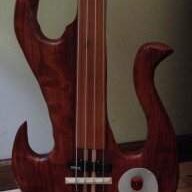
For some real fun, try putting a variable strobe light on a bass! It will amaze you how much the bass frame wiggles around at different frequencies.
If you aren't familiar with it, a strobe light is an old-fashioned technique for studying vibration and movement of structures. Back in my race car days, we used to put a car up on stands with the drive train running. Climb under with a variable strobe light, and you could see just how much the frame and parts were deflecting under load and vibration. Scary stuff!
Some years back, I think it was during the SWR bass project, one of the guys brought in a strobe, and we played around with it on the bass. You could clearly see how the neck and headstock and body were deflecting. I don't currently own a strobe light. I should find one and make some videos. That may answer some of these questions.

That’s a lot of work. You should get started right away. Probably take you a couple months full time.Ok, so I've been thinking about this briefly and have some initial questions.
1) Do we have any data on where energy is dissipated? How important are air friction and magnetic loading? How much energy is damped by the player directly from the body, the neck and the strap? How much energy is dissipated in the neck and in the body?
2) Is the induced vibration in the neck largely transverse (lateral strain)? How much energy is reflected at the boundary between neck and body? What is the nature of vibration in the body (transverse or longitudinal)? I'd expect a huge difference in the susceptibility of the body to induced transverse vibration relative to the neck.
3) is there a big difference in reflected sound based on the density of neck vs. body?
4) is the amount and nature of reflected sound a key to perceived tone?
Just a few things that come to mind.
Otto


Cool. Do you have any proof, or just this claim and some anecdotes?Who said wood body doesn’t matter said wood fingerboard doesnt matter no?
So rosewood maple and ebony sound exactly the same?
Ridiculous they have a huge difference

Really you can’t hearing the difference between those woods?Cool. Do you have any proof, or just this claim and some anecdotes?
HearReally you can’t hearing the difference between those woods?

Really you can’t hearing the difference between those woods?
Its a funny thing, you know. I played a gig a few months ago where a number of folks asked why I kept swapping basses as they could not hear any difference.
First up, I was a little surprised, but I took it as a compliment that I must just sound like me, whatever bass I play.
To give some context, the three were all ash bodied. Fingerboards were maple, pau-ferro and ebony. The last two are fretless with Chromes, the first is fretted and has Pro-Steels. The first is a fretted SBMM Ray34, followed by a fretless 93 StingRay 2-band and a Warwick Corvette standard, JJ. To my ears they are worlds apart, each having its place. I don't adjust the EQ for any of them - settings are pretty much flat and very clean with no effects.
On reflection, I think if I played the wrong axe for the song then people would notice the difference. Something would be 'off', even if it was not immediately apparent what 'it' was.
There are too many variables to link the differences to the woods, but IMHO, each bass has a voice that used right just sounds like 'the bass', but if used wrong, I think would be detrimental to the music.
YMMV...
Feel free to document it. No, an anecdote is not documentation.Really you can’t hearing the difference between those woods?
Ovation proved that you can string up a washtub and people will buy it.
Graphite neck instruments didn't exactly take off either.
I really like to talk with you face to face also playing different basses with different configurations and listening carefully but we can’t I’m on the other side of the planet otherwise I really enjoy this forum and still learning a lot about low frecuenciesFeel free to document it. No, an anecdote is not documentation.
I gigged my DIY washtub bass for over 2 years.
My washtub had a wood neck.
Cool, but that still wouldn’t be documentation.I really like to talk with you face to face also playing different basses with different configurations and listening carefully but we can’t I’m on the other side of the planet otherwise I really enjoy this forum and still learning a lot about low frecuencies
Regards
Manuel