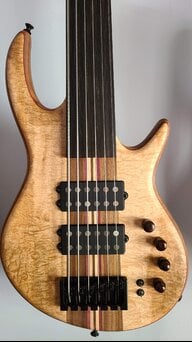
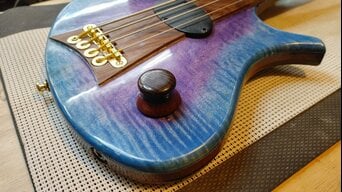
In my time I've played screw-on necks, set(glued) necks, and neck through instruments.
Not as a builder or someone far more schooled than I, but in my own experience, the real world where the rubber meets the road, this is my experience:
Primarily I played more neck through axes than most any other. 80's MIJ Yamaha BB's, 1200, 2000, 3000, 5000, then a pair of Alembic five-strings. As an aside, I also played a screw-on Yamaha BB1600, roughly equivalent to a 2000 or 3000 save for construction.
For me, the real advantage is the no-neck-block/heel. This is in combination with most neck throughs being 24-fret instruments. This does two things: First, should you decide to play 'up there', there's no neck block to catch your hand as you move. Also, you tend to have more upper frets clear of the body, often aided by the usually deeper treble-side cutaway. One of the things I pull out of the bag of tricks is to occasionally double a vocal line or riff, or play the bass line an octave higher if I'm only playing with acoustic guitars. It's now much easier.
But . . . that access is taken from the 34-inch scale, so now, you have less real estate between the end of the fingerboard and the bridge, which may put the pickups on a two-pickup axe closer together than a 20 or 21 fret instrument. This may or may not be a thing, depending on the player and the shape of the pickups installed.
Sustain is a two-part consideration:
ANY bass with a good setup and properly cut nut and serviceable bridge will sustain, especially on any loud stage. Length of sustain may vary from bass to bass, but I've never owned a self-quenching bass.
WHERE someone with the ears to hear it listens closely: In my experience, screw or set necks in a way 'interrupt' the lowest harmonics and tend to be more mid or lo-mid forward. This is often accentuated by the usual selection of 'white' woods (alder, ash, maple, etc.) present in Fender-Shaped-Objects. On many neck through axes, they tend to carry forward the lowest harmonics in a fashion not often heard elsewhere. My Alembic Elan Five had very pronounced low C's and D's, and you could easily hear the 'beat' of the fundamental or 1st/2nd harmonics in the right room and amp. And generally the presentation is more even than screw necks, which often have what I call that midrange bark or quack. Both useable, but may suit some more than others, and many won't hear this.
Finally, since the string tension is pulling on a continuous laminated assembly, all of my neck throughs were more stable than anything else. This requires the original build to be perfect in tems of milling the down angle of the neck/fingerboard (and REALLY complicates problems as you can't remove the neck), but this was never a concern ever on the Yamahas and Alembics, both built to very high standards.
Any construction method has its' pluses and minuses, but I liked the neck throughs best for access to the upper frets and a generally more sophisticated tone.
These are the things I found and experienced over some 20-odd years with that kind of bass.