• TalkBass has been independent since 1998. Add your voice.
    Create a free account to reply to discussions, view embedded media, and browse with fewer display ads.
    Join freeLog in
    Want zero display ads or expanded classifieds tools? Compare plans.

Bolt-on or neck through - what's the real difference?

Can't say any difference in sound I've heard is attributable to that and not pickups, body wood, neck wood, fretboard wood, fret size/material, string gauge/material, electronics, pickup style, pickup brand, pickup height, body finish, neck finish, string trees, lack of string trees, day of the week, or any combination of these.

Excellent point. It's just one of many variables. In order to determine a difference, you would have to build multiple basses with identical specs EXCEPT bolt on vs. neck thru. That's why I tend to listen to guys who have that kind of experience. From the FBass website FAQ section:

Does Neck-Through construction sound better than Bolt-On?

“Better” is subjective to the player.
We actually find that a wider range of players prefer Bolt-On. It has a quicker attack & an overall more lively tone, is more responsive to playing dynamics, doesn’t render the entire bass worthless if the neck is damaged beyond repair, and it’s standard to boot. The neck-through construction has always and will always be an option for those who want a little more compression and sustain. It’s a positively beautiful thing in the upper register.
 
  • Like
Reactions: 6-3-2
Excellent point. It's just one of many variables. In order to determine a difference, you would have to build multiple basses with identical specs EXCEPT bolt on vs. neck thru. That's why I tend to listen to guys who have that kind of experience. From the FBass website FAQ section:

Does Neck-Through construction sound better than Bolt-On?

“Better” is subjective to the player.
We actually find that a wider range of players prefer Bolt-On. It has a quicker attack & an overall more lively tone, is more responsive to playing dynamics, doesn’t render the entire bass worthless if the neck is damaged beyond repair, and it’s standard to boot. The neck-through construction has always and will always be an option for those who want a little more compression and sustain. It’s a positively beautiful thing in the upper register.

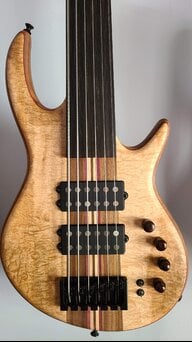
upload_2023-2-14_2-17-41.png

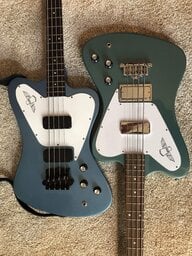
upload_2023-2-14_2-18-12.png

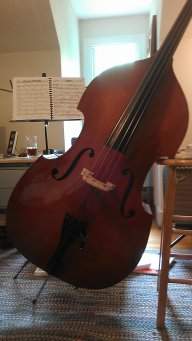
upload_2023-2-14_2-19-39.png

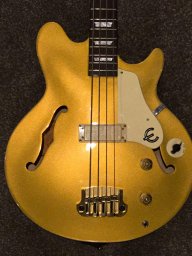
upload_2023-2-14_2-23-39.png


And there are probably some tests which show something completely different. So nothing is conclusive.
 
  • Like
Reactions: 6-3-2
This reminds me of the video where the dude makes the air guitar... Same strings and electronics and pickup height - no body or neck.... And gets really similar results.
 
View attachment 4968323
View attachment 4968324
View attachment 4968325
View attachment 4968328

And there are probably some tests which show something completely different. So nothing is conclusive.

Sorry, but this is bad "science".

Too many variables, not the least of which is: strings, wood, pickups, scale length, frets, bridges. Not to mention these are guitars and not basses (different frequency ranges, different string masses, etc). To make a comparison like this valid, one would have to have three identical guitars, except for the neck joint. Same strings, same pickups, made from the same pieces of wood (not just species, but actual pieces), same hardware, etc.

I'm sure some people will look right past these basic insufficiencies and accuse me of holding on to unsupported claims, but I'm not saying that a neck-through has more sustain than a bolt on (I've never said that). I'm simply saying this so called "test" design wouldn't pass a basic first-year engineering class.
 
This reminds me of the video where the dude makes the air guitar... Same strings and electronics and pickup height - no body or neck.... And gets really similar results.

Ah yes, the one where the guy "gets rid of the wood" by mounting the ends of the strings to 2 WOOD benches, and then says "it sounds the same" - "proving" that wood doesn't affect the tone of an electric guitar. Nobody seems to grasp how poor his experimental design is - that he hasn't controlled the variable he wished to demonstrate at all. As a scientist, that video is really good at one thing - demonstrating how bad pseudoscience can get, and how people will jump to conclusions that aren't at all supported by the "experiment" that was run.
 
In my completely subjective experience I've felt like that in neck thru's the way the body and neck vibrate when you play is very pleasant feeling. I don't have any reason to believe it impacts the tone in any meaningful way but strictly from a "feels good to play" both of my neck thrus purr when I play them.

other than that, I have no idea. basses of all kinds sound great. I think the benefits of neck thrus are entirely for the player, offering a better tactile experience and more comfort around the high frets. given the choice I'd probably take that option every time just from a feel preference.
 
Ah yes, the one where the guy "gets rid of the wood" by mounting the ends of the strings to 2 WOOD benches, and then says "it sounds the same" - "proving" that wood doesn't affect the tone of an electric guitar. Nobody seems to grasp how poor his experimental design is - that he hasn't controlled the variable he wished to demonstrate at all. As a scientist, that video is really good at one thing - demonstrating how bad pseudoscience can get, and how people will jump to conclusions that aren't at all supported by the "experiment" that was run.

It was actually pretty well done. Not scientific, I agree. Entertaining, yes. Informative, yes. Scientific, no. He wasn't trying to do "science" I don't think. Definitely a good watch though.
 
  • Like
Reactions: 6-3-2
Sorry, but this is bad "science".

Too many variables, not the least of which is: strings, wood, pickups, scale length, frets, bridges. Not to mention these are guitars and not basses (different frequency ranges, different string masses, etc). To make a comparison like this valid, one would have to have three identical guitars, except for the neck joint. Same strings, same pickups, made from the same pieces of wood (not just species, but actual pieces), same hardware, etc.

I'm sure some people will look right past these basic insufficiencies and accuse me of holding on to unsupported claims, but I'm not saying that a neck-through has more sustain than a bolt on (I've never said that). I'm simply saying this so called "test" design wouldn't pass a basic first-year engineering class.

Exactly. Lots of amateur science is used as a "gotcha" with basses and guitars. It just leads to more misunderstandings. Wish more had a basic understanding of what good research looks like.
 
  • Like
Reactions: lowfreqgeek
I've owned 13 basses in my lifetime - 3 of which were neck through and to be honest I can't tell the difference. My 2 main basses are bolt ons and my acoustic is . . whatever an acoustic is (set neck?) I'm thinking about having a custom bass made and is it worth the expense to have a neck through?

I have a jazz a p and a 4001. I can honestly say. I have no strong feelings either way. So I wouldn’t pay extra for something of no perceived benefit to myself.
Ease of repair would push the balance towards bolt on.
It’s down to personal preference and nothing else
 
27235286[/URL], member: 340733"]It was actually pretty well done. Not scientific, I agree. Entertaining, yes. Informative, yes. Scientific, no. He wasn't trying to do "science" I don't think. Definitely a good watch though.

The problem with it is that people keep referencing it as “proof” of something that it didn’t even test. It’s more disinformative than informative.
 
  • Like
Reactions: 6-3-2
Having owned both neck through and bolt on basses(and electric guitars), i personally don't think it really matters unless you simply like the smoother look of a neck through. In fact i generally prefer a bass with a bolt on neck since it would allow me to replace the neck more easily if i ever had to.
 
I have NTs and BOs that I like, but the nerd in me likes NTs better.

The whole BOs are better because you can replace the neck more easily is really odd to me, as having had hundreds of instruments, I've never had a bad neck that needed to be replaced. The stupid Gibson headstock design is just stupid design irrespective of whether BO, SN or NT.

Unless you have a Fender or very close clone that will accept Fender dimensioned necks, a BO with an issue where the neck needs to be replaced is likely going to be an expensive custom job or not available quickly. If an F bass suddenly went squirrelly as you're flying OS to a gig, you're not getting a replacement the same day, and it wouldn't be cheap. No aspersions on F Bass, just using them as an example as I was looking at one I really liked earlier. If it was an OOP bass from any company, a new neck would have to be designed and made from scratch at fair expense.

I agree with lowfreqgeek that it's a poor test, and would need to be replicated by others before I'd accept it as factual. But the highlighted bit is the the important bit.
 
I like being able to easily work on a bolt on neck.

Had a gibson guitar tumble over a few years ago and the set neck broke at the headstock. Typical damage and I fixed it. Still, I was pretty done with set necks after that from a repair perspective.
That’s one advantage to bolt-on necks: If it breaks, warps or twists, you can replace it yourself. Or upgrade it. Or swap it out for fretless. Or put a J neck on a P bass. Its handy for modders.
 
  • Like
Reactions: JRA and deepestend