
• TalkBass has been independent since 1998. Add your voice.
    Create a free account to reply to discussions, view embedded media, and browse with fewer display ads.
    Join freeLog in
    Want zero display ads or expanded classifieds tools? Compare plans.

Boner Bass Club

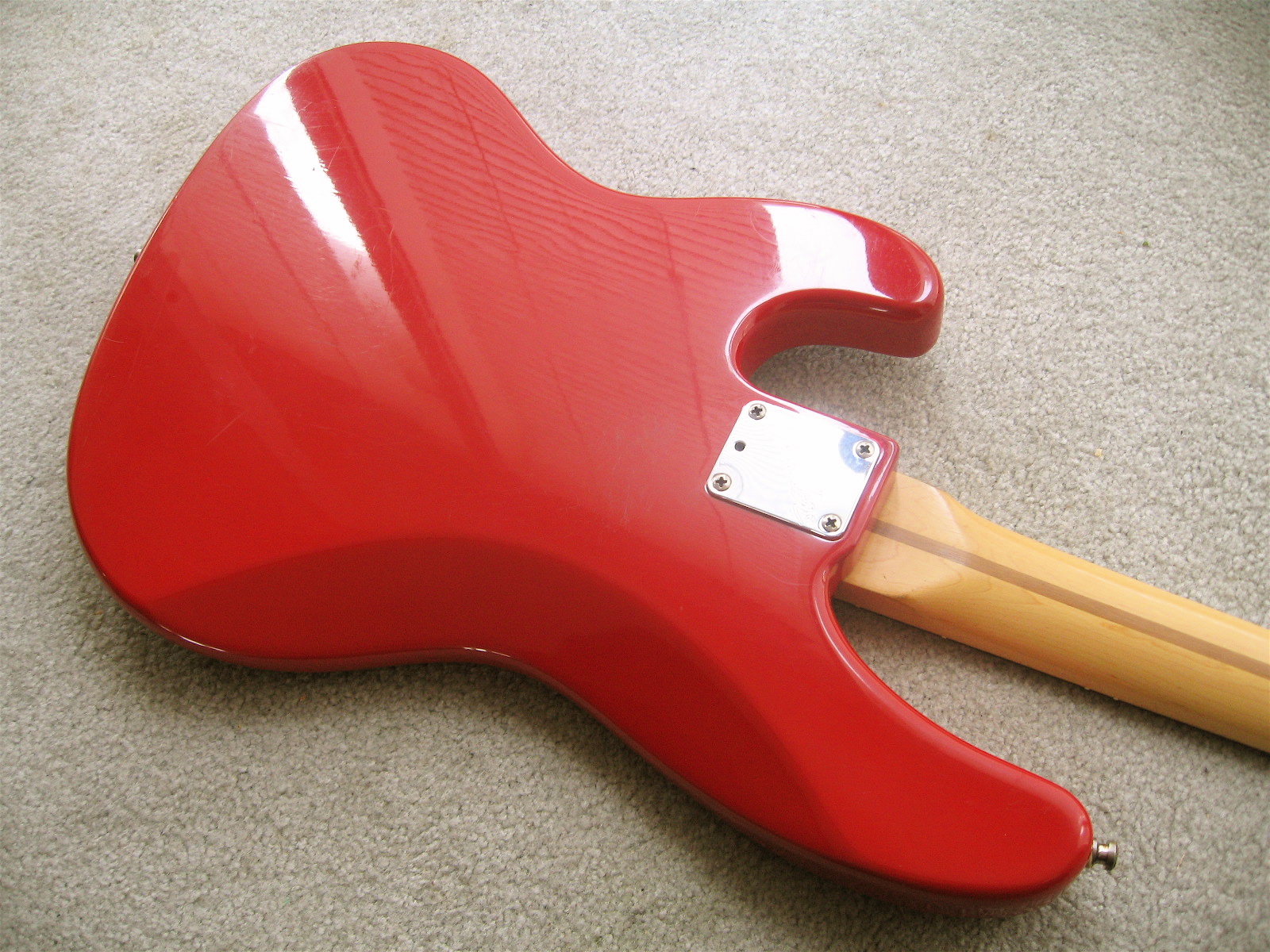
American Standard Jazz Basses produced between 1989 and 1994½ featured a larger body shape, a 'curved' neck plate set into a chambered pocket for greater sustain and a 22-fret neck, similar to that of a Precision Bass Plus, with a standard vintage-style top-load bridge, two separate volumes and a master TBX tone circuit. Usually known as "Boner" Jazz Basses, these early American Standard models (designed by George Blanda, who was Fender's senior R&D engineer during that period) were discontinued in 1994 and shouldn't be confused with the Fender Jazz Bass Plus, which has the same 22-fret neck design, but utilizes a different (downsized) body styling, Lace Sensor pickups, Schaller "Elite" fine-tuner bridge on the four-string model or Gotoh high-mass bridge on the 5-string model, and Phil Kubicki-designed active electronics. Unlike the Fender Precision Bass Plus, which had a "maple-neck" option, the Boner Jazz Bass was offered only with a rosewood fingerboard. The Jazz Plus Bass was available with an alder body and the option of a natural-finish ash body on the four-string model for a $100 upcharge, either a maple or rosewood fretboard on the four-string and pau ferro (an exotic hardwood whose tone is brighter than rosewood yet warmer than ebony) on the five-string. The Jazz Plus debuted in 1989 (the five-string model was released in 1990), discontinued in 1994 and replaced by the USA Deluxe Series Jazz Bass the following year.

This sheds some light on the boner family tree but isn't entirely clear, as in - "featured a curved neck plate" - but not on boner J's like mine w/a standard rectangular plate w/tilt adjustment port/hole and "Fender" stamped on it. Also, there's no mention of your idols series/parallel-less '93 P/J. Wonder if they could have been store requested special orders?
abzK69gb.jpg
 
  • Like
Reactions: HHudson
American Standard Jazz Basses produced between 1989 and 1994½ featured a larger body shape, a 'curved' neck plate set into a chambered pocket for greater sustain and a 22-fret neck, similar to that of a Precision Bass Plus, with a standard vintage-style top-load bridge, two separate volumes and a master TBX tone circuit. Usually known as "Boner" Jazz Basses, these early American Standard models (designed by George Blanda, who was Fender's senior R&D engineer during that period) were discontinued in 1994 and shouldn't be confused with the Fender Jazz Bass Plus, which has the same 22-fret neck design, but utilizes a different (downsized) body styling, Lace Sensor pickups, Schaller "Elite" fine-tuner bridge on the four-string model or Gotoh high-mass bridge on the 5-string model, and Phil Kubicki-designed active electronics. Unlike the Fender Precision Bass Plus, which had a "maple-neck" option, the Boner Jazz Bass was offered only with a rosewood fingerboard. The Jazz Plus Bass was available with an alder body and the option of a natural-finish ash body on the four-string model for a $100 upcharge, either a maple or rosewood fretboard on the four-string and pau ferro (an exotic hardwood whose tone is brighter than rosewood yet warmer than ebony) on the five-string. The Jazz Plus debuted in 1989 (the five-string model was released in 1990), discontinued in 1994 and replaced by the USA Deluxe Series Jazz Bass the following year.

This sheds some light on the boner family tree but isn't entirely clear, as in - "featured a curved neck plate" - but not on boner J's like mine w/a standard rectangular plate w/tilt adjustment port/hole and "Fender" stamped on it. Also, there's no mention of your idols series/parallel-less '93 P/J. Wonder if they could have been store requested special orders?
abzK69gb.jpg

My 92/3 certainly doesn't have a curved plate, nor is it inset. It does have a TBX tone control, and I want to say the manual I have for mine (I still have all the original stuff) suggests it has graphite reinforcement in the neck?
 
My one true love... Bought her new in '92. She had a black finish, which my teenage self very amateurishly sanded off and stained mahogany. The gouges in the finish are from my technically-bad-but-effective, Flea-style slapping technique - I use my middle finger for popping and every time a tiny bit of wood comes with it.

Over the years I've replaced the pups with DiMarzio Model J humbuckers, rewired it with push-pull pots for series-parrallel and control bypass, and replaced the broken plastic nut with a bone nut.

She has a fat, round, juicy, sweet tone that gets loads of compliments. And other bassists who pick her up always tell me how smooth and easy it plays.

Never had a problem with the spacing, maybe because this is the bass I learned on. If anything, I find the wide spacing really lets me dig in compared to other basses I've played.

I'm sure this has zero resale value now, which works out fine because I will NEVER sell her.
 

Attachments

  • IMAGE_1.jpg
    IMAGE_1.jpg
    120.5 KB · Views: 189
  • IMAGE_2.jpg
    IMAGE_2.jpg
    115.4 KB · Views: 155
My one true love... Bought her new in '92. She had a black finish, which my teenage self very amateurishly sanded off and stained mahogany. The gouges in the finish are from my technically-bad-but-effective, Flea-style slapping technique - I use my middle finger for popping and every time a tiny bit of wood comes with it.

Over the years I've replaced the pups with DiMarzio Model J humbuckers, rewired it with push-pull pots for series-parrallel and control bypass, and replaced the broken plastic nut with a bone nut.

She has a fat, round, juicy, sweet tone that gets loads of compliments. And other bassists who pick her up always tell me how smooth and easy it plays.

Never had a problem with the spacing, maybe because this is the bass I learned on. If anything, I find the wide spacing really lets me dig in compared to other basses I've played.

I'm sure this has zero resale value now, which works out fine because I will NEVER sell her.

Right on! I love to see a bass (any bass) that someone makes their own in the journey to express their love of playing bass! It's funny because the boner J I now own kind of snuck up on me in terms of it's real worth - sometimes one stumbles on an instrument that simply helps free your expression. It focuses "worth" as something that has little to do w/"market value" or "vintage resale" or putting an instrument on a pedestal in the context of a monetary commodity.
 
  • Like
Reactions: azwipe
That's well-put, and I completely agree. Warts and all, this one's priceless to me, and only to me. I wouldn't trade her for a Fodera or a Sadowsky, and I probably wouldn't sound as good playing one!

Right on! I love to see a bass (any bass) that someone makes their own in the journey to express their love of playing bass! It's funny because the boner J I now own kind of snuck up on me in terms of it's real worth - sometimes one stumbles on an instrument that simply helps free your expression. It focuses "worth" as something that has little to do w/"market value" or "vintage resale" or putting an instrument on a pedestal in the context of a monetary commodity.
 
why not add a pickguard?

Reminds me of a story. I just bought my first used Kubicki Factor, a '86 in '93. I knew little about them at the time and looked up Kubicki (in Santa Barbara) and called him. As he characteristically did, he answered the phone himself and gave me many minutes of his valuable time to help enlighten me. I ended up sending it to him to put on a fretless neck and set it up. A couple days later he called and asked if I wanted him to do a few cosmetic repairs on the (blk) body. It was professionally used and somewhat abused and had a pronounced finger-nail cavity above the E string along with other nicks & dings. I told him I didn't mind the wear as it added character. He said "if only he had trimmed his thumb-nail..." It cracked me up, but after all this was one of his children! I spoke w/him over the years as I bought a couple more Factors that needed this and that. He was always generous w/his help and a real gentleman - rip Phil.
 
  • Like
Reactions: azwipe
Cool story.

You know, I lost the original white pickguard a long time ago, and never really missed it. But recently I had a tortoise pickguard custom made (I don't believe one was ever made for the original Boner J's).

The new pickguard looks great and all, and covers the worst of the damage up, but I ended up taking it off. I'm just used to the extra couple of millimeters under the strings now, and to be honest I've come to love the battle-scarred look.

It's funny, my guitarist just bought a "road-worn" telecaster that looks beat up, but is actually brand-new. I'd rather have the real thing. I just love how every instrument has a story.


Reminds me of a story. I just bought my first used Kubicki Factor, a '86 in '93. I knew little about them at the time and looked up Kubicki (in Santa Barbara) and called him. As he characteristically did, he answered the phone himself and gave me many minutes of his valuable time to help enlighten me. I ended up sending it to him to put on a fretless neck and set it up. A couple days later he called and asked if I wanted him to do a few cosmetic repairs on the (blk) body. It was professionally used and somewhat abused and had a pronounced finger-nail cavity above the E string along with other nicks & dings. I told him I didn't mind the wear as it added character. He said "if only he had trimmed his thumb-nail..." It cracked me up, but after all this was one of his children! I spoke w/him over the years as I bought a couple more Factors that needed this and that. He was always generous w/his help and a real gentleman - rip Phil.
 
...and to be honest I've come to love the battle-scarred look.

It's funny, my guitarist just bought a "road-worn" telecaster that looks beat up, but is actually brand-new. I'd rather have the real thing. I just love how every instrument has a story.

I was at a vintage guitar show in Marin a few years ago and saw a 60's P-bass with something that "buckle-rash" only starts to describe. I kick myself for not taking a pic of it. Honest to god it looked like it was attacked by a grizzly - I can only imagine that a dude who played 6 nights a week for years in a roadhouse band wearing a huge western buckle caused such. Talk about battle scared!