• TalkBass has been independent since 1998. Add your voice.
    Create a free account to reply to discussions, view embedded media, and browse with fewer display ads.
    Join freeLog in
    Want zero display ads or expanded classifieds tools? Compare plans.

Boom Bass Cabinets?

Status
Not open for further replies.
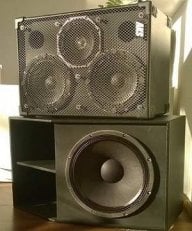
...ah the photo on the previous page helps with the baffle explanation. The website pic looks like the baffle is at 90 degrees with a shelf over the top. Now I'm seeing the cab is square and the baffle tilts back into the cab. That makes more sense.


Right... in some photos it looks like the cab has an angled hood when it's actually square.
 
Last edited:
  • Like
Reactions: monsterthompson
Very interesting stance.
Sorry you feel that way, Duke. I don't think I've been defensive, the same people are making the same negative comments that they made with the Glasstones and maybe you weren't privy to the years of naysaying followed by silence. I am reminding them that they're doing it again and suggestion they man up contrary to what they did with the Glasstones should it turn out they are wrong again.
I'll lay out how I'm looking at this situation, I consider this responsive, not defensive... because I didn't do anything I feel that I need to defend.

Thanks for replying. I don't know much about your history with Glasstone, except that you liked their cabs.

So who has tried to analyze the cabinets? I may have missed it. So far what I have seen is you saying you tried something similar things with the drivers reversed and a ported deployment vs. sealed. Would that really be relevant? I'm genuinely curious.

Yes, I'm one of the people who tried to analyze the front woofer/slotted woofer configuration (which I have worked with), in another thread. You dismissed my comments as follows: "Suffice it to say that if the cabs do work as advertised and this is something the TBE's [Talk Bass Experts] were unable to comprehend or accomplish...". It sure sounds like you are saying that I don't understand the cabs and am incompetent because my experiments didn't accomplish the same things you are claiming for your cabs. The fact that my experimental cab was ported rather that sealed is irrelevant to analyzing the behavior of the front woofer/slotted woofer format. All of my ported cabs have pluggable ports, and so I actually did hear it both ways, but like I said that's irrelevant.

I'd be more than happy to go into detail about the things I posted in that other thread, which is linked below, if that would interest you. You can probably shed light on areas where what Drue did is fundamentally different.

The other was someone who keeps talking about how very familiar they are with the drivers whose stated attempt was a 22 lb. cab vs. one almost double the weight. Relevancy?

Experience with the woofer in question is indeed relevant. The weight of the cabinet that woofer was in is not. Experience modeling a woofer is also relevant, unless these cabs do something that is beyond the scope of T/S analysis and modeling.

I haven't seen modeling software that would allow someone to model these cabs. The same was true for the Lil G and yet people acted like they could draw conclusions based on modeling. Does that make sense?

What makes you think these cabs cannot be modeled? It's a bit more complex because of the effects of the slot loading, but that's all. And the single-woofer cabs would be fairly simple to model.

You asked about my affiliation and asked nothing afterwards. Right? Was that where I was defensive?

No, and I appreciate your reply to my inquiry.

Should they be dismissed without listening? That is what I'm recommending the folks who think they understand EVERYTHING that's going on with these cab and think they can't work should do vs. telling the people that have actually heard them that there's something wrong with them and how they listen.

Let's not go to extremes here. Some things about these cabs can be deduced by intelligent analysis, and some things cannot. The fact that not everything can be deduced from analysis does not mean that nothing can.

I honestly haven't seen anyone attempt to analyze these so it would seem a stretch that I'm the one who's defensive about something that hasn't happened. I respect you and your work, show me what I missed. And if I didn't miss it let's talk about that.
Thanks.

In response to a question in another thread I attempted some analysis, so I think it has happened.

I appreciate your willingness to communicate to try to resolve our (my?) misunderstandings. Not having yet attained infallibility, I invite you to let me know if and when I've crossed any lines. I have blind spots!

Thanks.
 
Last edited:
Thanks for replying. I don't know much about your history with Glasstone, except that you liked their cabs.

Yes, I'm one of the people who tried to analyze the front woofer/slotted woofer configuration (which I have worked with), in another thread. You dismissed my comments as follows: "Suffice it to say that if the cabs do work as advertised and this is something the TBE's [Talk Bass Experts] were unable to comprehend or accomplish...". It sure sounds like you are saying that I don't understand the cabs and am incompetent because my experiments didn't accomplish the same things you are claiming for your cabs. The fact that my experimental cab was ported rather that sealed is irrelevant to analyzing the behavior of the front woofer/slotted woofer format. All of my ported cabs have pluggable ports, and so I actually did hear it both ways, but like I said that's irrelevant.

I'd be more than happy to go into detail about the things I posted in that other thread, which is linked below, if that would interest you. You can probably shed light on areas where what Drue did is fundamentally different.

Hi Duke. What I try to do when reading here is think about how many ways I could take what's being written. Here's what I wrote: "Suffice it to say that if the cabs do work as advertised and this is something the TBE's [Talk Bass Experts] were unable to comprehend or accomplish..."

Here's what I meant: if the cabs do actual work as has been attested to by people who've heard them IRL and the folks here who hold themselves up to being able to know that that couldn't possibly happen are wrong... there's a clear disconnect. And since you aren't clear on this, I don't really include you with those people because you didn't incessantly follow any mention of Glasstone cabs around taking potshots as some did. They know exactly who they are and they're doing it again. Cool. You're one of the handle of folks who knows what they know and don't dismiss the idea that results can happen that weren't expected. I did find your mention of your experiment interesting because you seem to be saying that several years ago you tried something similar that on the surface didn't actually sound all that similar. For instance, were Faital 12PR300's used? Is that important?

Experience with the woofer in question is indeed relevant. The weight of the cabinet that woofer was in is not. Experience modeling a woofer is also relevant, unless these cabs do something that is beyond the scope of T/S analysis and modeling.

I wasn't talking about yours, I was talking about someone else's "experience". Here's where I got a genuine chuckle. Here's CL400Peavey's posturing:

"Support your cab with technical information. Your anecdotal, "experienced" based statements are beyond worthless. They are detrimental to small shop/boutique builders everywhere. You not only water down the product you are selling, you make it more difficult for straight forward designers to be taken seriously".

So what's humorous about that? So far he's repeatedly offered that he has experience with the 12PR300. He did mention a 22 lb. cabinet. And he complained about anecdotal statements by others when AFAIK that's ALL he has offered as a counterpoint. He has provided no plots nor any other diagnosis of the cabs. He failed to do the same with the Glasstones. Again, he follows the brand(s) around offering nothing but his blanket dismissals based on "trust me, I know things".

I only brought up the weight because the person dismissing the cabs brought it up as evidence that since his 22 lb. cab didn't work, that means something elsewhere.


What makes you think these cabs cannot be modeled? It's a bit more complex because of the effects of the slot loading, but that's all. And the single-woofer cabs would be fairly simple to model.

Duke, I tend to be very precise with what I write for a reason. I did not say these cabs nor the Lil G couldn't be modeled. I said "I haven't seen modeling software that would allow someone to model these cabs". Because "I" haven't. I haven't seen anyone else model the Lil G yet. I'd love to see modeling on the Lil G that proves it can't work.

No, and I appreciate your reply to my inquiry.

Same here because I genuinely respect your experience and POV. Others, not so much... and I have ample reason for that :D

Let's not go to extremes here. Some things about these cabs can be deduced by intelligent analysis, and some things cannot. The fact that not everything can be deduced from analysis does not mean that nothing can.

I honestly have no idea how you got there from what I wrote. I didn't even hint at that.


In response to a question in another thread I attempted some analysis, so I think it has happened.

More details on that might help show how relevant that was to this. That would be one person. In the meantime THESE cabs and for that matter the Lil G have not been publicly modeled and analyzed. Lots of educated and uneducated guesses, but who has actually modeled a Lil G?

I appreciate your willingness to communicate to try to resolve our (my?) misunderstandings. Not having yet attained infallibility, I invite you to let me know if and when I've crossed any lines. I have blind spots!

Thanks.

My beef isn't with you, never has been. Like I said, I highly respect your POV over the myopic one that tends to rule the day here.
 
Last edited:
Hi Duke. What I try to do when reading here is think about how many ways I could take what's being written. Here's what I wrote: "Suffice it to say that if the cabs do work as advertised and this is something the TBE's [Talk Bass Experts] were unable to comprehend or accomplish...".

The reason I thought you were talking about me is, I was the only one who said they'd tried something similar and did not get the results that were being claimed.

Duke, I tend to be very precise with what I write for a reason. I did not say these cabs nor the Lil G couldn't be modeled. I said "I haven't seen modeling software that would allow someone to model these cabs". Because "I" haven't. I haven't seen anyone else model the Lil G yet.

No you didn't say it in so many words, but you implied it.

I honestly have no idea how you got there from what I wrote. I didn't even hint at that.

"That" refers to my statement, "Let's not go to extremes here. Some things about these cabs can be deduced by intelligent analysis, and some things cannot. The fact that not everything can be deduced from analysis does not mean that nothing can.

I wrote this in response to your statement about "... folks who think they understand EVERYTHING that's going on with these cabs...". Brad, can you show me one place where someone has claimed to understand EVERYTHING that's going on with these cabs? If not, then your statement went to an extreme. Hence my reply.

More details on [Duke's attempted analysis] might help show how relevant that was to this. That would be one person.

My beef isn't with you...

Thank you. It sounds like I may have misunderstood your intentions. If you weren't taking pot shots at me, then I have no beef with you either.

I'll go into a bit more detail about the effects of combining a down-firing woofer with a front-firing woofer, but I'll do that in a later post because it will take some time to do more than scratch the surface. It's a viable approach, whether or not I chose to use it.
 
Last edited:
  • Like
Reactions: dukeorock
I haven't seen or heard this cabinet. I'm an open-minded guy, although I appreciate math/physics based analysis and modeling, and feel it adds a lot of weight to the claims about any cabinet IF done correctly.
Anyway, I've built two fEARfuls, a 15/6/1 and a 12/6/1 cube, and I'm a convert. I've since gotten rid of all my other cabinets other than my B100R, which sounds good, although it's heavy and not terribly loud or low.

With that as background, I owned a Lil G for a short time. It works, in that it reproduces a bass guitar signal and sounds pretty good. It doesn't have a lot of true low end or high mids, most of its volume seeming to come from the midbass/lowmid range, with some highs from the tweeter (and a hole in between). To be fair, this is also true of many larger and heavier commercial cabinets. It can produce a fair volume level, but it is not miraculous. I might have been more impressed if I didn't have the fEARfuls. My personal feeling was that the 12/6/1 cube absolutely stomped on the lil G as far as clean volume and low end, while at least matching it in the mids. It is a bit larger and heavier, but due to the handle placements etc. it's actually easier to carry around. Those who like that mid punch without much low fundamental, may prefer the lil G. Of course, that frequency profile can always be achieved using eq with a more fullrange speaker, but there is something to be said for getting the sound you want out of the box. On the other hand I can't see getting a heavy reggae sound out of a lil G, so it depends what you are looking for.

I'm guessing that the Boom Bass cabinets are similar to the Glasstones in that they produce a low-midrange-dominant sound that some will like and others won't. I could be wrong there of course.
 
  • Like
Reactions: dukeorock
The reason I thought you were talking about me is, I was the only one who said they'd tried something similar and did not get the results that were being claimed.

You aren't the only TBer who's said they've tried something similar to the 90 degree driver deployment.

This was not all about you. It was more about the folks who've stalked Glasstone posts for years, offered no real proof behind their dismissals and did not admit that the cabs did work as described by folks who actually tried them. And like clockwork they're following this around, once again with no real interest in anything other than proving they can't work. Using anecdotal evidence no less.
:D

No you didn't say it in so many words, but you implied it.

Sorry, I didn't imply it. I said what I said. I didn't say no one COULD model the Lil G. Strangely enough as far as I know no one has. If there's really that much interest in the cab by the naysayers, model it and prove your point.

"That" refers to my statement, "Let's not go to extremes here. Some things about these cabs can be deduced by intelligent analysis, and some things cannot. The fact that not everything can be deduced from analysis does not mean that nothing can.

Once again, what did I write that lead you to believe that was what I was saying? Because it wasn't. And the analysis that was involved other than yours was simply vague familiarity with one of the drivers. That's not much analysis IME.


I wrote this in response to your statement about "... folks who think they understand EVERYTHING that's going on with these cabs...". Brad, can you show me one place where someone has claimed to understand EVERYTHING that's going on with these cabs? If not, then your statement went to an extreme. Hence my reply.

How could they flat out dismiss it without knowing EVERYTHING about it?

Here is what I wrote: "Should they be dismissed without listening? That is what I'm recommending the folks who think they understand EVERYTHING that's going on with these cab and think they can't work should do vs. telling the people that have actually heard them that there's something wrong with them and how they listen".

I really don't see that as the same thing. Still.

Thank you. It sounds like I may have misunderstood your intentions. If you weren't taking pot shots at me, then I have no beef with you either.

I'll go into a bit more detail about the effects of combining a down-firing woofer with a front-firing woofer, but I'll do that in a later post because it will take some time to do more than scratch the surface. It's a viable approach, whether or not I chose to use it.

Cool. I look forward to it. As I mentioned, experiementation was necessary to get the cabs to this point.

Just curious, as a small builder what are your thoughts on this? I'm not surprised at the people who liked it, just wondering how someone actually in the game feels:

Support your cab with technical information. Your anecdotal, "experienced" based statements are beyond worthless. They are detrimental to small shop/boutique builders everywhere. You not only water down the product you are selling, you make it more difficult for straight forward designers to be taken seriously.

Is BBC affecting how seriously Thunderchild is taken? I understand we're detrimental to small shop/boutique builders everywhere.

And CL400Peavey, why not support your dismissal with technical information.
:)
 
I haven't seen or heard this cabinet. I'm an open-minded guy, although I appreciate math/physics based analysis and modeling, and feel it adds a lot of weight to the claims about any cabinet IF done correctly.
Anyway, I've built two fEARfuls, a 15/6/1 and a 12/6/1 cube, and I'm a convert. I've since gotten rid of all my other cabinets other than my B100R, which sounds good, although it's heavy and not terribly loud or low.

With that as background, I owned a Lil G for a short time. It works, in that it reproduces a bass guitar signal and sounds pretty good. It doesn't have a lot of true low end or high mids, most of its volume seeming to come from the midbass/lowmid range, with some highs from the tweeter (and a hole in between). To be fair, this is also true of many larger and heavier commercial cabinets. It can produce a fair volume level, but it is not miraculous. I might have been more impressed if I didn't have the fEARfuls. My personal feeling was that the 12/6/1 cube absolutely stomped on the lil G as far as clean volume and low end, while at least matching it in the mids. It is a bit larger and heavier, but due to the handle placements etc. it's actually easier to carry around. Those who like that mid punch without much low fundamental, may prefer the lil G. Of course, that frequency profile can always be achieved using eq with a more fullrange speaker, but there is something to be said for getting the sound you want out of the box. On the other hand I can't see getting a heavy reggae sound out of a lil G, so it depends what you are looking for.

I'm guessing that the Boom Bass cabinets are similar to the Glasstones in that they produce a low-midrange-dominant sound that some will like and others won't. I could be wrong there of course.

This is a very interesting assessment considering the previous ones.

In any event, my mileage varied with the Lil G.
:cool:
 
Ah my name taken in vain....

You know I would hold the hammer and nails for you, but you seem to manage them while climbing up on that cross all by your self.


I'll have a simulation of the wedge tomorrow.

What wedge are you talking about?

As far as the rest of this, thanks. Like I said, this should be fun.
:D

You do see the hypocrisy in your anecdotal claims, right?
 
was he referring to some other single driver cab in their line up?

Transparent as ever.
:)

Ian was referring to his 112. >>I<< was referring to the 1012, 1212 and 1215. Do those... and while you're at it, whip up something on the Lil G. I am genuinely looking forward to it.

And remember, Ian said this:" I'm telling you, this thing held its own against 810's, 210 / 115 stacks and 410's". This was at a festival he performed in.

Which you turned into this: "I know the limits of the 12PR300. It will not surpass an 810".

TIA
 
Last edited:
Hi Brad, I don't see any point in further discussion about what your words do or do not mean or imply, as you are the final authority on the subject, since they are your words.

Cool. I look forward to it [Duke going into detail about how he thinks the woofer forward/woofer slotted format works].

Stay tuned!

Just curious, as a small builder what are your thoughts on this? I'm not surprised at the people who liked it, just wondering how someone actually in the game feels:

Is BBC affecting how seriously Thunderchild is taken? I understand we're detrimental to small shop/boutique builders everywhere.

I am all for innovative solutions, this configuration is certainly innovative, and Drue may have refined it (who was the first? Was it Glasstone?). As for competition, I welcome it, as long as we're competing on the merits and value of our products. And as for my competitors, in my opinion it's a big enough pond that the fishermen can all be friends.
 
Here are five things that happen when we use one woofer front-firing and have the other down-firing:

1. The air mass in the area underneath the downfiring woofer, either in the slot or just underneath the baffle that the woofer is mounted to, couples with the cone well enough to increase the apparent moving mass. The net result is an increase in the woofer's effective Qes of ten to fifteen percent. Qms also moves down slightly, but Qes dominates, so the woofer has a little bit bigger low end but is a little bit less efficient. It's pretty much a wash, to within 1 dB or so, as far as how loud that woofer will go in the bass region with a given wattage input, but we do lose a little bit of output higher up because of the slight reduction in efficiency.

2. The slot (airspace + boundaries + aperture) acts as an acoustic filter to reduce the sound pressure level progressively as the wavelengths get shorter. It is sort of like the acoustic equivalent of wiring an inductor in series with that woofer. So the downfiring woofer contributes full power down low, and then less and less as we go up the spectrum. This is the dominant effect from this configuration.

3. There is a path length difference because the downfiring woofer is farther away from the audience than the frontfiring woofer is. At long wavelengths this path length difference is a negligible fraction of a wavelength, so the output of the downfiring woofer combines in-phase with the output of the frontfiring woofer. If these are identical woofers, we get +6 dB relative to one woofer alone. As the wavelengths get shorter the phase differential increases, and at 1/4 wavelength, or about 350 Hz if the downfiring woofer's center is 10" back, the two outputs are in "phase quadrature", so they sum to +3 dB instead of +6 dB. At 1/2 wavelength (700 Hz), the downfiring woofer's output is 180 degrees out-of-phase, so we get a cancellation dip. Fortunately this dip is not as deep as we might expect. Nor is there much of a corresponding peak at 1.4 kHz, where their outputs are in-phase again. The reason for that is coming up next.

4. The slot (airspace, boundaries and aperture) de-correlates the shorter wavelengths because they have room to bounce around inside (the longer wavelengths don't have room to bounce and so they're just pressure in there). What shorter-wavelength energy does emerge from the aperture(s) is thus de-correlated (in semi-random phase), so when it combines with the energy from the front-firing cone, it does so non-coherently (summing to +3 dB IF their outputs were the same SPL, which they are not at shorter wavelengths because of the filtering effect mentioned above). This is why our 1/2 wavelength dip isn't very deep, and why we don't see a peak-and-dip pattern as we go up in frequency, which we would see without this de-correlation effect. I take advantage of this in the open-format midrange chambers in my Hathor series bass cabs.

5. Gravity causes the cone to sag against the supporting mechanical spring of the suspension system. How much depends on several parameters and you can find equations online to calculate it. If the cone's normal rest position is neutral or forward (and most are a bit forward), this will reduce the linear excursion capability of the woofer. In practice, it's probably not a big deal unless you have a fairly high-compliance, heavy-cone woofer.

The dominant effect is the rolling off of the downfiring woofer's mids and treble, such that it's only strongly reinforcing in the low end. I'd have to run measurements to know what a particular woofer's frequency response is in that configuration, but I'm totally confident that it's generally downward-sloping north of a few hundred Hertz.

If we had such measurements, we could model this system by rolling off the woofer's response to match our measurements, increasing its Qes to account for the increase in effective moving mass, combine its response with that of the front-firing woofer in-phase south of the 1/4 wavelength path length frequency, transitioning to random phase (non-coherent or de-correlated) above that frequency. We can ignore the dip mentioned above, it's a detail, not really part of the big picture.

Of course we'd model the other woofer's response as well. If they are identical woofers, each gets half of the available airspace. If they are dissimilar woofers, their sharing of the available airspace is complex and beyond the scope of what I'm willing to calculate now. Let's just say one will dominate over the other, and the designer may want to figure out which one and how much. This domination can be a good thing, if it keeps the shorter-excursion woofer from going into fartout earlier than it otherwise would have.

So what we'll end up with is a curve that, relative to the front-firing woofer all by itself (and limited to its share of the airspace), is up by 6 dB in the bass region and in some of the lower midrange region, gently sloping downward until the curve is only a little louder than the single woofer at the top end.

This is exactly what happens to the power response of an array of woofers like what we see in a typical 8x10 cab, and it is the power response that dominates the in-room response for most people in the room. In the case of the 810, the acoustic filtering of the shorter wavelengths occurs because of off-axis cancellation (beaming). Every time we double the dimension of a driver or flat array of drivers in a given dimension, we lower the frequency at which beaming sets in by one octave in that dimension. The 8x10 array therefore starts beaming one octave lower than a 110 in the horizontal plane, and two octaves lower in the vertical plane. This is also why a 110 or 210 never sound like an 810 even if they use the exact same woofers with the exact same internal volume per woofer.

So this is where the "big cab" tone of this little cab comes from: Basically the configuration has about 5 dB less top-end energy than the same two woofers in the same volume box but front-firing. I think it would be possible to design a passive filter for the second woofer that would accomplish the same thing without having to resort to the unusual configuration, BUT that unusual configuration has some inherent coolness of its own that may make it more desirable. It packs a lot of output into a compact space, so we don't need as much frontal area to get a given low-end SPL out of the cab.

The low end is still subject to the laws of physics, so the low end isn't actually louder than the low end from a same-sized conventional box (driven by the same amplifier power) - but it sounds that way because the upper part of the spectrum isn't as loud.

So imo this is a valid format, especially if the compact cabinet shape is desired. It may do exactly what some people are looking for. I tried it and it wasn't what I was looking for, but neither are a lot of other things I try, and I learned some stuff along the way.
 
Last edited:
So here is the sensitivity response of the individual speakers in the BBC Tank, sealed cabs, in about their portion of air space.

1.jpg

Adding them, and taking in to account Duke's tip in item 1. I left the 15PR400 curve there, for perspective as we shift things around.

2.jpg

Ok so at this point we start to see how deep the cab is going to reach. -3db is at 90hz, and -10db is at 50. As Duke has already said, the slot is going to work as a filter for the mids and highs coming off the 15. So above 350-500hz, your response is going to take a -3.5db cut to line up with what is coming off of the 12. The power handling of this alignment is going to be limited by the single 12. That is around 300 watts in this configuration before you are reaching the mechanical limits of the 12. Making the total cab, a 600 watt cab.
3.jpg

For comparison here is a single 3015LF, ported box about 130l tuned to 46hz. The difference in the low end performance is staggeringly different. The -3db point is 45hz. The mids are going to still go in favor of the 3015LF through to about 800hz, once the response of the tank lines up with the 12 due to the slot filter doing its job. Above that you would need to pair the Eminence woofer with any number of mid drivers. Their responses are more easily compared to the 12PR300.

What the Tank does have, that the Eminence loaded cab does not, is a big low mid hump. The peak from 100 to about 600 hz is going to dominate what you hear. This isnt true bass, but your ear is going to get enough harmonic content, that some people will be impressed with it.

These are back of the napkin simulations, using free tools on the internet (Thank you Francis!). I am sure there are more refined programs, but these do show a general trend of what the cabs are doing, and are valid for comparison sake.
 
  • Like
Reactions: Brad Johnson
A simple calculation will show why.

The 12PR300 is no xmax wunderkind, voicecoil lenght is 12.5mm and airgap height 8mm. For comparison, the 10"Oberton driver I use has a voicecoil lenght of 17mm and a gapdepth of 7mm, it's volume displacement will be approx be the same as the Faital.
There's no way the 12PR300 is able to shove as much air as an 810, only if you would put the driver in a big horn enclosure you will be able to rival an 810 and this is not the case here.
 
5. Gravity causes the cone to sag against the supporting mechanical spring of the suspension system. How much depends on several parameters and you can find equations online to calculate it. If the cone's normal rest position is neutral or forward (and most are a bit forward), this will reduce the linear excursion capability of the woofer. In practice, it's probably not a big deal unless you have a fairly high-compliance, heavy-cone woofer.

Downfiring is IMO a bad idea.
 
My 1st guess is that the cabs with the inner-woofers make use of 4th order bandpass enclosures. And that the outer and inner woofer are not physically connected.
Outer woofer = closed cab
Inner woofer = 4th order bandpass

From my understanding the driver share the same air space, internal of the cab. Then the down firing woofer is in the open slot, which is acting like a filter.
 
Status
Not open for further replies.