Maybe it's just that I'm old and stuck in my ways and ideas.
I certainly can appreciate the value of superior engineering and build quality because if I couldn't I'd have never spent the thousands of dollars I did on Leica cameras that I did at that time in my life. That didn't however mean that I didn't appreciate and employ other maker's products for their unique capabilities. Thing is though, nothing could match how a Leica did what it did nor could it even approach doing what a Leica did to a roll of Kodachrome. (Sorry Nikon & Canon guys, it's true; and I was a Canon guy, too.) Remember, however, in this example, we're talking about manufacturing tolerances which are measured in increments which are literally less than a single wavelength of light in difference in the case of the optics, and mechanical standards for rigor in use and refinement of feel which might only be approached in a consumer good by the finest of watches or the most stringent demands of super performance powertrains at peak operational limits, to say nothing of proprietary manufacturing techniques which are trade secrets.
Let's look at basses.
Beautiful wood. - The first line of defense for a boutique guitar. You simply cannot get the absolute beauty offered by limited production means in a mass-produced piece when it comes to naturally grained finishes and hand-selected timber examples. Unquestionably fact. I am not immune to this myself and in fact have on the stove a personal project of extreme exotically grained beauty in a Jazz shape. You may look at it when it's done and turn up your nose, but that's your problem not mine. For me, however, the beautiful woods found in so many boutique pieces are wasted on amorphous blobs of uninspired bloat. They commonly look like they came from the same jelly-bean design school as a '97 Ford Taurus. That's my problem, not yours. So for me, not worth the difference. If it doesn't look like a Jazz, it doesn't have appeal for me. Boutique makers copy it for a reason.
The comparative level of complexity of the making of a slab and neck of a solid body bass and a traditional bass viol are, in my mind a world apart. It seems that the skill of laying out a 34" scale on a fretboard is one of fairly simple understanding when compared to the skill of shaping the top plate of a bass nearing the size of a small kitchen table. So, what that really comes down to is boutique basses employ good cabinetry skills and not much more.
Yes, being a skilled fret tweaker is a very special skill, but the reality of that is frets can be tweaked. Somebody will always have the skill to tweak a fret, mass or boutique. And while the batting average of a hand-picked neck stock may be higher than a mass produced one, that doesn't mean that one can't find an equally well performing mass produced piece of wood to tweak the frets of. Certainly, one must be discerning but to suggest that there is no such thing as a boutique stinker or that such discernment will always arrive at the boutique door is poppy-cock.
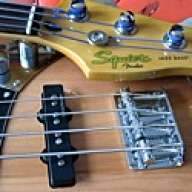
VERY attractive pieces, however, are a dime a dozen. I find the Squier Vintage Modified maple body of my FrankenSquier bass to be extremely attractive, and could you take it in a time machine back to 1965 at it's same relative price to offerings of the day as it is now, with the finish quality it offers, nothing could have stopped it.
We won't even go to the question of the sonic qualities, or lack thereof, exotic woods of boutique basses may or may not offer. While it may very well be true that there are to some extent more than subtle differences to be found, the actual discernment of those differences in real world performances in a blind testing might be much more difficult to suss out than the player dropping his GAS wad might believe. Floating around here somewhere on TB is the 2x4 bass test, or some such thing. As I recall, sonic differences were found, but nowhere near what the pricing of ANY boutique bass might suggest. YMMV.
Mechanicals - In a world where Hipshot, Schaller, Gotoh, and the other familiar handful of brands exist, rare is the instance where a boutique actually produces a custom piece, at least beyond a custom labeled product. It is beyond the capacity of most boutiques to manage the capital to do so. It would seem that Babicz is genuinely a boutique bridge with a significant difference (eccentric cam string height adjustment) but when you break down everything else the others offer the differences are few and minor, or meaningless in the face a properly chosen not as-adjustable simpler mech.
Electronics - Yes, electronics vary, but ultra-custom electronics can be fitted to a mass-produced instrument for a fraction of the cost that purchasing them as original equipment installations on a boutique bass demand. Again, the boutique builder is commonly driven to the mass marketplace himself to provide the rarity of his special sauce to the marketplace. "We use ACME pickups!" Big whoop. There are ACME pickups closing on eBay in the next 10 minutes. He may actually make his own pups, but then he dilutes his own brand by selling them so I can install them on my Squier if I want. Um... isn't that kind of counter productive, at least in the pursuit of exclusivity?
Strings - Well, I don't see any maker genuinely making the fame of it's name based on truly individual string tech, other than perhaps Kala with the Ubass. Yes, boutique makers have their own brands, but I believe that satisfies the demand of the marketplace for the esoteric appeal as much as it actually provides a genuinely distinctive difference over the multiplicity of offerings of string specialty manufacturers. Commerce always seems to rape art.
That pretty much sums up, at least as an overview, the reality of mass vs. boutique in one guy's opinion. One question which comes to mind is, when does a boutique maker cross the threshold to being a mass marketer? That kind of turns the whole discussion inside out, doesn't it. Hasn't Sadowsky sort of become a junior Fender?
Howl though you might, I think the argument can be made that at some point in a price range beyond the market norm of high-quality mass produced goods, the appeal of boutique is as much to the ego of the buyer as to the rationality of the purchase argument. Any opinion to the contrary isn't going to wash with me.
If all the world had were Fender basses, the music we listen to wouldn't sound all that much different than it does today. At the bottom line it's just a fact.
iJazz - A fool and his money are soon parted.













 I just don't like the MIA Fender's I've played, but I briefly played a Carvin and loved it.