
Enjoy the benefits of a premium membership!
Upgrade Account
-
TalkBass has been independent since 1998. Add your voice.
Create a free account to reply to discussions, view embedded media, and browse with fewer display ads.
Join free Log in
Want zero display ads or expanded classifieds tools? Compare plans.
You are using an out of date browser. It may not display this or other websites correctly.
You should upgrade or use an alternative browser.
You should upgrade or use an alternative browser.
More options
Who Replied?

Turnaround
Commercial User
FWIW, I think there is far more value in getting a stock nut fine tuned, regardless of its material, than changing to brass or bone or synthetic.Thank you one and all, I have seen the light, and will not be installing a brass nut on my Shecter.


Just a note on the aluminum topnuts. The Peavey, and I believe the Danelectro, topnuts were die cast. The Peavey in the same mold as the bridge, saddles, knobs and neck plate. It was basically free since the weight of material was minuscule. Once you remove the skin that forms on the outside of a die cast part during the cool down process, the interior is very grainy, high friction and can't be polished. Worse thing that can be done to an aluminum topnut is to lower the action by filing the slots and causing the strings to hang up. Can't be cured. Everything was so accurate on the Peaveys that I've never seen one of theirs that really needed lowering. It's an area that's sorely neglected by 99.9% of manufacturers.
Aluminum extrusion will take a high polish and not give problems with hangups in the slots but a taste of graphite doesn't hurt. Small aluminum extrusion is normally available at local metal supplier/fabrication businesses. I use 1/8" through 1/4".
Aluminum extrusion will take a high polish and not give problems with hangups in the slots but a taste of graphite doesn't hurt. Small aluminum extrusion is normally available at local metal supplier/fabrication businesses. I use 1/8" through 1/4".

About aluminum nuts: I make mine from standard 6061 alloy bar stock. It machines and polishes up just fine. I've never had any issues with strings digging or dragging or causing significant wear in the slots. I wouldn't recommend using 3000 series alloy, which is what some of the hardware store extrusions are made of. That's soft and gummy.

I actually went the other direction ... my Spector came with a brass nut. When I downtuned it to BEAD, I had a synthetic one cut for it because I didn't want to marr the original. After a few months I went back to standard, but couldn't locate the original brass one ... so I still use the synthetic one cut for BEAD. The strings fit in there just fine, and I can't tell the difference between the 2. Still has sustain for days either way. Fresh strings matter more, IMO
Once you remove the skin that forms on the outside of a die cast part during the cool down process, the interior is very grainy, high friction and can't be polished.
this must be the difference with aluminum then, using the right alloy and not die-cast.I make mine from standard 6061 alloy bar stock. It machines and polishes up just fine. I've never had any issues with strings digging or dragging or causing significant wear in the slots.I wouldn't recommend using 3000 series alloy, which is what some of the hardware store extrusions are made of.
I make mine from standard 6061 alloy bar stock. It machines and polishes up just fine. I've never had any issues with strings digging or dragging or causing significant wear in the slots. I wouldn't recommend using 3000 series alloy, which is what some of the hardware store extrusions are made of. That's soft and gummy.
A local business has 6063 T-5 (used in die punching operations) and it works well. T-5 is the tempered hardness.

If you hear a significant difference, it's probably imaginary. They tarnish and just look bad after a while, often fall off because glue doesn't stick to them well. And some say that brass saddles suck tone, so wouldn't that apply to the nut as well?
I think the disadvantages of brass nuts outweigh the questionable touted benefits.
I've had a naval bronze nut on my US J plus for almost as long as I've had it and it's never been any problem at all. I split two plastic nuts directly under the G string in the first couple of months I owned it and my repair guy said I might want to consider a brass nut. He said he'd need to order some bar stock to make it and I offered to bring him a piece of naval bronze big enough to make a nut from. I gave him the key stock and he made a nut and after more than twenty years is still doing just fine.
i believe it's aluminum, something i would never use by choice!
I was about to mention looking for a hard enough alloy, but Mr. Johnson beat me to it.
Okay, I'll speak up as the contrarian, as usual. I use aluminum for the nuts on all the basses I build, and have been for many years. I used brass on some of my earliest models, but I found that I like aluminum better for various reasons. And yes, I've done back-to-back testing of brass vs aluminum vs bone vs several plastics.
In terms of sound, it's all about the hardness of the material. A metal nut, either brass or aluminum (or steel or titanium) will add some extra high end ring on the open notes, as compared to any of the softer materials. How much it will add depends on what you are comparing it against. If the current nut is bone or Micarta or some of the other harder plastics, the difference will be small. If the current nut is soft nylon or molded plastic, as used on lower priced basses, then the extra high end will be more noticeable.
Now, the question of whether the nut plays any part in the sound of a bass once you are fretting a note has been argued many times here on TB. It does play a part, but the amount of difference you'd hear by switching to brass will be small, and will depend on the overall design of the bass. If other parts of the bass's structure are already giving it a mushy sound, then switching to a brass nut won't suddenly make it bright and clear. Making the nut harder won't override the other mushy parts. But, if it's a tight stiff structure overall that's being made mushy by a soft mushy nut, then switching to a metal nut can clear it up.
My guess is that putting a brass nut on your Schecter will make a small improvement in the sound, but not a whole lot. Brass nuts don't do much of anything on most Fenders, which is why so many will argue that brass nuts are useless. They are talking about Fenders.
My Fender has a naval bronze nut made from key stock we used to make material stops out of in a little production shop I worked in.
Turnaround
Commercial User
I split two plastic nuts directly under the G string in the first couple of months I owned it and my repair guy said I might want to consider a brass nut.
Now there's a valid reason for changing the nut from plastic to brass. I'm not convinced about other reasons for the switch, though looks may be valid if that's your vibe.
...Now there's a valid reason for changing the nut from plastic to brass...
My vibe is pretty simple. If it works don't fix it.

If you hear a significant difference, it's probably imaginary. They tarnish and just look bad after a while, often fall off because glue doesn't stick to them well. And some say that brass saddles suck tone, so wouldn't that apply to the nut as well?
I think the disadvantages of brass nuts outweigh the questionable touted benefits.
Never heard about them sucking tone, better tell the people who makes bells out of them.
Tarnish, if bothersome, clearcoat it before installing.
Being metal, a couple of lines/grooves filed into the bottom prevents shear................on any nut material.
Never had a brass nut cleave on me under a string.

Instead of different nuts I installed zeroglide zerofrets on my Rick 4003s and Pbass. I like how the open strings sound like a fretted note now, others prefer the standard sound of an open string with a nut.
First thing comes to mind is less contact area than a solid one piece nut, also those screw heads look like they might catch the round wound strings and interfere with tuningallparts has this: ABM Precision Bass Adjustable Brass Bass Nut | Allparts.com
is this something along the line of what you're thinking?
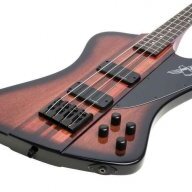
You'll be more impressed if you get brass string saddles. Check out the new 5 string j-bass which comes with them factory fittedWhat can I expect if I replace the plastic nut on my bass with a brass one? Bass in question is a Shecter Stiletto neck-through 5 string.View attachment 897721
What are the Pros using to fix the nut in place? CA Glue? Elmers white glue? Is it OK to leave paint under the nut, or does it have to be scraped back to bare wood?
What are the Pros using to fix the nut in place? CA Glue? Elmers white glue? Is it OK to leave paint under the nut, or does it have to be scraped back to bare wood?
I fasten my aluminum and brass nuts down with a pair of 4-40 socket head cap screws, threading directly into the maple (or other wood) of the neck. It clamps them down tightly to the wood, which is good for sound reasons, and they are easily removable for maintenance.

What are the Pros using to fix the nut in place? CA Glue? Elmers white glue? Is it OK to leave paint under the nut, or does it have to be scraped back to bare wood?
White or yellow. Wood glue is easier to clean up and is almost accident-proof. Some folks like CA because it's faster.
The glue keeps the nut from moving laterally, especially important for string paths that are not in a straight line from bridge to tuner. String pressure holds the nut down to the fingerboard.
A "permanent" bond, like epoxy, isn't a good idea. At some point the nut will need to be removed. There is little to recommend sawing, grinding, chiseling, and other heavy tool use when a gentle tap and a wiggle or two normally does the trick.

Funny stuff about sustain. I had a customer that wanted a high mass bridge and a brass nut for maximum sustain, then installed a foam mute.
But would his stock bridge and nut have resulted in less sustain from his foam mute that is the big question?
Also how much sustain do you really need?
I really haven't encountered any basses that couldn't hold a note for a couple of bars, and how often do you actually need a note to ring through for more than a couple of bars?


and how often do you actually need a note to ring through for more than a couple of bars?
I have fairly often, but what I usually do there is lightly and quickly roll the note with the very tips of my fingers. Once you get the hang of it, it's no big deal to keep the note going for dozens of bars if needed.


