
Enjoy the benefits of a premium membership!
Upgrade Account
-
TalkBass has been independent since 1998. Add your voice.
Create a free account to reply to discussions, view embedded media, and browse with fewer display ads.
Join free Log in
Want zero display ads or expanded classifieds tools? Compare plans.
You are using an out of date browser. It may not display this or other websites correctly.
You should upgrade or use an alternative browser.
You should upgrade or use an alternative browser.
Bugera all tube head
- Thread starter bassadicct
- Start date
More options
Who Replied?Here is update
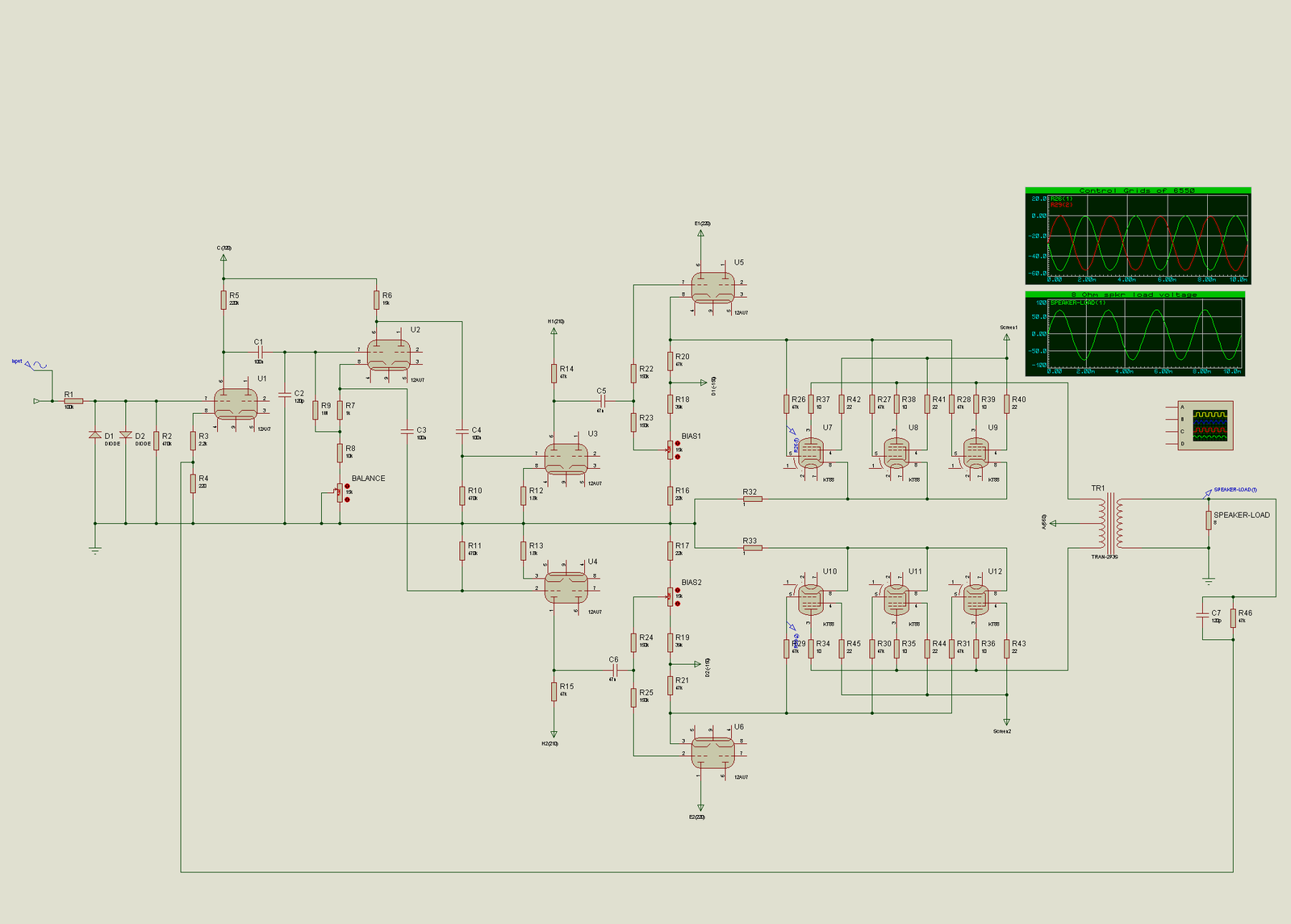
I have only KT88 model, not 6550, it's not a big difference I hope
Transformer 1.9 KOhm Ra-a
Bias set to 0.072 mV over test resistor (24 mA per Tube)
Dummy speaker load 8 Ohm
Test #1 (No feedback from OT)
Input signal 0.12V amplitude, 400Hz
Voltage swing over speaker 70V (140V ptp)
Current: 70V / 8 Ohm = 8.74 A
Power peak: 70V * 8.74A = 611.8 W
Power RMS = 611.8W / 2 = 305.9 W
No diode clipping.
Test #2a (With feedback from OT)
Input signal 0.12V amplitude, 400Hz
Voltage swing over speaker 16V (32V ptp)
Current: 16V / 8 Ohm = 2 A
Power peak: 16V * 2A = 32 W
Power RMS = 32W / 2 = 16 W
No diode clipping.
Test #2b (With feedback from OT)
Input signal 0.55V amplitude, 400Hz
Voltage swing over speaker 70V (140V ptp)
Current: 70V / 8 Ohm = 8.74 A
Power peak: 70V * 8.74A = 611.8 W
Power RMS = 611.8W / 2 = 305.9 W
No diode clipping.
I have only KT88 model, not 6550, it's not a big difference I hope
Transformer 1.9 KOhm Ra-a
Bias set to 0.072 mV over test resistor (24 mA per Tube)
Dummy speaker load 8 Ohm
Test #1 (No feedback from OT)
Input signal 0.12V amplitude, 400Hz
Voltage swing over speaker 70V (140V ptp)
Current: 70V / 8 Ohm = 8.74 A
Power peak: 70V * 8.74A = 611.8 W
Power RMS = 611.8W / 2 = 305.9 W
No diode clipping.
Test #2a (With feedback from OT)
Input signal 0.12V amplitude, 400Hz
Voltage swing over speaker 16V (32V ptp)
Current: 16V / 8 Ohm = 2 A
Power peak: 16V * 2A = 32 W
Power RMS = 32W / 2 = 16 W
No diode clipping.
Test #2b (With feedback from OT)
Input signal 0.55V amplitude, 400Hz
Voltage swing over speaker 70V (140V ptp)
Current: 70V / 8 Ohm = 8.74 A
Power peak: 70V * 8.74A = 611.8 W
Power RMS = 611.8W / 2 = 305.9 W
No diode clipping.

Nice work! This is what modeling is all about.
Put the spice model anywhere?
Can you do a frequency sweep - say starting at 40hz
Can you add a reactive load like:
http://www.duncanamps.com/technical/dummyload.html
Can you take the amp to clipping and do a spectrum analysis at a few spots up to and past clipping?
Put the spice model anywhere?
Can you do a frequency sweep - say starting at 40hz
Can you add a reactive load like:
http://www.duncanamps.com/technical/dummyload.html
Can you take the amp to clipping and do a spectrum analysis at a few spots up to and past clipping?
It is not a spice model, it is Proteus ISIS 7.0  (i can e-mail it)
freq response is flat from 20 Hz till 20+ KHz with feedback, and till 7-8 KHz without feedback on dummy resistive load
with reactive load like http://www.duncanamps.com/technical/dummyload.html freq sweep looks like
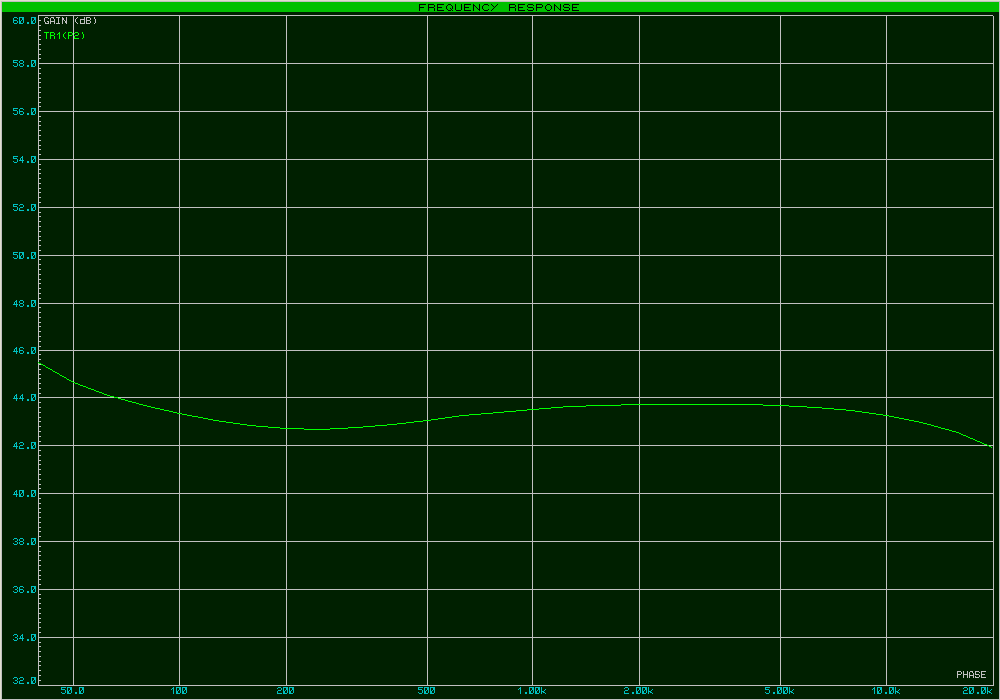
that low freq resonance (caused by feedback i think) will be eaten by OT in real life
I don't know how to do freq analysis in clipping mode in Proteus
(i can e-mail it)freq response is flat from 20 Hz till 20+ KHz with feedback, and till 7-8 KHz without feedback on dummy resistive load
with reactive load like http://www.duncanamps.com/technical/dummyload.html freq sweep looks like
that low freq resonance (caused by feedback i think) will be eaten by OT in real life
I don't know how to do freq analysis in clipping mode in Proteus

So has anybody priced or played one yet?
FWIW, The guitarist in a stage band I played with the other day was using a tube Bugera combo, and it sounded really good, kind of Fender-y, with a touch of Marshall-ness.
FWIW, The guitarist in a stage band I played with the other day was using a tube Bugera combo, and it sounded really good, kind of Fender-y, with a touch of Marshall-ness.

Guess it's out of the gate now. Let the games begin.
[Invalid or Expired Link Removed]
Edit: Spoke too soon. According to this site, it's available in June.
Link Removed
[Invalid or Expired Link Removed]
Edit: Spoke too soon. According to this site, it's available in June.
Link Removed
It may be a while before the US sees them:
"This product is currently not available for sale in the United States and Canada pending verification of compliance with applicable technical standards and regulations."
Hard to see what in a tube amp would cause any FCC problems but B* can't risk any further lawsuits.
"This product is currently not available for sale in the United States and Canada pending verification of compliance with applicable technical standards and regulations."
Hard to see what in a tube amp would cause any FCC problems but B* can't risk any further lawsuits.
Some Bugera related feedback for you all, for what it is worth.
I use the BVP5500, not a tube amp though. It has, thus far, been very solid. Great head for the price. I actually really, really like this head. With the "Valve" gain maxed, I get some pseudo saturation going and it has a ton of power and great, really great, tone.
I have to warn my fellow TB'ers though...
My guitarist picked up the 333xl, an all tube amp, and has had nothing but problems. So far he has had one replaced outright (never was told the reason for failure, but we are pretty sure it was transformer related) and his replacement is currently in the shop, which was an upgraded version, or so we were told. There is a problem with his replacement head in regards to sudden power loss... it just stops working at will. The guy doing the warranty work has not been able to duplicate the issue, which is not a good thing. We finally decided that we could not rely on that head any more and will be offloading that thing asap. We knew the risk and we are paying for making the wrong decision.
Just food for thought. Perhaps they can work out the bugs. If that were the case, I would be all for it. The 333xl sounds AMAZINGLY good. It really does, but it has to work. Which it simply does not.
I use the BVP5500, not a tube amp though. It has, thus far, been very solid. Great head for the price. I actually really, really like this head. With the "Valve" gain maxed, I get some pseudo saturation going and it has a ton of power and great, really great, tone.
I have to warn my fellow TB'ers though...
My guitarist picked up the 333xl, an all tube amp, and has had nothing but problems. So far he has had one replaced outright (never was told the reason for failure, but we are pretty sure it was transformer related) and his replacement is currently in the shop, which was an upgraded version, or so we were told. There is a problem with his replacement head in regards to sudden power loss... it just stops working at will. The guy doing the warranty work has not been able to duplicate the issue, which is not a good thing. We finally decided that we could not rely on that head any more and will be offloading that thing asap. We knew the risk and we are paying for making the wrong decision.
Just food for thought. Perhaps they can work out the bugs. If that were the case, I would be all for it. The 333xl sounds AMAZINGLY good. It really does, but it has to work. Which it simply does not.
It may be a while before the US sees them:
"This product is currently not available for sale in the United States and Canada pending verification of compliance with applicable technical standards and regulations."
Hard to see what in a tube amp would cause any FCC problems but B* can't risk any further lawsuits.
Well perhaps it is enough current and voltage inside of the amp that is needed to power six 6550's... we are talking about a 300w tube amplifier. The United States is very picky on its consumer regulations mate. Meant to keep all of us safe.. that does not take into acount stupid user error however!

Its better to take a long time making sure it is FCC compliant, then rushing a product, and having every Metallica fan get shocked and so on as soon as they turn the amplifier on.
Bugera/Behringer has had recent Lawsuits? Since when?
Behringer/Bugera is a huge company who sells thousands of products a year, is run by Germans, and has has hundreds of new products a year.

..."This product is currently not available for sale in the United States and Canada pending verification of compliance with applicable technical standards and regulations."
Hard to see what in a tube amp would cause any FCC problems but B* can't risk any further lawsuits.
I suspect that this means that they've submitted the amp to a third party safety certifier, not the FCC. I'd like to say that they have submitted it to UL, but I believe that every Bugera amp I've seen has been Listed by ETL (using UL Standards).
Bugera/Behringer has had recent Lawsuits? Since when?
FCC lawsuit against Behringer
Invalid Link Removed
And there's always some lawsuit out there
[Invalid or Expired Link Removed]
I appreciate the actual backing up mate. Often times people just don't reply when you take them up on something. 
just an update.
Bugera service seems solid, but the local guys we found for warranty work... well you know how that goes.
Turns out this time it was a bad Molex connector, so I will let folks that know what the heck that is chime in, if needed.
I have to say, I wont pick up any bugera tube heads until I see this thing last more than 3 practices, which is all we have gotten out of one thus far.
The BVP5500, on the other hand, has hours and hours of use in a short time (I am a bit addicted to playing) and is pumping along like a champ.
Bugera service seems solid, but the local guys we found for warranty work... well you know how that goes.
Turns out this time it was a bad Molex connector, so I will let folks that know what the heck that is chime in, if needed.
I have to say, I wont pick up any bugera tube heads until I see this thing last more than 3 practices, which is all we have gotten out of one thus far.
The BVP5500, on the other hand, has hours and hours of use in a short time (I am a bit addicted to playing) and is pumping along like a champ.

rats, beat me to it.From the link-
"There are lots of amplifiers on the market today that claim to be valve amps just because theyve got a 12AX7 inside. But it takes a whole lot more than just a preamp tube to qualify an amp as being 'all-valve.'"
From MusiciansFriend-
"The Bugera BVP5500 Valve Bass Amplifier Head begins with 2 selected pairs of 12AX7 preamp tubes with their own Drive control. When you want to rock the house, the BVP5500 bass amp brings the serious power with 550 clean, fan-cooled watts to the table."
Irony. Sometimes, it's a real bastard.
It bugs me that the Bugera Valve amp is listed under tube amps on MF when other tube SS hybrids by much more...sincere companies arent.
Also, there are a lot of bass players that dont waste their time on talkbass researching amps, they just deposit their paycheck and go straight to the store/website and buy whatevers.
As far as the bugera amp with tube output. Please, everybody buy them. That way I will easily sound better than most other bass players.
About 6550's putting out 300 watts; no problem, 6550's are more heavy duty than 6L6's and can handle higher volts.
El34's can go even higher believe it or not. Or have you not met the 90 watt Traynor YBA1a with only 2 EL34s?

It is not a spice model, it is Proteus ISIS 7.0
freq response is flat from 20 Hz till 20+ KHz with feedback, and till 7-8 KHz without feedback on dummy resistive load
with reactive load like http://www.duncanamps.com/technical/dummyload.html freq sweep looks like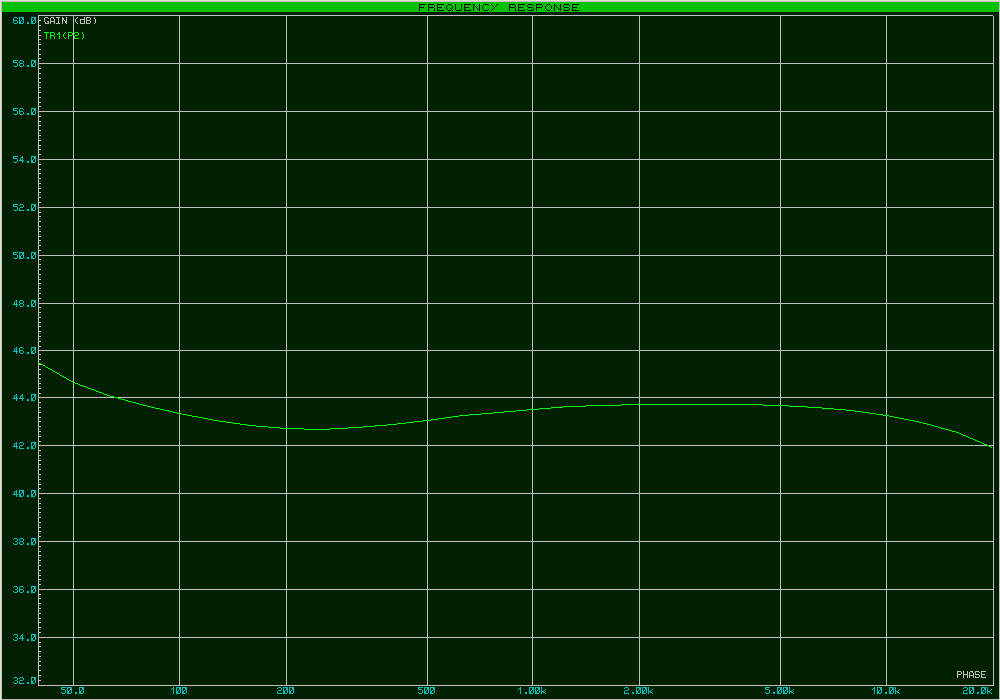
that low freq resonance (caused by feedback i think) will be eaten by OT in real life
I don't know how to do freq analysis in clipping mode in Proteus
Frequency analysis usually assumes a small signal model. But you could model some clipping waveforms using a simple time sweep with, say, 100 and 1000 Hz sinewaves. That would be very interesting to see.
I don't get it? Why all the tripping. An all tube 300 watt amp for under a grand? Might not have status written all over it but perhaps y'all are missing some perspective...
Most Japanese guitar makers, Ibanez being the leading example were cheap, flaky copies of classic original designs. Years later, they sorted their stuff out and now Japanese gear of all kinds is widely desired.
So the Bugera might have a few kinks in the beginning. But the price point slays, and if the design isn't too busy and components not overly cheap (remember, made in China isn't necessarily a bad thing when it comes to quality control and consistency) a few mods here and there... well, it could end up being a collectors item...
Or it could be crap. Either way, more people, more tubes, more happiness!
I hear this argument a lot from Behringer apologists. Behringer is not known for high quality gear. They are known for cutting corners in areas that matter like power supply components. most every broken behringer I have ever seen was power supply failure. Tube amps are pretty dependent on having robust power supplies. Especially bass amps. There are a couple of guitar amps that sound great because the power supplies sag and groan with effort with every note. Not what most bassists want!
I also wouldnt want some bad quality solder job to cause 500 volts to somehow show up at my bass pickups.
Behringer has been busted putting "UL listed" logos on things that arent. They have been busted selling gear that was never electrically evaluated for sale in the US market. This makes me wary of the safety of their gear. Not as crucial with solidstate. Much more so with tubes which have hundreds of volts flying around inside.
... They have been busted selling gear that was never electrically evaluated for sale in the US market. ....
Third party safety certifications (UL Listing, etc.) are voluntary in the US, they're not required by any government agency (that I'm aware of).
Third party safety certifications (UL Listing, etc.) are voluntary in the US, they're not required by any government agency (that I'm aware of).
Darn I cant remember the deets of it. I do know I had a product I was going to try and market a little while back but the costs associated with getting it cleared for domestic sale where more than I had on hand in capital, and I am not worthy of a business loan :scowl:.
There is the FCC one for sure. But I seem to recall another rating/test as well.
There are links previous in this thread about the FCC suit. But UL and I believe CE brought suits against them. Regardless of whether you need those stickers on your gear to sell it, Behringer was slapping them on their products without so much as talking to UL.
The diodes are at 0 volts DC, and there's quite a bit of local feedback in the first stage, the second stage is the phase splitter, and the third section is a cathode follower driving the grids (no voltage gain) with some bias coordination.
I do not think there's enough gain for the output stage to be driven into clipping before the diodes begin to conduct, their conduction slope (compression/limiting/distortion) along with the natural clipping of the output stage when pushed harder, will most likely result in a good part of the overdriven sound of this amp.
Sometimes there's more to a circuit than meets the eye, and in this case I think I know WHY they are there and WHY they improve things for the intended market, but since I didn't design the amp, it would be pure speculation on my part. The guys who originally designed the SVT platform are REALLY sharp guys and the one that I know is absolutely qualified to make whatever design decisions he want to... and they have earned (and continue to earn) this respect.
Anybody know if the new Bugera amps include such circuitry as diodes in the signal path?
I'm curious if they thought they would be a good idea either for "protection" or for adding overdriven sound?


