• TalkBass has been independent since 1998. Add your voice.
    Create a free account to reply to discussions, view embedded media, and browse with fewer display ads.
    Join freeLog in
    Want zero display ads or expanded classifieds tools? Compare plans.

Bugera Bass Combo Amplifier who has played them?

I know this is an old thread, but I'll chime in. I bought a Demo of the Bugera BXD15A Combo Amp from Sweetwater. When it arrived, the box was in horrible shape. The looked and sounded nice. My first gig with it, the DI was cracking and popping, and back it went. I figured it had something to do with the fact it was a demo amp. I just bought a brand new one from Sweetwater today and hopefully the DI will work.
 
That’s the electrical wattage load not the power amp output.
I own Turbosound PA systems and monitors.
3000 watt with 2-18”
They blow away QSC and JBL same class PAs
Peak power vs RMS power are totally different.
This bass amp at 1000 Watt peak is probably about 500 watt or less RMS.
The single 15” Turbosound speaker does and will handle it.

I have this bass amp coming tomorrow and will be used at 2 rock shows this weekend.
I’ll follow up on how it performs next week.
 
So a still a lot have suggest it is BS and the wattage that they claim is BS, but I still am looking to hear from someone who purchased this combo and can give us all definitive proof ( say it vs a 800w something or other) that it will take down walls or it isn't what it is said to be
a 1000 watt class D amp.

he clearly states in is a 1000 watt amp in this video
 
So a still a lot have suggest it is BS and the wattage that they claim is BS, but I still am looking to hear from someone who purchased this combo and can give us all definitive proof ( say it vs a 800w something or other) that it will take down walls or it isn't what it is said to be
a 1000 watt class D amp.

he clearly states in is a 1000 watt amp in this video


Maximum sustainable SPL at the frequencies you need is the information that you seem to be looking for. This information is almost but not entirely unrelated to the wattage of the amplifier.

Reading the thread it seems like the actual problem you have is concern over FoH replicating your tone on larger gigs correct? I think that increasing stage volume is a very sub-optimal way to approach resolving that problem. At any gig large enough to have adequate PA, the dispersion and power you’ll get from the FoH rig will be better than anything you can reasonably get on stage.

If I was in your shoes I would concentrate on getting the best tone possible to the sound guy, and then trust him/her to make it sound good in the room and or the mix.

Best options for giving FoH a great tone are probably a high quality DI or pre-amp that sounds like you want, or a small rig with a good mic on it. And honestly just a decent sounding cab close mic’ed with a 57 will be leaps and bounds better than trying to out do the PA at a festival or something.

 
Maximum sustainable SPL at the frequencies you need is the information that you seem to be looking for. This information is almost but not entirely unrelated to the wattage of the amplifier.

Reading the thread it seems like the actual problem you have is concern over FoH replicating your tone on larger gigs correct? I think that increasing stage volume is a very sub-optimal way to approach resolving that problem. At any gig large enough to have adequate PA, the dispersion and power you’ll get from the FoH rig will be better than anything you can reasonably get on stage.

If I was in your shoes I would concentrate on getting the best tone possible to the sound guy, and then trust him/her to make it sound good in the room and or the mix.

Best options for giving FoH a great tone are probably a high quality DI or pre-amp that sounds like you want, or a small rig with a good mic on it. And honestly just a decent sounding cab close mic’ed with a 57 will be leaps and bounds better than trying to out do the PA at a festival or something.
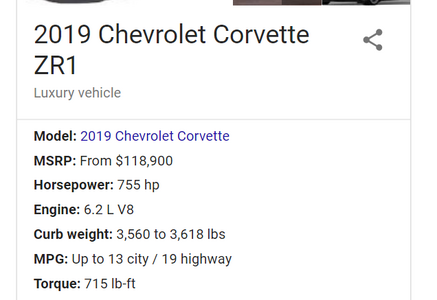
Thanks but clearly I am not I am simple trying to determine like any other purchase that what I am hearing is the truth such as if you tell me my ZR1 is producing this 755hp and I am going to pay $120,000 for the car that I should not be second guessing the hp that is being claimed. see what I am getting at.
 

Attachments

  • upload_2018-11-26_16-14-42.png
    upload_2018-11-26_16-14-42.png
    26.1 KB · Views: 40
Do you mean like the fuel mileage claims? Like The horsepower claims (gross HP, brake HP, or is it a calculate from torque horse power number)?

Without the specific metrics, a number is nothing more than a number.

 
  • Like
Reactions: Balog
Ok.

The quoted specs for the Bugera are probably true is some technical way, but are misleading at best.

Even if the specs were true they would provide almost no usable information.

Your proposed course of action will not solve the issue you are having.
 
I just want to know if I am paying for a 1000 what amp I want headroom of a 1000 watt amp. I have a 300 SVT I know where my headroom is and I know how much I can get out of it. btw playing 49 years this year I have played through and damn near every amp on the planet not my first rodeo. I know my SVT isn't going to produce the 375 RMS that is peak when all your ducks are in a row and all of the planets have a line and maybe not then either, but you know you are sitting on a ton of headroom. Since people like Victor Wooton are standing behind this brand I just want to know again if anyone has one and what is your finding.
Do you mean like the fuel mileage claims? Like The horsepower claims (gross HP, brake HP, or is it a calculate from torque horse power number)?

Without the specific metrics, a number is nothing more than a number.
Come on man they throw it on a dino they have tweak that computer on that 6.2-liter supercharged V8 duel fuel injected to give you what you pay for this isn't your daddies corvette top speed is 210 mph ZR1 can hit 60 miles per hour from a standstill in 2.85 seconds and hit 100 mph in 6.0 seconds. The supercar is capable of completing a quarter-mile race in 10.6 seconds at 134 mph.
 
The Behringer class-D "iNuke" amplifier is claimed to be 3,000 watts, some Link Removed said it actually outputs 625 watts RMS with a continuous 1 KHz sine wave. If you apply the same ratio of "Behringer Watts/RMS continuous watts" the BXD15 would be about 208 watts continuous. This is a "guesstimate" at best, but it sounds about right, given the cost and size of this amp.

By the way, in the thread I linked to above, there's a rather lengthy explanation from Uli Behringer himself explaining the hows and whys of their fabulous power ratings. I didn't take time to read it.

 
This problem of varying units is not restricted to bass amps, or even music instrument amps. If you’re old enough to remember the sixties, you may recall that car makers were advertising huge amounts of power. Then, seeming over night the power ratings of the engines dropped a lot. What had been the case is that some manufacturers were testing their engines with no mufflers, no air cleaners, no auxiliary equipment like power steering pumps, air conditioning compressors, or even generators. That helped the engines look really strong for advertising, but once you hooked all that stuff up to put it on the street, the numbers dropped.

Similarly, if you look at the gasoline pump, you will see that the rated octane is (r+m)/2. This reflects the two different ways of calculating octane, Research and Manufacturers. As the manufacturers sought ever higher octane numbers, their numbers differed from the pure research values. The feds stepped in and made them average the two for advertising purposes.

The indiscriminate trampling of watt values has existed in home stereo and car stereo markets for generations. Remember advertising copy is written by the marketing guys, not the engineers in many cases.
 
The Behringer class-D "iNuke" amplifier is claimed to be 3,000 watts, some Link Removed said it actually outputs 625 watts RMS with a continuous 1 KHz sine wave. If you apply the same ratio of "Behringer Watts/RMS continuous watts" the BXD15 would be about 208 watts continuous. This is a "guesstimate" at best, but it sounds about right, given the cost and size of this amp.

By the way, in the thread I linked to above, there's a rather lengthy explanation from Uli Behringer himself explaining the hows and whys of their fabulous power ratings. I didn't take time to read it.

After reading that BS from Uli Behringer I now have much less respect for their company than before. What a used car salesman.
 
Uli's statements are factual and fair:

Although over the years there have been attempts at standardizing the way power amplifiers are measured and rated, it appears to me that even in the face of legislation, there continues to be no consensus in the pro audio industry.
...
There was a time when the accepted method for measuring amplifier power was to inject a sinusoidal signal (usually 1 kHz) and measure the output just as the sine wave began to distort.
...
The problem with this method is, as most manufacturers and users discovered over time, that it measures a parameter that may not necessarily be the best predictor of actual amplifier performance. Real program material, whether it be music or speech, is very different from a sine wave and it is a leap of faith to correlate one to the other. Imagine a car that is capable of pulling a heavy load up a mountain compared to one that accelerates aggressively; which one is more powerful? It depends on what your objective is.​
 
Never trust Behringer marketing. Try before you buy. It's probably decent for the price but as everything else in life you get what you pay for.
 
So a still a lot have suggest it is BS and the wattage that they claim is BS, but I still am looking to hear from someone who purchased this combo and can give us all definitive proof ( say it vs a 800w something or other) that it will take down walls or it isn't what it is said to be
a 1000 watt class D amp.

he clearly states in is a 1000 watt amp in this video

That amp sound horrible ....