

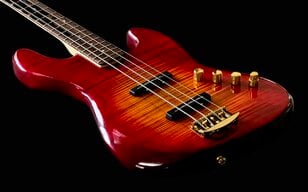
Yes, I use Briwax and similar products on items of furniture I make. I actually used colourless Liberon wax on my Carl Thompson style bass after oiling. I am not sure about Briwax as to whether it is colourless or slightly ambering.
I would recommend stockpiling as much old cotton material as possible for the buffing process. Denim is pretty good at first then softer "pillowy" cotton later. I would say that it is worthwhile taking your time with waxing as applying too much at once becomes very hard work when dry and it is time to buff it out. That harder work can translate into putting too much pressure into buffing and creating streaks or a bad finish in areas. Many thin coats lightly buffed out completely to a soft slippery gloss.
Briwax is thinner than the Liberon wax which says to me that it has less solids
/binding agents or just more solvent. Both are equally good for my uses however but I can't comment on how Briwax would work on an instrument finish as I have only used the Liberon. Equally I am unsure how the solvent (Toluene in Briwax) will react with your varnish, if at all.
Both waxes have a consistency like thin cream when it warms up to body temperature. Briwax is consistently like a creamy jelly and Liberon is like solid butter. I guess you could warm the tins up in hot(tish) water but this has never been necessary for me.
Briwax is cheaper although I do not entirely believe that the higher cost of the Liberon waxes mean they are superior.
This is how wax looked before and after over a curing oil finish (Tru-oil). Given that an oiled finish is relatively satin for the most part, wax brings up the gloss quite well. Wax over your varnish finish buffed up to a good gloss should become very glassy. Much glassier than the following examples.
BEFORE (a more diffuse satin-y look):
Link Removed
AFTER (additional cured coats of oil, flattened then thin layers of wax buffed out till surface becomes almost frictionless):
Link Removed
Link Removed
In the context of furniture, this is purely one layer of Briwax "Walnut" over plain Birch (think, "Maple") sanded up to 400 grit. The gloss comes just from the wax being buffed up.
Link Removed
Link Removed
I think that you would be best testing your Briwax on any scrap pieces you used to test your finish, if you kept those. My only concerns would be the presence of solvents and the potential for the wax to amber your existing finish slightly. Other than that, I think it will be great.
Lonny - what specific waxes did you have in mind? I was wondering whether there are any out there with high solids content of Carnauba which to my mind would be harder and glossier over the longer term than "furniture-grade" waxes.
I would recommend stockpiling as much old cotton material as possible for the buffing process. Denim is pretty good at first then softer "pillowy" cotton later. I would say that it is worthwhile taking your time with waxing as applying too much at once becomes very hard work when dry and it is time to buff it out. That harder work can translate into putting too much pressure into buffing and creating streaks or a bad finish in areas. Many thin coats lightly buffed out completely to a soft slippery gloss.
Briwax is thinner than the Liberon wax which says to me that it has less solids
/binding agents or just more solvent. Both are equally good for my uses however but I can't comment on how Briwax would work on an instrument finish as I have only used the Liberon. Equally I am unsure how the solvent (Toluene in Briwax) will react with your varnish, if at all.
Both waxes have a consistency like thin cream when it warms up to body temperature. Briwax is consistently like a creamy jelly and Liberon is like solid butter. I guess you could warm the tins up in hot(tish) water but this has never been necessary for me.
Briwax is cheaper although I do not entirely believe that the higher cost of the Liberon waxes mean they are superior.
This is how wax looked before and after over a curing oil finish (Tru-oil). Given that an oiled finish is relatively satin for the most part, wax brings up the gloss quite well. Wax over your varnish finish buffed up to a good gloss should become very glassy. Much glassier than the following examples.
BEFORE (a more diffuse satin-y look):
Link Removed
AFTER (additional cured coats of oil, flattened then thin layers of wax buffed out till surface becomes almost frictionless):
Link Removed
Link Removed
In the context of furniture, this is purely one layer of Briwax "Walnut" over plain Birch (think, "Maple") sanded up to 400 grit. The gloss comes just from the wax being buffed up.
Link Removed
Link Removed
I think that you would be best testing your Briwax on any scrap pieces you used to test your finish, if you kept those. My only concerns would be the presence of solvents and the potential for the wax to amber your existing finish slightly. Other than that, I think it will be great.
Lonny - what specific waxes did you have in mind? I was wondering whether there are any out there with high solids content of Carnauba which to my mind would be harder and glossier over the longer term than "furniture-grade" waxes.





 .
.


