• TalkBass has been independent since 1998. Add your voice.
    Create a free account to reply to discussions, view embedded media, and browse with fewer display ads.
    Join freeLog in
    Want zero display ads or expanded classifieds tools? Compare plans.

Building a superior 2x10 cab

OP, to me it seems some of the crossover related issues could be solved by using a dedicated processor + a good PA cab without passive filters + a power amp. My Community SLS PA(to take one example) goes from "quite OK" to "impressive" when you the step up from generic electronic crossovers and eq to a dedicated processor. Processors are pretty affordable second hand.
Just a thought.
 
OP, to me it seems some of the crossover related issues could be solved by using a dedicated processor + a good PA cab without passive filters + a power amp.

Thats indeed the best way to go when you only have a bass-preamp. I did have a stereo poweramp with built in electronic crossover and such a setup worked very well.
But now I have a bassamp(head) so this design is based on the passive principle.

But, when you want the most out of the 2x10 cab with tractrixhorn then you should use a stereo poweramp (or two separate mono amps, one with aprox 400watts rms and the other like 80watts rms) And then do the whole crossover stuff with a DSP. You also will need some measuring equipment to tune the crossover.
 
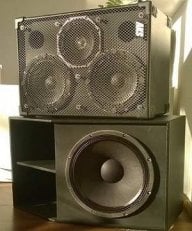
You mean like THIS?

GB1288T-UQ_sm1.jpg

Sorry for the slight hijack, but I just got this cab, and it sounds very VOCAL, and 3 dimensional.

Would an SWR Triad do what you are all thinking about?
Seems it has a driver for every need.
 
Just for grins an' giggles I modeled both the Oberton and the Beyma drivers on WinISD last night. Also printed out the graph which was posted. I understand the desire to "ignore" the bottom octave, but in order to render the low-midrange "flat", the response drops off like a rock about 100Hz. Looks like the first overtone on low B is -3/4dB.. I'm just trying to get educated here.. I've designed and built some cabs, learned a few lessons.. Just seems to me the LF cutoff is a bit steep..
 
the response drops off like a rock about 100Hz

First, this is a simulation (which is actually pretty accurate)
Second, do you really believe the specs of all these bass cab manufacturers?
In the past I simulated a few of them, and none of them did what they promissed.
The TSP's of the Oberton speakers are very well chosen, there are very few manufacturers that have a driver with such ideal parameters for a bassguitar loudspeaker.
I tried the Oberton in a test cabinet and I also compared it to the Eminence deltalite II. Both have about the same response in a 30 liter cabinet. The main difference is the very audible distortion of the deltalite when you push it beyond xmax.
 
Why would part of your design goals be to push your drivers beyond xmax?

For most 10" woofers the xmax is not very high, maybe 3 to 5mm. When you play live the woofers will easily go beyond that, e.g. when you thumb the E-string. So, what you want is that the woofer has a progressive suspension to keep the distortion from rising rapidly. There are also other design tricks that can keep the distortion within certain limits when the driver goes beyond xmax. What I noticed with the deltalite is that the distortion comes in very rapidly once you go beyond xmax. Us bassists need a great dynamic range. Some choose a large cone area and limited excursion. Others want a smaller cab (which means in most cases a smaller cone area) but keep the same air displacement, so they need a large xmax and a design that will keep the woofer from distorting rapidly once it gets beyond xmax.
Xmax seems to be a trendy word these days, it's actually better to look at the distortion figures in the low frequency range at a pretty high spl.

Maybe I had Deltalites from a "monday morning" batch :D
But the Beta10's I had were even worse then the deltalites, so I think it's the design.
 
Why would part of your design goals be to push your drivers beyond xmax?

A good point. The OPs recommended driver looks OK for the application, which is crossing over at 1.5kHz or less. If that's what you're doing then the 2510 is the wrong driver to begin with, because what makes the 2510 is what it does above 1.5kHz. And it couldn't have the mids that it does if it had the specs to do below 100Hz what a multiway oriented driver can do. Comparing the two is very much an apples/oranges situation, as they properly should not be considered as candidates for the same usage. BP102 is far a better comparison among drivers that are readily available.
 
A good point. The OPs recommended driver looks OK for the application, which is crossing over at 1.5kHz or less. If that's what you're doing then the 2510 is the wrong driver to begin with, because what makes the 2510 is what it does above 1.5kHz. And it couldn't have the mids that it does if it had the specs to do below 100Hz what a multiway oriented driver can do. Comparing the two is very much an apples/oranges situation, as they properly should not be considered as candidates for the same usage. BP102 is far a better comparison among drivers that are readily available.

Bill, I hope I understand what you mean.
Why do you think I can not compare the Oberton to the Deltalite?
They look more similar (on paper) then the BP102.
You think the 2510 is a good mid/woofer? The Oberton behaves better in the mid range.
 
Bill, I hope I understand what you mean.
Why do you think I can not compare the Oberton to the Deltalite?
They look more similar (on paper) then the BP102.
You think the 2510 is a good mid/woofer? The Oberton behaves better in the mid range.

Are you sure you aren't thinking about the B102? Because the BP102 looks more similar to the Oberton you are thinking of than the Deltalite...by far.

The BP102 is not a good mid range driver. It excels in the low end, which also means it will not do well in the upper mids or highs. If you are thinking 2-way with a tweeter (as opposed to a mid range driver) then it really depends on how low you want to go overall. The BP102's xmax is 6.2mm and it's xlim is 10.0mm. I certainly don't hear much in the way of distortion before it reaches it's limit.
 
You think the 2510 is a good mid/woofer? The Oberton behaves better in the mid range.
That depends on what you consider good behavior. If it's a hi-fi or PA cab flat response through the mids is generally desirable. With a musical instrument driver run full range, not so much. And full range, or at least to its 3kHz useful limit, is what a 2510 is intended to do.
 
F What I noticed with the deltalite is that the distortion comes in very rapidly once you go beyond xmax.

I realise you're talking about the 10's, but my experience with 12's is that the Beyma speakers (112NdW) complain far more violently and audibly when pushed to Xmax than the Deltalite 2512's. So much so that I've stopped using the Beymas. I don't know if the same applies to the 10's and unfortunately there's no accurate way to model how a speaker will behave when stressed. You have to suck it and see I guess. Or better still, design your rig so you don't hit xmax.
 
Are you sure you aren't thinking about the B102? Because the BP102 looks more similar to the Oberton you are thinking of than the Deltalite...by far.

The BP102 is not a good mid range driver. It excels in the low end, which also means it will not do well in the upper mids or highs. If you are thinking 2-way with a tweeter (as opposed to a mid range driver) then it really depends on how low you want to go overall. The BP102's xmax is 6.2mm and it's xlim is 10.0mm. I certainly don't hear much in the way of distortion before it reaches it's limit.

I'm sure I'm talking about the BP102, the ones you have in your cabs.
The BP102 is indeed not a good midrange driver, and the way you combine it with a 6" mid is the way to go.
I never tried this driver so can't tell how it behaves in terms of distortion. But I believe you when you say you don't hear much of that before it reaches it's limit.
The xlim of the deltalite is 8mm (16mm in total), but when you drive it like that it sounds horrible.
I think the Oberton combines both worlds, good midrange and good bass response. In the ideal cabinet the BP102 will go deeper, but the cabinet needs to be BIG. The Oberton needs like 30liters to perform well, it's not going to produce the suboctave (which normal sized 10"cab does?). For that you need a dedicated subwoofer.
 
That depends on what you consider good behavior. If it's a hi-fi or PA cab flat response through the mids is generally desirable. With a musical instrument driver run full range, not so much. And full range, or at least to its 3kHz useful limit, is what a 2510 is intended to do.

What I consider good behavior is indeed flat response, but also a cone with no (or just a single) breakup node. And low distortion throught it's usefull range.

I allready explained the instrument/fullrange thing in post #13 of this thread

The 2510 can be used up to 2 khz, then breakup starts to occur. It's TSP's are actually quiet good to produce low bass, if they could only get rid of that nasty distortion......
 
I realise you're talking about the 10's, but my experience with 12's is that the Beyma speakers (112NdW) complain far more violently and audibly when pushed to Xmax than the Deltalite 2512's. So much so that I've stopped using the Beymas. I don't know if the same applies to the 10's and unfortunately there's no accurate way to model how a speaker will behave when stressed. You have to suck it and see I guess. Or better still, design your rig so you don't hit xmax.

What you tell is exactly what I get with the 10", so maybe the 12" is just designed better.

To see how a speaker behaves when stressed manufacturers need to show the distortion (h2 and H3) numbers at 90 and 100 dB for 10" woofers. And e.g. 100 and 110 dB for 15" woofers etc.
Manufacturers alse need to use Klippel, just to check if the "motor" is symetrical and other interesting stuff Invalid Link Removed
It looks like eminence uses Klippel, maybe they forgot to "klippel" the 2510 I had, heheheheh.

Yesterday I read through my collection of HobbyHifi and Klang&Ton magazines (yes, they are german loudspeaker magazines) to look for examples. I found a test of 15" woofers, some had similar xmax(on paper) but the distortion figures (below 100hz) varied dramatically. There was one 15" hifi woofer (Visaton TIW 400) that had even lower distortion figures at 105 dB then all the PA woofers that where in the test. There was one that came close, a Beyma driver.
 
Sundogue's approach keeps me thinking.
I did build something like that before (post #27) but the 5" drivers back then were not very sensitive.

But now I found this driver Link Removed
It looks like a good candidate, it's spl in the usable range (700 - 9000hz) is about 95-100dB. I would not use it below 700 because the distortion starts to rise. The Beyma 605nd also looks good, it has a slightly higher spl but it has more H3 distortion, bummer.
700hz is good because I (allmost) get the pointsource I'm after and I can (probably)keep an airinductor for the lowpass.....
 
Just like you say, there are more to "excursion" than "meets the eye". The Xmax will not reveal all geometrical properties that determine excursion related distortion, as two drivers with equal Xmax might behave totally differently due to the total length of gap and voice coil. Some expensive woofers have" inverted" or underhung gap/coil geometry and often perform far better in some areas. Power compression can certainly be audible, too, and some manufacturers go to extreme designs to deal with heat. Look at Volt for instance.

I have a couple of Deltalite II 2510 in an EBS ProLine cab and I do not (like Bill and many others) consider the peaky mids to be beneficial or useful in any way. I simply added an inductor in series with the woofers to tame the mids. The result is a decently flat response through the mids up to the point where the tweeter takes over.
The range under 60-70Hz is also not well covered with that box. It worked quite well a sub, though...