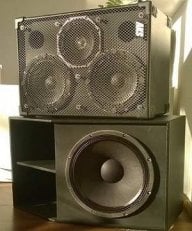
I'm now searching for a good 2" driver that I need to couple with the 8" tractrix horn. The tractrix horn has a mounting thread of 1 3/8". Does someone have experience with the eminence psd2002?

TalkBass has been independent since 1998. Add your voice.
Create a free account to reply to discussions, view embedded media, and browse with fewer display ads.
Join free Log in
Want zero display ads or expanded classifieds tools? Compare plans.

I'm now searching for a good 2" driver that I need to couple with the 8" tractrix horn. The tractrix horn has a mounting thread of 1 3/8". Does someone have experience with the eminence psd2002?
The exit is 1"but the voicecoil is 2".
So, what driver do you recommend for 1 3/8" mounting thread?
The price should be reasonable and the driver should be able to handle a crossover point of 1.5khz.

That cab has caught my eye as well, jlepre. The price though...ouch.

About the "studio" sound, well, what I want is a cabinet that has nearly no coloration. The coloration should come from the pre-amp and the bass it self. See it like this, what is the best way to get the same sound onstage and through the PA (when you channel your signal via the pre out to the PA) The best way is having a cab that is as neutral as it gets.
About multipledrivers.... When I use 2 10"woofers a round 8" tractrix horn with 2"driver and cross them at 1.5 khz I will get a very uniform radiation pattern because of the low crossover point and because the tractrixhorn has a very smooth radiation pattern. Also, I will have less phaseshifting and combing effects then a 2x10 cab and tweeter crossed at 3.5khz.
consider building the cab as a "two-and-a-half way"; that is, rolling off one of the woofers an octave or two below the crossover point. This technique is used in some large studio monitors that have two big woofers side-by-side and a horn above them. The advantage is, running a single woofer up in the crossover region widens the radiation pattern, and that wider radiation pattern in turn allows you to push the crossover frequency north a bit to where it's easier on your compression driver.
Best of luck with your design!
I did some simulations (software) and did not get good results for the two and a half way system. The crossover will get way too complex....
Any idea/guess as to what this cab would cost ?
Agree that the crossover will be complex.
Here's a link to measurements of a home audio two-and-a-half way system:
Invalid Link Removed
Figures 3 and 4 are of interest.
Not trying to talk you into it; just trying to show that a two-and-a-half way system can work.
Is there a special reason for you not to look for a studio monitor or good PA cab to this application? Is it cost?
Theoretically the main benefit to a 2.5 is realized when the crossover uses the 6dB voltage sensitivity increase of dual woofers to compensate for the 6dB sensitivity loss below the baffle step frequency. It also can be used to restrict the bandwidth of a second woofer to minimize the deleterious effects of horizontal placement, but that's better addressed by simply not placing woofers horizontally.The phase shift problem in 2.5 way design for home audio is perhaps compensated in the baffle gain?
Theoretically the main benefit to a 2.5 is realized when the crossover uses the 6dB voltage sensitivity increase of dual woofers to compensate for the 6dB sensitivity loss below the baffle step frequency.

Duke brought up the 2.5 with respect to the 2x10 cab, pointing out that with horizontally placed drivers they should either be crossed at less than 1.5kHz (IMO less than 1.2kHz would be better) or one of the woofers should be low-passed at that frequency or lower. His point was with respect to the inevitable comb filtering that would occur if they were run higher.Lets stick to the 2x10cab (and cabs in general) stuff
Duke brought up the 2.5 with respect to the 2x10 cab, pointing out that with horizontally placed drivers they should either be crossed at less than 1.5kHz (IMO less than 1.2kHz would be better) or one of the woofers should be low-passed at that frequency or lower. His point was with respect to the inevitable comb filtering that would occur if they were run higher.
What he didn't mention was the halving of the horizontal dispersion within the bandwidth where the drivers are fully coupled.
I'm all for building superior cabs, but you can't build one if you start with an inferior topology, and placing woofers horizontally does just that.
 .
.


