• TalkBass has been independent since 1998. Add your voice.
    Create a free account to reply to discussions, view embedded media, and browse with fewer display ads.
    Join freeLog in
    Want zero display ads or expanded classifieds tools? Compare plans.

Cabinet Stand

Out of curiosity I decided to try out using a cabinet stand at a gig last night. I perform with an Aguilar GS112 and Fender Jazz with tone and volume maxed and nickel roundwounds and no FOH sound. I made a quick plywood mock up prototype fashioned after the Atlas Low Rider stand. I set the angle at 30 degrees based on my proximity to the cab while performing. I figured I'd try it as a means of managing my volume by directing as much sound as possible to my ears rather than my feet.

As I expected I found that I didn't like my tone as much, it had lots more mids than usual. I am aware of how higher frequencies are more directional. I compensated slightly by EQing up the bass and it sounded OK although I probably should have dropped the mids instead. Here is my question.

Does anybody use amp stands for bass or was it a fad that ran its course?

I'm considering using this setup for pit orchestra work where I have to keep my volume WAAAY down.
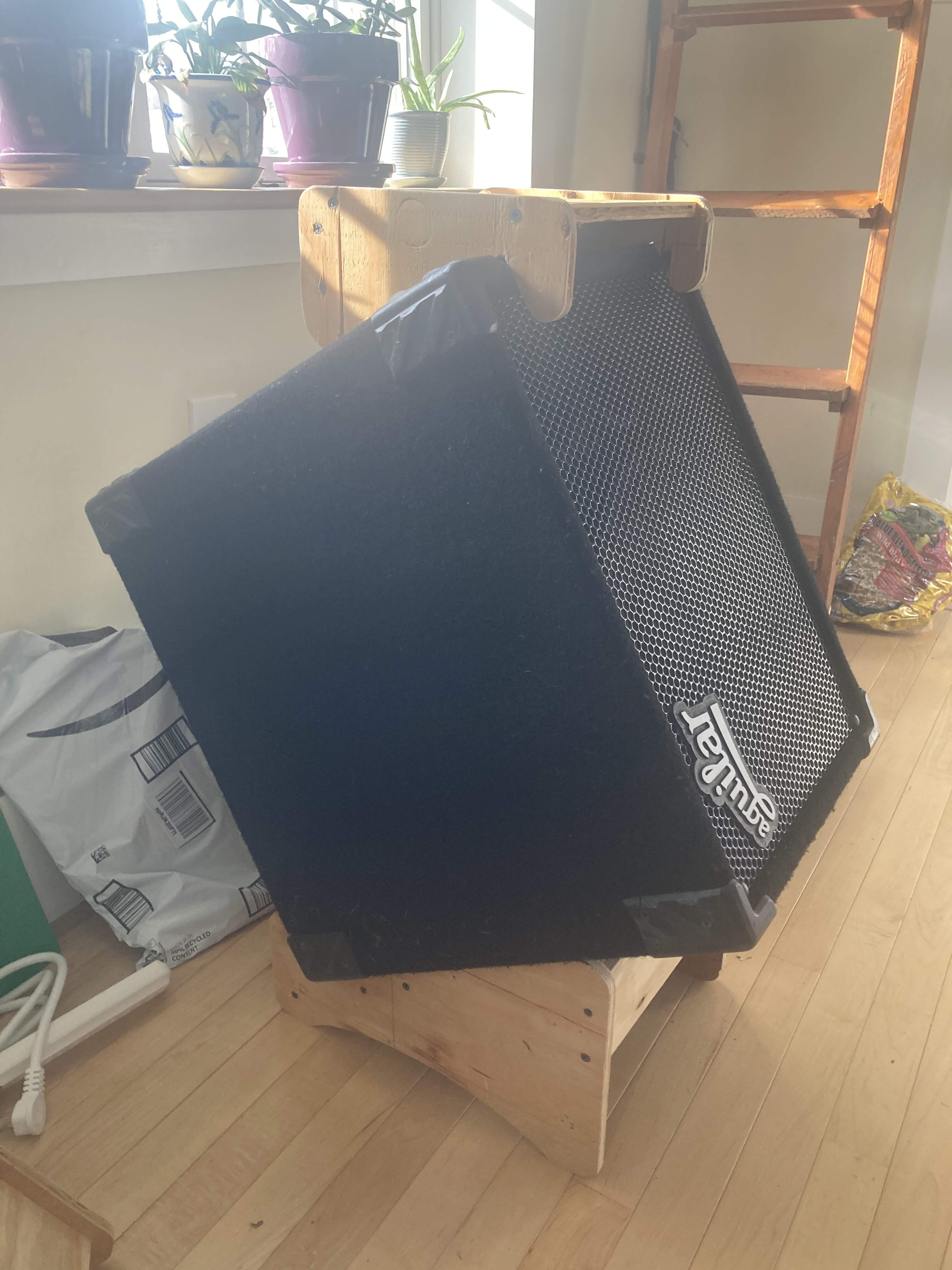

IMG_4909.jpg
 
I use a stand all the time, and have done so for 30+ years. You are hearing more mids because the cab is closer to your ears and also, pointed up at them, as opposed to being on the floor, blowing at the back of your knees. I much rather prefer what I'm hearing using a stand than having it on the floor, but I don't do any pit gigs, so that might be a factor. Use your EQ, that's what it is there for.
 
I use a stand all the time, and have done for 30+ years. You are hearing more mids because the cab is closer to your ears and also, pointed up at them, as opposed to being on the floor, blowing at the back of your knees. I much rather prefer what I'm hearing using a stand than having it on the floor, but I don't do any pit gigs, so that might be a factor. Use your EQ, that's what it is there for.

What are you using for a stand?
 
  • Like
Reactions: DJ Bebop
I recently returned an Boss amp stand. The build of the stand was great. But, I measured a 10 dB drop for frequencies under 80 Hz when on the stand vs. on the floor in a 12 x 12 foot room. I figure I need to hear bass if I am playing a bass guitar. I returned that stand as I am not actively gigging. I am working out better solutions to get rid of some wonky resonances I experience in the room for recording/studio/practice. The stand got rid of the resonances. That is one plus.
 
  • Like
Reactions: DJ Bebop and brocco
I recently returned an Boss amp stand. The build of the stand was great. But, I measured a 10 dB drop for frequencies under 80 Hz when on the stand vs. on the floor in a 12 x 12 foot room. I figure I need to hear bass if I am playing a bass guitar. I returned that stand as I am not actively gigging. I am working out better solutions to get rid of some wonky resonances I experience in the room for recording/studio/practice. The stand got rid of the resonances. That is one plus.
That's odd, I do not experience any low end loss when using a stand. I asked Bill FitzMaurice about this once and his reply was: "This is boundary reinforcement, which occurs when the cab baffle is less than 1/4 wavelength from the*floor. Lifting the box as much as 2.8 feet will have no effect below 100 Hz, what is considered 'bass', as it's still within 1/4 wavelength, so de-coupling doesn't reduce low-end response. However, above 100 Hz response is reduced, and that can be very beneficial in reducing 'boom', as boom is mostly sourced not in the bass below 100Hz but in the mid-bass from roughly 120-350 Hz"
 
I just use a folding step stool. I found one a little wider than the one linked. It works for my 210 or 410. It doesn’t change the angle, just uncouples it from the floor and gets it a little closer to my ears.

The uncoupling was the big thing for me. In some places it sounded good on the floor, others really boomy. I did find I had to eq more extensively to compensate on the floor. Now on the stand I get a much more consistent tone. I can still get the low end thump but it’s the real thump, not the coupling with the stage that will not be carried to FOH.
 
That's odd, I do not experience any low end loss when using a stand. I asked Bill FitzMaurice about this once and his reply was: "This is boundary reinforcement, which occurs when the cab baffle is less than 1/4 wavelength from the*floor. Lifting the box as much as 2.8 feet will have no effect below 100 Hz, what is considered 'bass', as it's still within 1/4 wavelength, so de-coupling doesn't reduce low-end response. However, above 100 Hz response is reduced, and that can be very beneficial in reducing 'boom', as boom is mostly sourced not in the bass below 100Hz but in the mid-bass from roughly 120-350 Hz"
This is great info, and I recently saw some research results reinforcing it. I usually use a milk crate or something for small cabs (the crate wears a black t-shirt :)). There’s no loss I’m aware of, but it brings the mids into much more focus. I don’t find angling necessary for me (tried it) but I can see why some like it for increased sense of presence in the mix.

 
it had lots more mids than usual.
That's because you're closer to on axis; speaker drivers, all of them, are more directional as you go up in frequency, how much depends on the size of the driver. What you're now hearing is the natural frequency response of the cab closer to on axis, as it's pointed more towards you're ears, than your legs.
 
That's odd, I do not experience any low end loss when using a stand. I asked Bill FitzMaurice about this once and his reply was: "This is boundary reinforcement, which occurs when the cab baffle is less than 1/4 wavelength from the*floor. Lifting the box as much as 2.8 feet will have no effect below 100 Hz, what is considered 'bass', as it's still within 1/4 wavelength, so de-coupling doesn't reduce low-end response. However, above 100 Hz response is reduced, and that can be very beneficial in reducing 'boom', as boom is mostly sourced not in the bass below 100Hz but in the mid-bass from roughly 120-350 Hz"

That is the response I measured. That is empirical. It is one data point. With all due respect, I do not why I should accept what someone says about what “should” happen when my measurement for my room says what actually happened.
 
Last edited:
That is the response I measured. That is empirical. It is one data point. With all due respect, I do not why I should accept what someone says about what “should” happen when my measurement for my room says what actually happened.
Well, Bill actually builds and designs bass cabs for a living; he is an acoustical engineer. I'm sure he would enjoy discussing with you your findings, if you are interested. Here's a link to his forum : BillFitzmaurice.info - Index page
 
That is the response I measured. That is empirical. It is one data point. With all due respect, I don’t care what someone says about what “should” happen when my measurement for my room says otherwise.

You can't measure actual low frequency response very accurately at all in a small room. How many mic positions did you average? I've played around a lot with doing RTAs with the mic at where my ears would be, but moving the mic even a foot gave very different results.
 
Last edited:
You can't measure actual low frequency response very accurately at all in a small room. How many mic positions did you average? I've played around a lot with doing RTAs with the mic at where my ears would be, but moving the mic even a foot gave very different results.

Maybe you folks can go fight about this inane point somewhere else instead of hijacking this thread.
 

Latest posts