• TalkBass has been independent since 1998. Add your voice.
    Create a free account to reply to discussions, view embedded media, and browse with fewer display ads.
    Join freeLog in
    Want zero display ads or expanded classifieds tools? Compare plans.

Carl Thompson called me yesterday....

I’ve never had an intonation issue with 34”. Nor have I ever noticed an intonation problem, say, in Geddy’s 34” basses. And I have perfect pitch.

Yeah, the entire concept of “intonation” is really just a matter of opinion anyway.

There really aren’t too many people in the world that can realistically identify a perfect 5th from an equally tempered 5th in a performance setting.

I certainly can’t, even when I clearly understand the concept and what to listen for.
 
  • Like
Reactions: Double E
I've built a few 36" scale basses, they were cool. On four string at least my strings of choice (DR Sunbeams) fit no problem. For reference the nut on your favorite 34" bass is almost exactly where fret #1 will be on a 36" scale. My hands only ever felt stretchy on riffs with a lot of 1st->4th fret jumps. Just avoid surf music in F and you'll be fine. If you ever want to have it feel like a 34" bass again you can downtune 1/2 step and capo at the first fret, or just leave it in Eb tuning and sound enormous.
 
Has the builder seen your hands and playing style?

I have big hands with long fingers, but I play one finger per fret and although I prefer 34" basses I would not want a 36".

Also what gauge strings do you use? Heavy gauge strings then extra length will help intonation, but with less thick strings I doubt you will notice any difference.

I once played a 30" Mustang and it was great fun...

I would also ask... if you build 36" and 32" basses how come they are both OK but in the middle is no good?
 
Just saw this thread, have to read through it all, but wanted to toss in my 2 pennies after reading about a page or 2 of discussion...

36" scale is his thing... I would go with it. Don't be the guy that goes to a famous restaurant and orders the Chef's signature dish with extra garlic.

SO MUCH THIS --^

For those unaware, the wait time for a CT bass is several years with the occasional instrument popping up for sale to raise funds so Carl can live or order more supplies and whatnot. Carl is an AMAZING person. He is open, he is honest, and he shares his gifts with the world. The demand for a CT is extremely high and I'd imagine that Carl can even get picky on if he wants to build a bass for someone or not without feeling any impact to his work or orders.

I currently own a pair of CT full frills 4 string basses but have owned a small handful of no frills and semi-frills as well. Around the time I got my first frills bass I was spending as much time at Carl's shop as I could (usually to swing by and buy a set of strings or some other innocuous reason to go there and hang). Each time, Carl would tell me stories and show me things on the basses and in the shop much like the youtube videos. I consider the time I spent with Carl as priceless and it really helped me to reach a point of self realization about what I thought I knew about basses and what made a bass great...and what makes Carl's basses great.

I can't speak for Carl and his actual process, but to me...Carl's process always came across as just using your head. He would run into a problem and figure out a solution (like what kind of pickup to put in the first ever 6 string bass that Anthony Jackson commissioned). The years of experience and requests that came Carl's way in the early days of bass from the manhattan jazz musicians of the 50's forced Carl to figure out how to do things better. He would tell me stories of a famous jazzz musician coming to him (as Carl was one of the known instrument repair guys around at the time) and complaining that they didn't like the way the instrument sat on their body, so he tried different things and settled on moving the position of the strap button to appease that customer. Over the years, his design knowledge just improved from experience and feedback from REAL musicians (Not a bunch of bedroom bassists obsessing over the nuance of low B tightness that will never be heard outside of your home and your drummer's basement - no offense to us). Remember, Carl's basses are played all over the world so to him the difference between a 36" and a 34" when it comes to intonation might be based on that world view of climates and other factors...I don't know, but I'm sure his experience dictates his requirements for a reason...although Carl will be the first person to tell you that he doesn't have a clue about what he is doing!

Simply put, Carl's basses are just a better bass. They balance...and no not on a strap...on your lap. That means you can lift your hands and put them behind your head and the bass will stay on your lap exactly as it was when you held it...forget about nose dive on a strap, this thing sits perfectly on your lap!!! Oh, and speaking of playing with a strap, Carl's basses have strap buttons placed in a more thought out spot so the bass sits right. The weight is as light as possible and there are many design enhancements that allow for a super thin body (like the football on the input jack since the input jack is thicker than the body itself) and better neck angle...it just gets in the way much less. You never fight with a CT when you play with it...it just feels right, and for me, it allows me to just play.

I've also met MANY CT owners along the way and there is a certain understanding about Carl's instruments. You either see it and feel it...or you just don't get it. It's cool if you don't get it...if everyone needed the same bass, there would only be one bass out there, but we are different people with different needs. I'm not sure why there is so much negativity against the way Carl does it, the only logical guess would be around the difficulty in getting one of his basses (if I can't have it, it must suck - aka the haters), but you never see someone complaining that Fender won't build them a 37.5" scale bass or that Fodera or bass builder x won't do something you specifically want and are willing to pay for.

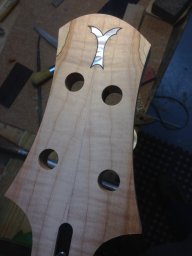
If you want a Carl Thompson, then to me...you choose your string count and you choose your scale length of either 32", 36", or 38" and the rest is up to Carl and his crew. If you want certain woods or specialties, then you don't really want a Carl Thompson. There is a reason that Carl's basses are so well loved and so desired and it isn't because he builds everything to exact specs of the buyer...it's because all his customers get a Carl Thompson and everything that name means when it is stamped on the headstock.

I'm gonna put this reply here again as it bears repeating based on the discussion in this thread:

36" scale is his thing... I would go with it. Don't be the guy that goes to a famous restaurant and orders the Chef's signature dish with extra garlic.
 
Ok, caught up...

few things to comment on

^^^ Agree ....Never forget it's a business. I smell sales here too....

Carl Thompson basses is not run like a business. Each bass is made mandrolically by hand with the only exception being the semi frills/no frills which have fully hand carved necks and CNC'ed bodies (those are actually more handmade than even a Fodera believe it or not as I understand that Fodera only does finishing sanding by hand). Clearly if Carl wanted to, he could farm out his designs to some overseas maker and we'd have the CTSEs or some nonsense and Carl would be in a state of the art shop, not a basement in a brooklyn brownstone.

Wayyyyy too many people get caught up in scale length as if the number of inches in the scale length alone means something. They mean nearly nothing with regard to how the thing feels or plays for you.

Going to have to disagree with you on this one...and this is where I'm actually qualified to participate in this discussion. As I mentioned in my previous post, I own 2 CTs...one is a 32" and the other is a 36". They feel drastically different. Both are butter and easy as pie to play...but as I've gotten older and my arthritic tendencies have gotten more noticeable, I find that I fatigue way easier on the 36" than the 32". I used to be able to play the 36" all damn day and night, but these days if I bring it out to a jam session that lasts over 2 hours, I find my hand is cramping if I am rocking the low register a lot. The 32" feels like a toy...I can fly on that lil bugger and never get tired. It does not sound as great as the 36" but still sounds great and brings out the best in my playing. As a result, I am looking to trade my 36" for a 32" (For Trade - FT: 36" scale Carl Thompson 4 string | ISO: 32" scale Carl Thompson 4 string) -- OP, if you want to come out to NY, you can try both of mine and see for yourself how good the 36" feels (and the 32" for that matter)

Anyway, Vinny Fodera and I Skyped this afternoon and he convinced me that an Ebony fretboard would better match the penny loafers I wear to my retirement community gigs. The man's a genius, what more can I say?

I know that this was a goof post, but I don't know if I would trust Fodera all that much...but my opinions on Fodera are better kept out of this discussion (though I'm sure many CT fans/owners would feel the same way about Fodera).

New CT employee : mr Thompson , I’m halfway through with that 36 in scale bass that you told me

Carl: dammit ! It’s the third time this month. I said 34 , thirty four!!!! I’m gonna have to call yet ANOTHER customer and try to pull the “36 inch is better for intonation “ story. If he doesn’t want it , it’s coning out of your paycheck.

actually, it's a little different...they don't look to resell it...they just chop off the bad parts and redo it:

 
One does recall that Anthony Jackson was deeply disatisfied with his six string which prompted his move to Ken Smith and then Fodera. Though I expect his craft has come on since then.

Right. AJ left most of the details to Carl, who built the bass with extra narrow string spacing, making it difficult to play.

Though it's worth noting that Carl suggested an extra-long scale length for that first 6, but AJ convinced him to go with 34"...
 
Has the builder seen your hands and playing style?

I have big hands with long fingers, but I play one finger per fret and although I prefer 34" basses I would not want a 36".

Also what gauge strings do you use? Heavy gauge strings then extra length will help intonation, but with less thick strings I doubt you will notice any difference.

I once played a 30" Mustang and it was great fun...

I would also ask... if you build 36" and 32" basses how come they are both OK but in the middle is no good?
pzv5j7l.jpg
 
  • Like
Reactions: Garret Graves
In my circles, we tend to ask creative folks to create things for us in a way that is open ended. Most recently: a chef, a bartender, a deck-builder, a house painter, a graphic designer, a hair stylist. In these cases, the relationship is not as simple as customer<->provider. We want the person to be free to be creative. It’s part of what we want from the experience. We want a little of them to be present in the work they perform. We want a one-off. We want our project to be the one where they get to let their hair down a little. It’s not a compromise. It’s not kow-towing. It’s an enhancement. It’s a pleasure. It’s part of the joy of not buying sh*t-in-a-box at AmeriMart. We want the the process to be present and visible in the results.

Sounds like a reasonable recipe for disaster.

Ever watch "Trading Spaces"? You immediately brough Hildi to mind.

Someone can describe their vision to me but in the case of a musical instrument I have to like playing it. Ergonomics is a huge factor. And I may have missed it but 36" is just a number. I had a 34" scale bass that because of how it was designed (bridge towards the middle of the body, like a guitar) was a farther reach than a 36" I own. Now imagine a 36" with the ergomonics of that 34". It would've been practically unplayable for me.

Lots of people try basses with 36" and dislike them. Can't imagine why the same thing couldn't happen in this case. Being in awe is one thing, sitting there looking at a several thousand dollar purchase that you immediately realize you don't like is a much stronger emotion in the opposite direction.

 
  • Like
Reactions: IamGroot
Sounds like a reasonable recipe for disaster.

Ever watch "Trading Spaces"? You immediately brough Hildi to mind.

Someone can describe their vision to me but in the case of a musical instrument I have to like playing it. Ergonomics is a huge factor. And I may have missed it but 36" is just a number. I had a 34" scale bass that because of how it was designed (bridge towards the middle of the body, like a guitar) was a farther reach than a 36" I own. Now imagine a 36" with the ergomonics of that 34". It would've been practically unplayable for me.

Lots of people try basses with 36" and dislike them. Can't imagine why the same thing couldn't happen in this case. Being in awe is one thing, sitting there looking at a several thousand dollar purchase that you immediately realize you don't like is a much stronger emotion in the opposite direction.
Sorry, no I am not familiar with that show. My point, if I have one, is that just as one might commission a painting without a mandate that it match the couch, the acquisition of such an iconic hand-built musical instrument may reasonably have other criteria for evaluating the process than some of the critiques of OP’s experience or openness to Other ideas. In the world of architecture, where form and function are equally in tension, this is often the norm. Different strokes for different folks. But if OP frees Carl to go for it, that doesn’t make him gullible. There are different ways to engage in such a project. OP’s is valid.
 
  • Like
Reactions: cosmicevan
Going to have to disagree with you on this one...and this is where I'm actually qualified to participate in this discussion. As I mentioned in my previous post, I own 2 CTs...one is a 32" and the other is a 36". They feel drastically different. Both are butter and easy as pie to play...but as I've gotten older and my arthritic tendencies have gotten more noticeable, I find that I fatigue way easier on the 36" than the 32". I used to be able to play the 36" all damn day and night, but these days if I bring it out to a jam session that lasts over 2 hours, I find my hand is cramping if I am rocking the low register a lot. The 32" feels like a toy...I can fly on that lil bugger and never get tired. It does not sound as great as the 36" but still sounds great and brings out the best in my playing. As a result, I am looking to trade my 36" for a 32" (For Trade - FT: 36" scale Carl Thompson 4 string | ISO: 32" scale Carl Thompson 4 string) -- OP, if you want to come out to NY, you can try both of mine and see for yourself how good the 36" feels (and the 32" for that matter)

Odd that you think you've somehow disagreed with me here. The main point I made is that the distance from upper strap button to nut is more relevant to the overall feel of your instrument than the scale length. I'd be willing to wager every penny I'll ever see in my lifetime that this measurement is greater on your 36 than on your 32, and in that regard, instead of disagreeing with me, you've actually confirmed my point.

Cheers.
 
Sorry, no I am not familiar with that show. My point, if I have one, is that just as one might commission a painting without a mandate that it match the couch, the acquisition of such an iconic hand-built musical instrument may reasonably have other criteria for evaluating the process than some of the critiques of OP’s experience or openness to Other ideas. In the world of architecture, where form and function are equally in tension, this is often the norm. Different strokes for different folks. But if OP frees Carl to go for it, that doesn’t make him gullible. There are different ways to engage in such a project. OP’s is valid.


On that show, two designers redecorate individual rooms of two participants' homes. Hildi became well know for her completely off the wall designs, like covering walls with fake fur, feathers or plastic flowers. They looked as goofy as that sounds.

If you're commissioning a bass to hang on a wall, go for it. If you need to play it you should have some input into the ergonomics. Unless of course your time and money mean little to you. Better luck next time.

I've commissioned basses before. I sure as heck wasn't going to leave them up to chance, I don't care who the luthier is. If you as a luthier want to build what you want to build despite what I ordered, cool... you can pay for it and keep it.
:D
 
On that show, two designers redecorate individual rooms of two participants' homes. Hildi became well know for her completely off the wall designs, like covering walls with fake fur, feathers or plastic flowers. They looked as goofy as that sounds.

If you're commissioning a bass to hang on a wall, go for it. If you need to play it you should have some input into the ergonomics. Unless of course your time and money mean little to you. Better luck next time.

I've commissioned basses before. I sure as heck wasn't going to leave them up to chance, I don't care who the luthier is. If you as a luthier want to build what you want to build despite what I ordered, cool... you can pay for it and keep it.
:D
Yes, but Carl Thompson is Carl Thompson and even though some people have said, we shouldn’t put him on a pedestal, I would argue that we should. Simply because, that’s the way he works. There are plenty of other companies, just as well known, that will bend over backwards to build the clients “vision” (Alembic immediately comes to mind here). CT builds his vision. If that isn’t going to work for you, go somewhere else.

Personally, fir this reason, I would never order a CT. But I would certainly love to buy a used one if I found one I liked.
I would and probably will buy a new Alembic someday.
 
Last edited:
  • Like
Reactions: chris_b
I'm not sure why there is so much negativity against the way Carl does it, the only logical guess would be around the difficulty in getting one of his basses (if I can't have it, it must suck - aka the haters)

If it makes you feel better take refuge in this idea then so be it, I suppose it's easier than having an objective review of why some folk don't like these basses. I find the argument of 'you can't have it, so you don't like it!' to be absolutely contra to reasoned debate because it shuts the discussion down over assumed identities of 'has and has not'. I often see this on other corners of the internet, not least when discussing performance cars and motorbikes, which is my other passion. "So what if you don't like the transparent panels on the doors of the McLaren Senna? You couldn't afford one anyway!". I make a distinction between peesons I consider qualified to comment and persons who have the means to buy whatever we're discussing. There is often little overlap between the two groups.

On the subject of why some people don't like these basses, does their unique character not cause you to expect them to polarise opinion? They aren't another Fender clone, so the usual slings and arrows are to be expected. But then, they're not conventionally beautiful or attractive instruments. They're from a rather cruder school of design than the basses which started with Alembic, Fodera and Ken Smith. These three companies, but especially Fodera and Ken Smith, created the modern epoch of a boutique bass in my eyes (though they could not have done so without the immense passion and skill of the visionaries at Alembic). Carl's basses are closer to a Wish bass in their design. Steve Wishnevsky was roundly lampooned on Talkbass when I first started visiting around fifteen years ago (things were more permissive and perhaps less well mannered then). I couldn't help but see the similarity between what he and Carl Thompson were doing and thought that if Carl's name were on the headstock, those instruments would have been bashed a whole lot less.

I recall seeing a no frills bass a couple of years ago that was a three piece maple body with absolutely no matching at all. In fact, it looked rather 'shop class' and attracted some derision for this, not least because of it's pricetag and plain appointments. Perhaps the magic really is in the feel and balance of these things. What I am certain of now is that there is no shortage of instruments that feel great and balance well these days and if I had ordered that bass to see it arrive with such an apparent mismatch of grains in tbe wood top, I would have had trouble not raising an issue just because it was a Carl Thompson. I don't consider luthiers as artists. They're extremely skilled craftsmen and I know myself well enough as a musician to know what I want. I do not pay them money for them to indulge some mercurial passion or to follow some abstract muse. I pay them to build what I want and that payment is a bond of trust which goes both ways. Some others may not agree with me on this.

My earlier point about the beatification of an individual is that it can shut down on constructive criticism. One feels particularly naked in making criticism of Carl because he is clearly idolised by some here and he has maintained his image as the sole creator of these basses for so long. Even though he has a team in his workshop, every instrument feels like a personal creation, even if it does look like it's been slung together. But if you can't speak freely or fear of hurting the feelings or challenging the reputation of such a man then we might as well revert to simple fawning praise and see any interesting discussion stifled.
 
Yes, but Carl Thompson is Carl Thompson and even though some people have said, we shouldn’t put him on a pedestal, I would argue that we should. Simply because, that’s the way he works. There are plenty of other companies, just as well known, that will bend over backwards to build the clients “vision” (Alembic immediately comes to mind here). CT builds his vision. If that isn’t going to work for you, go somewhere else.

Personally, fir this reason, I would never order a CT. But I would certainly love to buy a used one if I found one I liked.
I would and probably will buy a new Alembic someday.


I don't necessarily equate vision with specs. Do you? If he's going by his vision then he'd need to make it clear up front that he may ignore what you specifically asked, and worse, paid for. Be forewarned.
:D

I hate narrow string spacing. So if Carl arbitrarily decided to build my bass that I spec'd with 19mm spacing with 16mm spacing instead on a whim, I'd be more than unhappy. Because dropping more than $5k on a new order and "Surprise!" rarely go hand in hand as far as satisfaction. You can have your pedestal, I'm operating on planet Earth and I expect whomever I'm doing business with to do the same.

I remember a luthier drastically changing an order a few years back. There's not enough hero worship in the world to make that okay.

I had a pretty cool used CT a few years ago.
 
@India_Sierra I agree we all should be free to have opinions, but I find that Carl gets unfair criticism because he is so highly regarded that he is held to a higher standard...that’s all. Just look at all the bashing he is taking in this thread for not jumping up and down to build a 34” bass because a paying customer asked...I am curious if the OP ever even mentioned a desire to have 34” scale when putting down an initial deposit (and if so what was discussed at that point in time). That’s the point...aesthetics aside, people seem to have these weird expectations of customer service and specs around Carl’s work. All the disbelief in this thread is about the way Carl does “business” nothing to do with the aesthetics...all these armchair quarterbacks saying how Carl should react to a paying customer that is not them...they weren’t involved in the ordering process and we don’t even have those details. Clearly most of those complaining would have never gotten past the first phone call asking about sting spacing...that’s not what a Carl Thompson is about. You don’t design a bass, Carl does and you are buying his yet to be made bass. Every bass I have gotten from Carl was a discussion on the number of strings and at times, the scale length. We didn’t talk woods, string spacing, none of that.

@Brad Johnson I would recommend that you only work with builders who expect to be given strict measurements of your needs. The point is that Carl is not that kind of builder...and just because you pay him thousands of dollars, you shouldn’t expect him to be that kind of builder. He doesn’t get paid thousands of dollars per instrument because he will build you the exact bass you dreamed up...he gets paid thousands of dollars per bass because people want his instruments bad enough that they will pay that money and wait the time to get one. Just because you have different standards for what happens when you buy an expensive bass doesn’t mean that you are right or wrong. This is just how this situation is...and for those who are appalled by this situation, that’s ok...there are plenty of us who are not. Call us fan boys, call us blind loyalists, call us fools...we are extremely happy with the bass Carl delivers and if not...honestly you could probably flip it and make a few bucks since Carl doesn’t charge as much as he could (that’s not something you can say about ANY luthier willing to build a bass to your exact specs).
 
Last edited: