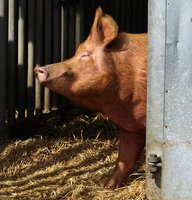
Hang on - aren't the ones at the bottom really parsnips? I cry foul!

Enjoy the benefits of a premium membership!
Upgrade Account
-
TalkBass has been independent since 1998. Add your voice.
Create a free account to reply to discussions, view embedded media, and browse with fewer display ads.
Join free Log in
Want zero display ads or expanded classifieds tools? Compare plans.
You are using an out of date browser. It may not display this or other websites correctly.
You should upgrade or use an alternative browser.
You should upgrade or use an alternative browser.
Carrot News Megathread
- Thread starter Drucifer
- Start date
More options
Who Replied?

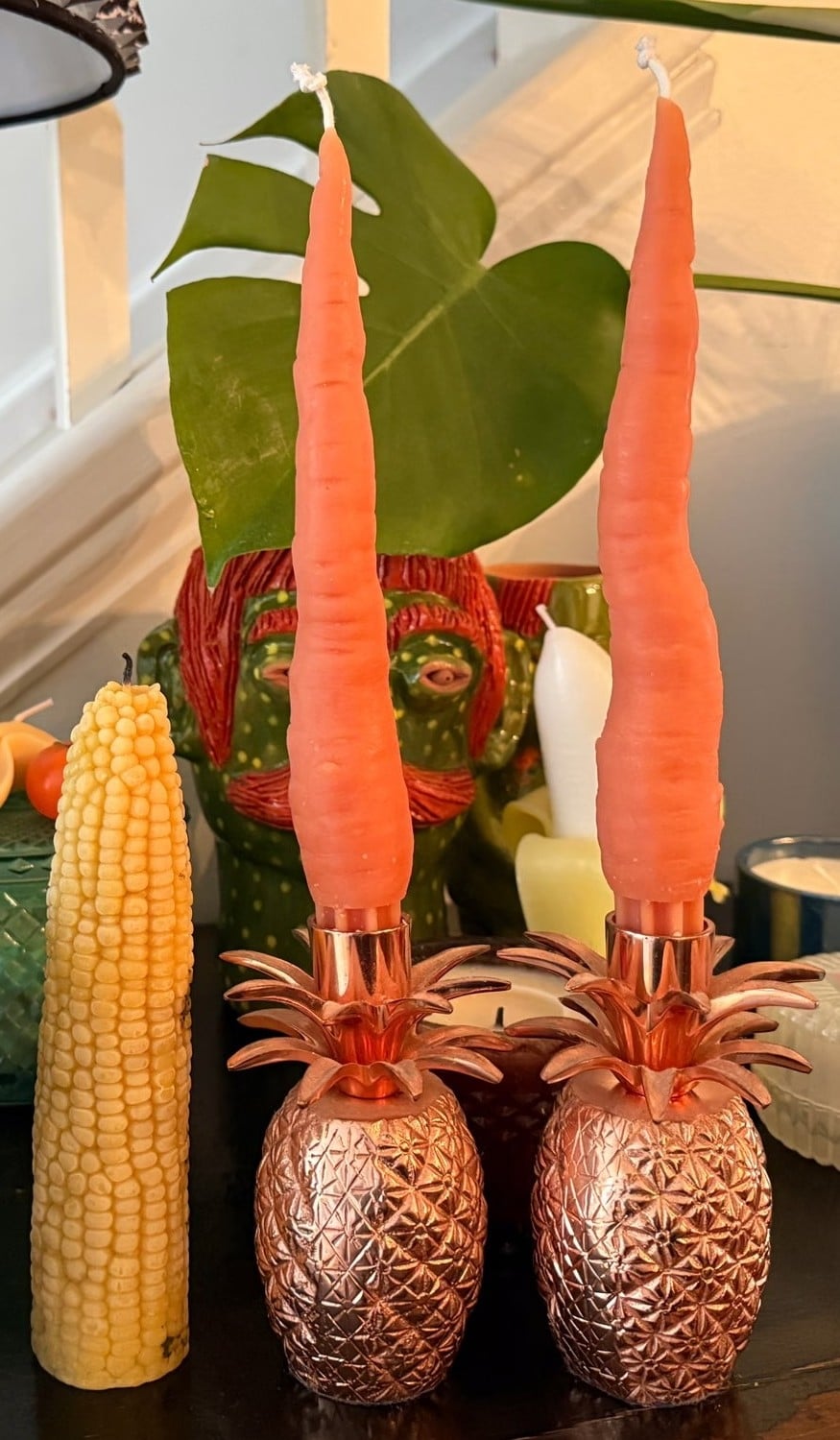
I forget where I saw this, but apparently, "vegetable candles" are a thing, somewhere, for some reason. 


- Apr 20, 2009
- 2,620
- 4,666
- Disclosures
- Endorsements: your name could be here, Mr. Sadowsky!
You can cross-post to the corn news and the pineapple news megathreadsI forget where I saw this, but apparently, "vegetable candles" are a thing, somewhere, for some reason.
View attachment 7362242
- Apr 20, 2009
- 2,620
- 4,666
- Disclosures
- Endorsements: your name could be here, Mr. Sadowsky!
- Apr 20, 2009
- 2,620
- 4,666
- Disclosures
- Endorsements: your name could be here, Mr. Sadowsky!
- Apr 20, 2009
- 2,620
- 4,666
- Disclosures
- Endorsements: your name could be here, Mr. Sadowsky!


- Apr 20, 2009
- 2,620
- 4,666
- Disclosures
- Endorsements: your name could be here, Mr. Sadowsky!
Uh oh, it’s bananas vs. carrots…
Longer version with close-up of the bass player at 0:46
Longer version with close-up of the bass player at 0:46
You know that those two goofballs are Ben Stiller and Benson Boone?
- Apr 20, 2009
- 2,620
- 4,666
- Disclosures
- Endorsements: your name could be here, Mr. Sadowsky!
Strange - they don't say eating carrots makes you a better bass player. It does, doesn't it?
- Apr 20, 2009
- 2,620
- 4,666
- Disclosures
- Endorsements: your name could be here, Mr. Sadowsky!
From our soon-to-be AI overlords:Strange - they don't say eating carrots makes you a better bass player. It does, doesn't it?
No, eating carrots does not make you a better bass player. There is no evidence suggesting a direct link between consuming carrots and improving musical ability.
However, carrots do offer health benefits that could indirectly support your playing:
- Vision Health: Carrots are rich in vitamin A, which is important for maintaining eye health.
- Overall Nutrition: They are a nutrient-dense food that supports general health.
- Apr 20, 2009
- 2,620
- 4,666
- Disclosures
- Endorsements: your name could be here, Mr. Sadowsky!
Stupid AI left out the biggest opportunity for improvement, new gear.From our soon-to-be AI overlords:
No, eating carrots does not make you a better bass player. There is no evidence suggesting a direct link between consuming carrots and improving musical ability.
However, carrots do offer health benefits that could indirectly support your playing:
For actual improvement as a bass player, consistent practice and developing a solid understanding of musical, rhythm, and technique are the recommended approaches.
- Vision Health: Carrots are rich in vitamin A, which is important for maintaining eye health.
- Overall Nutrition: They are a nutrient-dense food that supports general health.
But eating carrots is easier!From our soon-to-be AI overlords:
...
For actual improvement as a bass player, consistent practice and developing a solid understanding of musical, rhythm, and technique are the recommended approaches.
Hey!! I fact-checked with Claude AI and it offered this:
From: Journal of Applied Nutrition and Musicology, Vol. 47, Issue 3, pp. 112–119
Authors: Dr. Flemming Rootveld, PhD (Daucology & Rhythmic Biochemistry), Uppsala Institute for Improbable Research
It has been conclusively demonstrated — in the sense that we ran the numbers until they agreed with us — that regular consumption of Daucus carota (common carrot, raw, unwashed, preferably stolen from a neighbour's garden) produces a cascade of profoundly bass-positive physiological effects in the adult human musician. Central to this phenomenon is the dramatic upregulation of beta-carotene-induced haemoglobin resonance, whereby carotenoid compounds bond with iron-rich red blood cells to produce what the literature now calls "grooved erythrocytes" — blood cells that, under electron microscopy, appear to pulse in 4/4 time.
This rhythmically entrained circulatory chemistry delivers oxygen to the finger flexors with a precision and low-end authority entirely absent in non-carrot-consuming pianists and, frankly, all guitarists. Furthermore, beta-carotene's well-documented conversion to Vitamin A triggers a little-discussed secondary pathway in the cochlea — retinal-auditory transduction — allowing the practised carrot consumer to physically hear sub-50Hz frequencies that would reduce a lesser musician to merely "feeling a bit odd near the speaker stack."
Perhaps most strikingly, subjects consuming ≥3 carrots daily for eight weeks demonstrated a 340% increase in Type IIx extreme nerve fibre density along the ulnar pathway — the so-called "Bootsy Bundle" — producing finger-to-string response times approaching those theoretically possible only in robots, or Pino Palladino. Grip dynamometry further confirmed statistically significant increases in left-hand fretting torque (p < 0.003, which we consider excellent), with subjects spontaneously executing previously impossible string bends while muttering things like "oh, that's it" and "yeah."
We therefore conclude, with the quiet confidence of people who have already ordered the commemorative Mesa tote bag, that the humble carrot is not merely a vegetable but a Schedule I performance-enhancing root, and recommend its immediate reclassification by WADA, the Musicians' Union, and your mother.
The Carrot-Bass Nexus: A Breakthrough in Nutritional Musicology
From: Journal of Applied Nutrition and Musicology, Vol. 47, Issue 3, pp. 112–119
Authors: Dr. Flemming Rootveld, PhD (Daucology & Rhythmic Biochemistry), Uppsala Institute for Improbable Research
It has been conclusively demonstrated — in the sense that we ran the numbers until they agreed with us — that regular consumption of Daucus carota (common carrot, raw, unwashed, preferably stolen from a neighbour's garden) produces a cascade of profoundly bass-positive physiological effects in the adult human musician. Central to this phenomenon is the dramatic upregulation of beta-carotene-induced haemoglobin resonance, whereby carotenoid compounds bond with iron-rich red blood cells to produce what the literature now calls "grooved erythrocytes" — blood cells that, under electron microscopy, appear to pulse in 4/4 time.
This rhythmically entrained circulatory chemistry delivers oxygen to the finger flexors with a precision and low-end authority entirely absent in non-carrot-consuming pianists and, frankly, all guitarists. Furthermore, beta-carotene's well-documented conversion to Vitamin A triggers a little-discussed secondary pathway in the cochlea — retinal-auditory transduction — allowing the practised carrot consumer to physically hear sub-50Hz frequencies that would reduce a lesser musician to merely "feeling a bit odd near the speaker stack."
Perhaps most strikingly, subjects consuming ≥3 carrots daily for eight weeks demonstrated a 340% increase in Type IIx extreme nerve fibre density along the ulnar pathway — the so-called "Bootsy Bundle" — producing finger-to-string response times approaching those theoretically possible only in robots, or Pino Palladino. Grip dynamometry further confirmed statistically significant increases in left-hand fretting torque (p < 0.003, which we consider excellent), with subjects spontaneously executing previously impossible string bends while muttering things like "oh, that's it" and "yeah."
We therefore conclude, with the quiet confidence of people who have already ordered the commemorative Mesa tote bag, that the humble carrot is not merely a vegetable but a Schedule I performance-enhancing root, and recommend its immediate reclassification by WADA, the Musicians' Union, and your mother.
Last edited:
I always dreamed of publishing a paper in Journal of Irreproducible Results - Wikipedia. Too late now ...Hey!! I fact-checked with Claude AI and it offered this:
The Carrot-Bass Nexus: A Breakthrough in Nutritional Musicology
From: Journal of Applied Nutrition and Musicology, Vol. 47, Issue 3, pp. 112–119
Authors: Dr. Flemming Rootveld, PhD (Daucology & Rhythmic Biochemistry), Uppsala Institute for Improbable Research
It has been conclusively demonstrated — in the sense that we ran the numbers until they agreed with us — that regular consumption of Daucus carota (common carrot, raw, unwashed, preferably stolen from a neighbour's garden) produces a cascade of profoundly bass-positive physiological effects in the adult human musician. Central to this phenomenon is the dramatic upregulation of beta-carotene-induced haemoglobin resonance, whereby carotenoid compounds bond with iron-rich red blood cells to produce what the literature now calls "grooved erythrocytes" — blood cells that, under electron microscopy, appear to pulse in 4/4 time.
This rhythmically entrained circulatory chemistry delivers oxygen to the finger flexors with a precision and low-end authority entirely absent in non-carrot-consuming pianists and, frankly, all guitarists. Furthermore, beta-carotene's well-documented conversion to Vitamin A triggers a little-discussed secondary pathway in the cochlea — retinal-auditory transduction — allowing the practised carrot consumer to physically hear sub-50Hz frequencies that would reduce a lesser musician to merely "feeling a bit odd near the speaker stack."
Perhaps most strikingly, subjects consuming ≥3 carrots daily for eight weeks demonstrated a 340% increase in Type IIx extreme nerve fibre density along the ulnar pathway — the so-called "Bootsy Bundle" — producing finger-to-string response times approaching those theoretically possible only in robots, or Pino Palladino. Grip dynamometry further confirmed statistically significant increases in left-hand fretting torque (p < 0.003, which we consider excellent), with subjects spontaneously executing previously impossible string bends while muttering things like "oh, that's it" and "yeah."
We therefore conclude, with the quiet confidence of people who have already ordered the commemorative Mesa tote bag, that the humble carrot is not merely a vegetable but a Schedule I performance-enhancing root, and recommend its immediate reclassification by WADA, the Musicians' Union, and your mother.
- Apr 20, 2009
- 2,620
- 4,666
- Disclosures
- Endorsements: your name could be here, Mr. Sadowsky!
From article:
Aldi reveals the surprising benefits of carrots in powering marathon runners
“They [carrots] provide a gentle, steady source of energy thanks to natural sugars, while their high water content helps support hydration. They also contain potassium for muscle function and beta-carotene, which supports recovery and immune health, which are all important for anyone training consistently.”


Latest posts
-

-
-

-
 The Bartolini BH2: Why Does It Sound So Dark? My EHB1265MS Experiments
- Latest: Riff Ranger