• TalkBass has been independent since 1998. Add your voice.
    Create a free account to reply to discussions, view embedded media, and browse with fewer display ads.
    Join freeLog in
    Want zero display ads or expanded classifieds tools? Compare plans.

Class D - where are the graphic EQs?

I had an Ashdown Superfly bass amp. It was ALL digital based graphic EQ (up/down buttons) for the tone. And you could save any EQ setting as a Preset. Plus every frequency was also lit on the face of the am above the buttons.

So easy to see onstage. Another nice thing about it, was I had EQ'ing (workable tone for the room) for every place we played at. No fussing around...just use that preset and it was EQ'd specific for that gig. You couldn't lose the setting accidentally by bumping knobs or sliders.
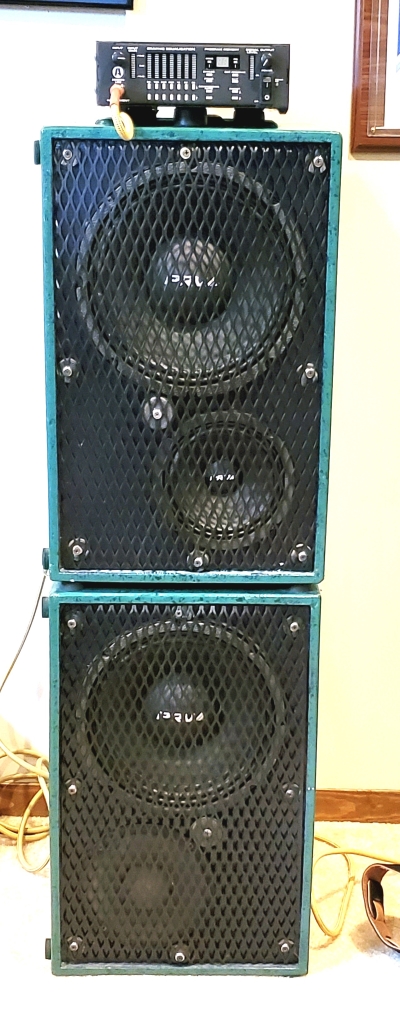

Superfly-110-rig.jpg
 
Back in the rack rig days, a few completely OCD guys put a 31-band graphic(!!!) between the rack preamp and the power amp. They'd talk your ear off about how precise their tone control was, but I watched one guy fight one for a couple hours only to hit the BYPASS button finally.

Graphics seem to have given way to easier to use (for most) semi-para and/or filters.
A 31-band EQ would be great for solving specific problems. Horrible for general tone-shaping.
 
And that elusive critter often shapes consumer desire, rather than responding to it. Classic example was the Pet Rock back in the 1970s.
Well the market for pet rocks coincided with the market for graphic eqs. Make of that what you will
Anyone who buys into the supply and demand concept as the sole driver of the market is deluding themselves.
Of course it's not. Innovation is also a huge market driver. But it's equally delusional to think manufacturers will keep making products that don't sell well.
 
  • Like
Reactions: jjk2007
Well the market for pet rocks coincided with the market for graphic eqs. Make of that what you will

Of course it's not. Innovation is also a huge market driver. But it's equally delusional to think manufacturers will keep making products that don't sell well.
Correct, there wasn't ANY market for mobile phones before manufacturers started offering them. They started out pretty heavy and expensive but the evolved to lighter, cheaper and MUCH more powerful/useful to the average customer. The customer AND the market evolved hand in hand.
 
Well the market for pet rocks coincided with the market for graphic eqs. Make of that what you will

Of course it's not. Innovation is also a huge market driver. But it's equally delusional to think manufacturers will keep making products that don't sell well.
Which is why with 5000 channels of cable, it all looks the same. It’s why with staggering audio bandwidth, so much music sits only in the top 4% of that bandwidth… restrained only by brickwall limiters. Car companies that used to make sedans now only making SUVs (Buick).

Lowest common denominator.

Just strikes me as odd, especially in this industry. So many bassists lust for more than a standard Fender or Ibanez, and there are literally dozens and dozens of boutique makers. You don’t have these makers saying “well it’s the Fender Jazz that sells the most, therefore we need to make all our basses fit the Fender Jazz mold”. Instead they make instruments that might appeal to 0.18% of the bass population - and they are celebrated for it.

Yet somehow, 9% of an amp market is not enough for manufacturers to bother with.
 
A GEQ doesn't change my thoughts about an amp. I used the one on my Hartke HA 7000. It was great for rolling off the low end, like a high pass before high passes were a thing. This is only because of the frequency range that Hartke offered.
IMG_6360.jpeg
 
Yet somehow, 9% of an amp market is not enough for manufacturers to bother with.
Tbh, this reads as a very naive understanding of manufacturing: 9% is nothing, realistically. Well, it’s something, it’s an opportunity for outboard GEQ manufacturers.

That 9% is not a guarantee of 9% sales, because those buyers are going to have a million other variables in consideration as well. Honestly that 9% probably boils down considerably under 5% when financial commitment actually comes into play.

Regarding the bass manufacturers, this is completely apples to oranges: an amp manufacturer has to work on massively different scales, testing, supply chains, and lifecycles than a boutique bass builder. And it’s not like there aren’t boutique amp builders, anyway.
 
  • Like
Reactions: Bassdirty
Which is why with 5000 channels of cable, it all looks the same. It’s why with staggering audio bandwidth, so much music sits only in the top 4% of that bandwidth… restrained only by brickwall limiters. Car companies that used to make sedans now only making SUVs (Buick).

Lowest common denominator.

Just strikes me as odd, especially in this industry. So many bassists lust for more than a standard Fender or Ibanez, and there are literally dozens and dozens of boutique makers. You don’t have these makers saying “well it’s the Fender Jazz that sells the most, therefore we need to make all our basses fit the Fender Jazz mold”. Instead they make instruments that might appeal to 0.18% of the bass population - and they are celebrated for it.

Yet somehow, 9% of an amp market is not enough for manufacturers to bother with.
Bass makers can easily make a one-off of a bass or just a few a year. Amp manufacturers may spend $50k to obtain safety and EMC certifications on a single model, then there’s design and tooling, additional NRE’s, etc.

A manufacturer has to sell quite a few amps just to get their R&D costs back.
 
I don't like parametric EQ on an amp. I don't need that exact of frequency selection and width. To me, an amp is more of a quick and dirty setting on the fly. If others can hear that they need to push 200-230Hz on the fly, kudos to them. I can't.
 
  • Like
Reactions: DWBass
Sorta joking with this post, but I think graphic eq is a major factor in the early demise of thousands of drivers over the years.

So easy to carve out the middle where all the relevant content is, just to boost the harmful low end and master volume to attempt to get louder. A GEQ in the hands of the inexperienced player is a cab designer's nightmare.

If I designed amps and cabs for a big brand I'd probably stay away from GEQ if only to prevent blown cabs warranty claims, lol.
 
So I guess you’d have everyone just be quiet and say nothing when you express such sentiments. Kinda anti-TB, doncha think?

As for that last bit, they (who the hell ever) has been saying that about SVTs for years. Guess how they are selling? Apparently pretty well, as there’s 2 versions of that amp available.

Class D has found its niche just as tube amps did (big transistor amps, too).

And that’s no exception.

I never "expected" anything of the sort. That's a sign of your thought distortions. Not mine. That problem of assumption belongs to you.
Your whole response, has been dictated by this fundamentally false assumption.
Blaming me for your assumptions is; Kinda reactionary and infantile "doncha think"?
Try thinking instead of "guessing", next time.

I'm not interested in what sells or doesn't sell, what has a niche or what doesn't have a "niche" or your "SENTIMENTS" on this.
I'm only interested in what works for me and my bass gear and offering help to the OP.

All the sales or niches in the world will not stop the march of technology and development, the nature of Negation of Negation and Qualitative and Quantitative changes. NO EXCEPTION.
I see you chose the word "DID" when referring to tube amps..
 
Last edited:
I know one of the big points of Class D is their smallness. And that designers have a tendency to want to leverage such selling points.

Both my amps - Hartke 3500 for electric, Crate BX100 combo for upright - have fantastic graphic equalizers. Especially with the upright, it’s that EQ that allows me to tame the acoustic feedback while retaining a sound that’s true to the instrument. And neither of these amps were expensive.

But at some near future point, I’m expecting both will become unserviceable. Enough components within will die that it won’t make economic sense to repair them. At which point I will want new amps. I’m just not seeing the “next phase” amp for me out there. Which is unfortunate, because certainly the weight savings would be a benefit to my aging back.
Just from reading posts here, it seem the preference is finding an amp that sounds good to them just plugging in and letting it fly. There are a fair amount of post with player looking for minimal knobs on basses as well.

I’m pretty sure the hard core pros are not driving this bus, but for occasional users for the vast majority I can understand a preference to plug and play as opposed to knob twisting the night away.

That being that case, manufacturers are just following the suit of potential buyers.
 
So many bassists lust for more than a standard Fender or Ibanez, and there are literally dozens and dozens of boutique makers. You don’t have these makers saying “well it’s the Fender Jazz that sells the most, therefore we need to make all our basses fit the Fender Jazz mold”. Instead they make instruments that might appeal to 0.18% of the bass population - and they are celebrated for it.

Yet somehow, 9% of an amp market is not enough for
Well a lot more than 0.18% of bass players would love a custom Zon or Fodera. But being gigging musicians they find it hard to justify the expense. Let alone the heartache of keeping it in a workplace full of thieving drunks and druggies. By the same token, if you were to forgo the economy of scale, you could have the amp of your dreams built for you.

Also, I mentioned it before but it really is the path of least resistance, I wonder how many 9%ers have accepted the reality of the market and learned to get good tones out of parametrics and semis. Plenty of people do sound good on modern amps.
 
Well it all depends on what your idea of a graphic is. I have a Mesa WD 800 and it clearly has what I consider to be a graphic EQ on it. It's not sliders it's rotary knobs that allow you to also change and tailor the frequency. So, it's parametric which is far better than any standard slider type graphic EQ. View attachment 7141808
You can tell what frequency the right knob is set at without “mathing”? I can’t. I find a GEQ more intuitive and easier to set on the fly and I own a WD-800. If Darkglass amps didn’t all have that baked in Darkglass sound, I’d probably get one to have a GEQ.
 
  • Like
Reactions: 60bass
You can tell what frequency the right knob is set at without “mathing”? I can’t. I find a GEQ more intuitive and easier to set on the fly and I own a WD-800. If Darkglass amps didn’t all have that baked in Darkglass sound, I’d probably get one to have a GEQ.
The frequency is proportional to the position of the knob between the end points.
 
You can tell what frequency the right knob is set at without “mathing”? I can’t. I find a GEQ more intuitive and easier to set on the fly and I own a WD-800. If Darkglass amps didn’t all have that baked in Darkglass sound, I’d probably get one to have a GEQ.
Since I also did sound for a decade or so I got to work with a lot of dual 15 band eqs and 32 band eqs and rack mounted parametric eqs. I also used acoustic control amps for many years with their smaller graphic eqs built in. My only issue with those Is that the sliders are more prone to getting dust and crud built up in them than a rotary knob. Also on the older rigs like the acoustics that had the big knobs on the sliders those knobs got broken off easily or bent and then you couldn't move the slider.

IMO The way to use that parametric EQ in the WD is just to boost the volume up and then swing the knob through the frequencies till you hear the sound you want and then lower the volume to match How loud you want that frequency to be. It's actually fairly intuitive for me at least as I use my ear more than looking at numbers because I am terrible at math. LOL. Also, it's the same type of setup used on the
M- pulse and Walkabout amps which I have used in the past so I'm already really familiar with how to use it.

I tried out a darkglass before I bought the Mesa and there was just something about the tone of the darkglass that I didn't care for. However, like anything else maybe I just didn't have time to mess around with it to really try to get it dialed in. When I unboxed the Mesa and set it on top of my GK NEO IV 212 cabinet It took me all of about 3 minutes to get a tone that I really liked.
 
The frequency is proportional to the position of the knob between the end points.

Certainly, but I can’t do a ((freq B - freq A) * pct travel) + freq A in my head while I’m playing. A GEQ has less adjustment but easier to see and set (for me). Actually, the easiest IMO is the per channel EQs that you have on the tablet based mixers, but you would need a touchscreen to include something like that on an amp and not sure I’d want that.
 
  • Like
Reactions: 60bass