• TalkBass has been independent since 1998. Add your voice.
    Create a free account to reply to discussions, view embedded media, and browse with fewer display ads.
    Join freeLog in
    Want zero display ads or expanded classifieds tools? Compare plans.

Club Alleva Coppolo (Part 10!)

Status
Not open for further replies.
Update: On my LM5

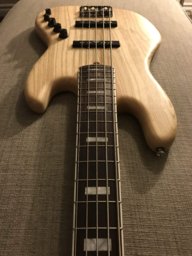
Spoke to Jimmy yesterday, what a heck of a nice guy. He's still swamped hoping to get my bass done in February but it may be March. The body hasn't come back from the painter yet. Going one piece neck but I think I am going to be passing on the bullet unless Jimmy's taken it to far to change. No micro tilt either, so really the only changes from prior models is the chunkier 1 piece neck. Looking forward to it!
 
Update: On my LM5

Spoke to Jimmy yesterday, what a heck of a nice guy. He's still swamped hoping to get my bass done in February but it may be March. The body hasn't come back from the painter yet. Going one piece neck but I think I am going to be passing on the bullet unless Jimmy's taken it to far to change. No micro tilt either, so really the only changes from prior models is the chunkier 1 piece neck. Looking forward to it!

Interesting - I didn't know you could get the one piece neck without the bullet. Will yours have a skunk stripe or no?
 
Interesting - I didn't know you could get the one piece neck without the bullet. Will yours have a skunk stripe or no?

I believe the 'skunk stripe' is a necessity on a 'one piece neck' (of course, with that additional filler wood, it really isn't one piece anyway), since that is how they fill the route that has to be cut into the back of the neck to get the truss rod in (of course, they could use maple, which would make it not be as obvious as the darker wood plug. Once the truss rod is in, it doesn't require any special type of adjustment design (i.e., bullet or whatever), as far as I know.

Any of you Fender experts know the logic of the change in design to the 'fretboard' from the one piece. I assume it had to to with making the production process identical between rosewood and maple fretboard basses? Was it considered a cost cutting method only, or was it considered an improvement over the one piece design?
 
I believe the 'skunk stripe' is a necessity on a 'one piece neck' (of course, with that additional filler wood, it really isn't one piece anyway), since that is how they fill the route that has to be cut into the back of the neck to get the truss rod in (of course, they could use maple, which would make it not be as obvious as the darker wood plug. Once the truss rod is in, it doesn't require any special type of adjustment design (i.e., bullet or whatever), as far as I know.

Any of you Fender experts know the logic of the change in design to the 'fretboard' from the one piece. I assume it had to to with making the production process identical between rosewood and maple fretboard basses? Was it considered a cost cutting method only, or was it considered an improvement over the one piece design?

Ahh that makes sense. Whats funny is that my Fender jazz has a Pau Ferro board so is obviously isn't one piece, but they still used the skunk stripe (not sure if the skunk stripe is there on mine to get the truss rod in or if it's just capped under the fretboard.

I always thought that necks had to have a separate fingerboard slab because of a difference in the angle of the cut of a fingerboard vs. a neck. But I was definitely wrong on that assumption.
 
Ahh that makes sense. Whats funny is that my Fender jazz has a Pau Ferro board so is obviously isn't one piece, but they still used the skunk stripe (not sure if the skunk stripe is there on mine to get the truss rod in or if it's just capped under the fretboard.

I always thought that necks had to have a separate fingerboard slab because of a difference in the angle of the cut of a fingerboard vs. a neck. But I was definitely wrong on that assumption.

Im pretty clueless on all this, so not sure. Hopefully the Fender experts can chime in.
 
I believe the 'skunk stripe' is a necessity on a 'one piece neck' (of course, with that additional filler wood, it really isn't one piece anyway)...
They've never meant literally one piece all inclusive. This has always and only meant that it's one piece of maple. Maybe they figured it'd require less clarification to customers than "integral fingerboard" or something. :)

Any of you Fender experts know the logic of the change in design to the 'fretboard' from the one piece. I assume it had to to with making the production process identical between rosewood and maple fretboard basses? Was it considered a cost cutting method only, or was it considered an improvement over the one piece design?
I'm guessing it was purely a manufacturing decision, so that all the necks could be made the same. Makes sense to me, anyway.

Oh, and at the risk of being flamed for saying so, I'm not yet convinced there's a significant tangible tonal difference between the two, tho I think the stripe does look classic and cool.

Now give me a second to put on my flame suit... there... that should do it...

:hiding:

:D
 
They've never meant literally one piece all inclusive. This has always and only meant that it's one piece of maple. Maybe they figured it'd require less clarification to customers than "integral fingerboard" or something. :)

I'm guessing it was purely a manufacturing decision, so that all the necks could be made the same. Makes sense to me, anyway.

Oh, and at the risk of being flamed for saying so, I'm not yet convinced there's a significant tangible tonal difference between the two, tho I think the stripe does look classic and cool.

Now give me a second to put on my flame suit... there... that should do it...

:hiding:

:D

+1 I was just clarifying that I would doubt there would be a tonal difference or anything between the two construction methods. I mentioned that it was not truly a one piece neck to try to head off those that might think there is something 'magic' in having a 'single piece of wood'.... just pointing out that it is not a single piece of wood (as some who aren't as compulsive about this stuff might think).

My view of it is that it is a cool way to get an instrument to look a bit more 'vintage'. My guess is, even though all pieces of wood are different, that the glued on fingerboard would provide a bit more stability to the neck, but just guessing there. I believe Sadowsky uses a quarter sawn maple board with a flat sawn neck. That's kind of cool, both look-wise (nice grain on the fretboard) and I assume stability-wise (two substantial pieces of wood cut with different grain and glued together). Again, just guessing, and talking in general terms.
 
Ken,

I know very little about this stuff but my guess would be that if there is any difference tonally it could be in the fact that the fingerboard is glued on. The lack or presence of the glue could change how the neck vibrations interact with the body.

Again I have no clue if it actually makes any difference and I can see where your thoughts on stability could be another "theory". It seems to me Jimmy is trying to be more true to the period, he didn't have any strong tonal comments about the difference.

Jimmy did point out that '74 was the year Fender had ash/maple, skunk stripe 1 piece necks but did not have the bullet. So my bass would be a period correct '74. He knows a heck of a lot about this sort of history....
 
Ken,

I know very little about this stuff but my guess would be that if there is any difference tonally it could be in the fact that the fingerboard is glued on. The lack or presence of the glue could change how the neck vibrations interact with the body.

Again I have no clue if it actually makes any difference and I can see where your thoughts on stability could be another "theory". It seems to me Jimmy is trying to be more true to the period, he didn't have any strong tonal comments about the difference.

Jimmy did point out that '74 was the year Fender had ash/maple, skunk stripe 1 piece necks but did not have the bullet. So my bass would be a period correct '74. He knows a heck of a lot about this sort of history....


That was my point about the 'one piece neck' not being one piece (as Vic points out, it was a short hand way of saying 'no fretboard'). There is also glue holding the stripe in.

+1 though... nothing wrong with 'period correct'. My FV5 has a one piece neck, and it's cool looking!
 
While we're on "vintage" I'll take us a little off topic...

I wanted to pick up a decent acoustic guitar to keep in the living room so my wife and I could play and sing for our 6 month old son. He really likes it BTW.

I wound up picking up a 1936 Recording King Model M-2. It was manufactured by Gibson for Montgomery Ward. It is pretty beat up but it sounds awesome and fits the decor of our 1927 Tudor.

Enjoy the picks:

BhGsv9gmkKGrHqQH-DwEsMLu09G1BLHsODb.gif

BhGspjwBmkKGrHqUH-EMEr8iPuELhBLHsNy.gif

BhGsTQQWkKGrHqUH-D8Er2Bc4qR3BLHsMzq.gif

BhGsNiQBmkKGrHqUH-EUEsNHYV1BLHsMij-.gif

BhGsHKwB2kKGrHqYH-CgEsLPGRlujBLHsMO.gif

BhGs2pgBGkKGrHqMH-EEEsMEYijYlBLHsOU.gif
 
I believe Sadowsky uses a quarter sawn maple board with a flat sawn neck. That's kind of cool, both look-wise (nice grain on the fretboard) and I assume stability-wise (two substantial pieces of wood cut with different grain and glued together). Again, just guessing, and talking in general terms.
Yes, but I don't think that's been forever, and I believe he even said in a video that he just likes the way it looks.

I still feel, as I think I read you to as well, that it's really more about looks than anything else. That said, if I were to order a maple necked AC right now, it'd have the "one piece" neck. I do like that.
 
Any of you Fender experts know the logic of the change in design to the 'fretboard' from the one piece. I assume it had to to with making the production process identical between rosewood and maple fretboard basses? Was it considered a cost cutting method only, or was it considered an improvement over the one piece design?

If you read any of the numerous books on Fender history, this is discussed. The change from one-piece maple necks to instruments with rosewood fingerboards in '59 was because Leo was unhappy with the discoloration that was happening on the maple fingerboards over time - from sweat or other player-induced biochemical reaction.

You would think that the change was production-related or to make a difference sonically, but that doesn't seem to have been the case.
 
If you read any of the numerous books on Fender history, this is discussed. The change from one-piece maple necks to instruments with rosewood fingerboards in '59 was because Leo was unhappy with the discoloration that was happening on the maple fingerboards over time - from sweat or other player-induced biochemical reaction.

You would think that the change was production-related or to make a difference sonically, but that doesn't seem to have been the case.
You misunderstood Ken's question. He wasn't asking why they went from one piece maple to a maple neck with a rosewood board. He was asking why they went from a one piece maple neck to a maple neck with a separate maple board.

My supposition was to unify manufacturing process and save money.
 
This is directed to the cats that made it to NAMM How about some discussion about Jimmy's new one piece skunk stripe necks and how they differ both in tone and feel if any from his standard two piece fret board capped version.
Hey Jonno,
I guess I can comment 'cause I played most of the basses in the AC NAMM booth. I have a 2-year old RA5 and have played a lot of AC basses at past NAMM shows, so I have a decent frame of reference. The newly built basses with one-piece necks felt very different and sounded a bit more solid and authoritative to me, but much more because the necks were a lot chunkier than because they were one-piece. I think it would really be impossible to compare unless the neck profiles were the same. I personally like the chunkier necks better.
 
Status
Not open for further replies.