• TalkBass has been independent since 1998. Add your voice.
    Create a free account to reply to discussions, view embedded media, and browse with fewer display ads.
    Join freeLog in
    Want zero display ads or expanded classifieds tools? Compare plans.

Club Alleva-Coppolo (Part 13)

Status
Not open for further replies.
Actually not correct - at least not historically. Wasn't Fender making the alder body with 70's spacing before or at least co-incident with ash bodies with 70's spacing? I believe that many of the 70's position 4 bolt jazz basses were alder. It was later in the 70's that ash/maple was the predominant Fender wood combination on the Jazz bass. That would make the late 70's bass (LM) a spin-off of the early 70's bass (RA), yes?

Further, (and much more relevant) Jimmy designed the RA with a particular player, tone, and period correct appearance in mind.
True. Ash bodies were only in the later 70's of the 70's J, but I think that's also the signature sound most people associate with "the 70's J". That said, you're right, an alder body with either a maple or rosewood board is period correct for the earlier 70's.

It is not a "parts bass".
Not sure where this came from... I don't recall anyone even remotely indicating this.
 
Hey Jason/Yohann,

What does the Primavera wood sound and feel like, and why has Jimmy decided to offer it in the U.S. now?

Hey George,
I don't really have any answers for either of your questions... Sorry.

Jason's will be the first EUT and even the first Primavera bodied bass I will have a chance to play. IIRC, I think Jimmy said it's Mexican Mahogany??? If not that it's a Mexican version of one of the woods we're all familiar with, I think it's Mahogany... If that's any indication of what the tone might be.

And as far as why it's available to us now, maybe Jason has something to do with it. And really, I will ask Jimmy why it was for export only to begin with... When I see LG's, LM's, etc. overseas now.
 
KULA WOOD - GOLD TREE - PRIMA VERA - Kula means golden, and this wood has the most beautiful golden laced grain.Locally the tree is also called the Gold Tree, not because of the golden wood, but because, at certain times of the year the tree is full of beautiful yellow flowers. Elsewhere in the world, this species of tree is called Prima Vera.The tone and volume is excellent, with a perfect balance of bass and treble. Kula wood is approximately the same density of Koa, possibly harder, and we usually combine this wood with a Spruce, Cedar, or Redwood top (see Combinations). Weight is 28 lb/ft and density is .45 sg.
 
Hey Jason/Yohann,

What does the Primavera wood sound and feel like, and why has Jimmy decided to offer it in the U.S. now?

Hey George,

Well ... I played both of the first EUT's that Jimmy made for winter NAMM 2009. I'm not a huge fan of maple anyway, so the 70's one didn't really do much for me. (No offense rodl2005, i know you have a great axe, just not my thing)
The 60's spacing w rosewood was the closest AC to my bigg redd bass that i've played since Jimmy started building. It had a weight like alder and a tone very similar, but most definitely had more happening in the low mids. It growled like crazy playing finger style & had a bit more "ping" than my LG5 for slap. By the time I got to it, it was sold, but I never forgot about it & now that I'm in the market for a 4 string, i thought it would be perfect.
As far as it being offered domestically now, I think the real reason is that all of the international dealers want what Jimmy is known for and not a variation. I believe that there have only been 2 rosewood basses & one maple EUT's built as of today. Jimmy got a bunch of primavera quite a while ago and was trying to figure out what to do with it since it was a limited supply. This was around the time he was considering an export only bass, so i think it was more of a timing thing. I don't think that he expected the volume of export orders that he has going on now. There are way more AC's on order from across the pond then there are from guys here in the U.S. So, now, I think Jimmy just wants to make use of the wood, regardless of where the bass is going.
Hope this answers your question.
 
Hey George...
Jason, thanks for the great info! Just one question. If primavera is fairly close to alder, why not just (continue to) use alder... especially if alder is easier to get? Some sort of export issue with alder that didn't apply to primavera? I guess the related question is, if it wasn't an export thing, what was it about primavera that caused Jimmy to buy it up while he could?
 
FWIW - On the models

KBP - P bass
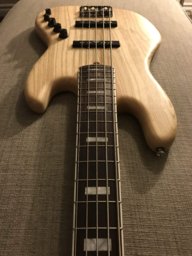
LG - 60s spacing alder/rosewood
RA - 70s spacing alder/maple
LM - 70s spacing ash/maple

(Both rosewood or maple are available on all basses)

All makes total sense to me, although for the outsider those initials don't mean all that much unless you are in the loop.

He offers:

Basic - Standard - Classic - Classic Supreme - Deluxe - Custom

This seems to differ with each model and where it all becomes confusing for some. I'd guess if this became more standard across each model many would be less confused.

I understand his reasoning though, he doesn't offer a matching headstock, bent plate bridge on the maple fingerboard basses only KBP and LG. Or Nitro finish on the ash bodied LMs. While he would most likely accomodate those types of requests it's his way of keeping a more historically accurate line.

I'll stop there before I confuse myself!
 
FWIW - On the models

KBP - P bass
LG - 60s spacing alder/rosewood
RA - 70s spacing alder/maple
LM - 70s spacing ash/maple

(Both rosewood or maple are available on all basses)

All makes total sense to me, although for the outsider those initials don't mean all that much unless you are in the loop.

He offers:

Basic - Standard - Classic - Classic Supreme - Deluxe - Custom

This seems to differ with each model and where it all becomes confusing for some. I'd guess if this became more standard across each model many would be less confused.

I understand his reasoning though, he doesn't offer a matching headstock, bent plate bridge on the maple fingerboard basses only KBP and LG. Or Nitro finish on the ash bodied LMs. While he would most likely accomodate those types of requests it's his way of keeping a more historically accurate line.

I'll stop there before I confuse myself!

+1 As I've posted a number of times, it is MUCH easier to first decide if you want a 60's J, a late 70's J, an early 70's J or a P Bass. That's 90% of the decision.

Once you have that decided, ignore all those sub-brand descriptions and just tell Jimmy the options you want (standard versus 'old style' bridge, nitro versus poly, and the body finish/color, and any special uber expensive wood options).... done!
 
The comparison/description sheet I wrote for Jimmy was aimed at having a 1-page layout of the trim lines... As confusing as it may be to newbies, I think the Model name letters are easy enough to learn and understand if it was put the way Peter just did - which is included in my suggestion - but it mainly focused on comparing trims.

I find it easier to understand if they were laid out like so:

Basic = this option and that option plus that option.
Standard = Basic + this and that
Classic = Standard but this instead of that + these other options.
Classic Supreme = Classic + these options.

Something of the sort that you can look back easily between trims to see why it's gonna cost you more.
 
The comparison/description sheet I wrote for Jimmy was aimed at having a 1-page layout of the trim lines... As confusing as it may be to newbies, I think the Model name letters are easy enough to learn and understand if it was put the way Peter just did - which is included in my suggestion - but it mainly focused on comparing trims.

I find it easier to understand if they were laid out like so:

Basic = this option and that option plus that option.
Standard = Basic + this and that
Classic = Standard but this instead of that + these other options.
Classic Supreme = Classic + these options.

Something of the sort that you can look back easily between trims to see why it's gonna cost you more.
Very cool.

Will the new list be posted somewhere soon?
 
The comparison/description sheet I wrote for Jimmy was aimed at having a 1-page layout of the trim lines... As confusing as it may be to newbies, I think the Model name letters are easy enough to learn and understand if it was put the way Peter just did - which is included in my suggestion - but it mainly focused on comparing trims.

I find it easier to understand if they were laid out like so:

Basic = this option and that option plus that option.
Standard = Basic + this and that
Classic = Standard but this instead of that + these other options.
Classic Supreme = Classic + these options.

Something of the sort that you can look back easily between trims to see why it's gonna cost you more.
I see your point here, but I still think it'd be easier if you simply pick a model (start with a "basic" LG, LM, RA, or KBP) and then just upcharge your way to whatever you want.

I just don't really see the need to pre-can specific variations... at least at his shop size level. It really only makes sense to pre-can configs like this if you're planning to do a lot of pre-staging with backstock. Seems to me he's pretty much still building to order, in which case a smaller product line with a larger list of options/upcharges makes more sense.

Again tho, IMHO/FWIW. :)
 
I see your point here, but I still think it'd be easier if you simply pick a model (start with a "basic" LG, LM, RA, or KBP) and then just upcharge your way to whatever you want.

I just don't really see the need to pre-can specific variations... at least at his shop size level. It really only makes sense to pre-can configs like this if you're planning to do a lot of pre-staging with backstock. Seems to me he's pretty much still building to order, in which case a smaller product line with a larger list of options/upcharges makes more sense.

Again tho, IMHO/FWIW. :)

+1 Simple, straightforward...

I have no idea what my two models would be called, other than an LM with a slightly upgraded paint finish, and an LG in Nitro with matching headstock.
 
The comparison/description sheet I wrote for Jimmy was aimed at having a 1-page layout of the trim lines... As confusing as it may be to newbies, I think the Model name letters are easy enough to learn and understand if it was put the way Peter just did - which is included in my suggestion - but it mainly focused on comparing trims.

I find it easier to understand if they were laid out like so:

Basic = this option and that option plus that option.
Standard = Basic + this and that
Classic = Standard but this instead of that + these other options.
Classic Supreme = Classic + these options.

Something of the sort that you can look back easily between trims to see why it's gonna cost you more.

The only isuue (without referring to each page on Jimmy's site) is the classic/supreme refer to bent plate, nitro, matching headstock, inlays, trans finish. Where on the LM some of those options are deluxe or custom with no classic/supreme. While the RA is standard or custom, no basic, no deluxe, no classic or supreme.

I agree with Ken all models BASIC and then a price list of options, upgrades and which models they are available on. You can include the "limited" fancy top as an upcharge. And even subtract $x for the imported no frills hardware and electronics.
 
Very cool.

Will the new list be posted somewhere soon?

I honestly don't know Bernie... I gave it to him a while back and he might change his mine about it by the time he gets around to it.

I see your point here, but I still think it'd be easier if you simply pick a model (start with a "basic" LG, LM, RA, or KBP) and then just upcharge your way to whatever you want.

I just don't really see the need to pre-can specific variations... at least at his shop size level. It really only makes sense to pre-can configs like this if you're planning to do a lot of pre-staging with backstock. Seems to me he's pretty much still building to order, in which case a smaller product line with a larger list of options/upcharges makes more sense.

Again tho, IMHO/FWIW. :)

Didn't he used to do it that way a while back? I thought I saw an old price list somewhere online that sort of detailed things the way you described... Which would make sense too.

IIRC, that one just showed a basic price for each model then below is the list of options and their respective upcharges.
 
The only isuue (without referring to each page on Jimmy's site) is the classic/supreme refer to bent plate, nitro, matching headstock, inlays, trans finish. Where on the LM some of those options are deluxe or custom with no classic/supreme. While the RA is standard or custom, no basic, no deluxe, no classic or supreme.

Sorry for all the replies, as soon as I post there's a new one I want to comment or respond to.

I see what you mean, my proposed sheet broke it down by model and their specific trim levels.
 
Didn't he used to do it that way a while back? I thought I saw an old price list somewhere online that sort of detailed things the way you described... Which would make sense too.

IIRC, that one just showed a basic price for each model then below is the list of options and their respective upcharges.
Yes, I think he did, and I just can not at all figure out why he changed from such a perfectly appropriate pricing model to all this fragmented stuff.
 
Status
Not open for further replies.