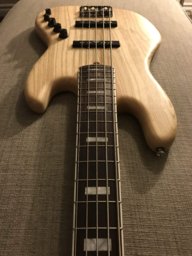
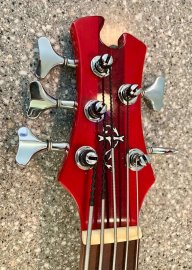
1) have you seen the Fbass cab teasers? Does that not take away from making instruments?
2) Fodera seems to do it just fine, and sucessfully, without loosing their focus on building their instruments. I would think George would want to get a hand in that side of business, think of ask of the threads that you've read where people have tried Fbass strings but didn't like the exposed core do now the use brand x.
That's like going to a concert and the band not having merch to sale because they don't want to distract from the music.
George, your thoughts?
I'm not George, but I did sleep in a Holiday Inn Express last night. And I went to a pretty good business school. And for fun and leisure I constantly read nerdy, technical books on topics such as business strategy from gurus like Michael Porter, so I'll take a stab at answering this.
We all know that there is a difference between branding and manufacturing.
I seriously doubt the Fecktones had much direct involvement in
making the t-shirts merchandised under their brand at their concerts. Victor Wooten is one gifted man, but I just don't know how good he is with a needle and thread, you know?
When it comes to their merchandise, the Flecktones
brand, they don't
manufacturer. This arrangement is a proverbial win / win. The Flecktones get money they otherwise wouldn't by loaning their brand, and the clothing wholesaler gets money it otherwise wouldn't if it tried selling generic t-shirts at Flecktones concerts.
And it is interesting that you mentioned Fodera. Fodera strings are actually built by small, "no-name" US companies and sold to Fodera so they can be resold under the Fodera brand. It is the same win / win there too. Fodera gets money they otherwise wouldn't by reselling strings, and their manufacturers get money they probably would not be getting if they tried to sell those same strings as their own brand.
Like Fodera, George's Fbass strings are manufactured by someone else and are sold under the Fbass brand. George's special sauce in this instance is in the specific gauges of the strings he has made for his instruments.
However, unlike Fodera, Fbass's string manufacturer has a very strong brand: La Bella. And unlike Fodera's string manufacturers, La Bella doesn't need Fbass to stay in business. It's not the same win / win arrangement as Fodera's.
Because La Bella sells everything from nylon coated flats to double bass strings, I'm sure that if George wanted, he could brand other La Bella offerings and really "get a hand in that business" as you say, and not lose too much focus doing it.
But loss of focus isn't the problem, this is a matter of what George wants his brand to mean to people out in the marketplace.
"Competitive convergence" is what happens when companies imitate and match each other's moves as they compete to be the best. Over time companies engaged in competitive convergence begin to look alike, thus commoditizing their industry.
When competing products become commodities, they have very small margins. Companies with a highly efficient, high volume manufacturing operation thrive quite nicely in a commoditized marketplace. But to a specialized, handcrafted, boutique builder, commoditization is death.
In other words, for George to compete in the string business, he would either have to become a high volume, highly efficient manufacturer, or brand the offerings of one.
Hopefully we all agree that Fbass should not become a high volume, highly efficient manufacturer. That would destroy their brand. We buy Fbass in large part precisely because they are not Fender or Ibanez with their mass-produced, McDonald's-like quality standards.
[EDIT: That was not meant to be a put down to Fender, Ibanez or McDonalds. I love Macs and my 1976 Fender Jazz bass. But usually I'm more in the mood for salmon and my AC6, you know?]
That means Fbass's only viable option for getting into the string business in a serious way is branding.
Let's assume for a minute that La Bella is okay with allowing the Fbass to become a competitor and they agree to provide Fbass with a broader product line of strings.
Is that what George wants for the Fbass brand? If he does, I see nothing wrong with it. If he doesn't, I understand that too.
IBM (one of my former employers) invented the PC, yet they got out of the PC business precisely because PCs became a commodity, and IBM flat does not want their brand competing in commoditized markets. They want their brand to be considered the very top tier by the marketplace, and would have been MORTIFIED to have their products sold in Walmart and K-mart the way Acers, HPs and Dells are today.
In short, IBM doesn't want a "hand in that business" because of brand positioning. They are just fine missing out on PC sales, because the credibility of their brand makes them money in other ways.
I'm guessing that's why Fbass is fine with us either getting Fbass strings if they work for us, or if they don't going to another string.
Too much there; sorry.