• TalkBass has been independent since 1998. Add your voice.
    Create a free account to reply to discussions, view embedded media, and browse with fewer display ads.
    Join freeLog in
    Want zero display ads or expanded classifieds tools? Compare plans.

Club Moollon

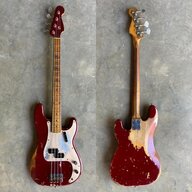
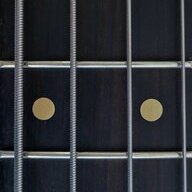
Taking an informal poll here: I'm dissenting on the nitro coating on my P-Classic's maple fingerboard, and wish it wasn't there because it slows me down and doesn't feel fluid, but I have read comments elsewhere by luthiers about this and many saying "don't do it."

I love the feel of Music Man's maple boards which appear to be a TruOil finish and maybe some gun stock wax, which I did to a Telecaster with excellent results. If I were to do this instead of just removing the finish altogether, it seems like it would be a better idea, no? I don't mind that the fingerboard might start to look "played".

What could go wrong, and what is your opinion on this notion? Should I leave well enough alone? I'd guess that there is something about the area around the frets that might suffer here.
 
Last edited:
nitro coating on my P-Classic's maple fingerboard, and wish it wasn't there because it slows me down and doesn't feel fluid

Are you referring to the fingerboard under your strings, or the back of the neck where your thumb/palm make contact? I’m assuming you’re talking about the back.

I know a few people have smoothed out the back of their Moollon necks with scotch brite pads, fine sandpaper, or steel wool to good effect. I think the “stickiness” eventually comes back but they just go over it again with the pad or steel wool. I haven’t heard of anyone completely stripping the finish and going with a gunstock oil on a Moollon. But plenty have done this on other basses (like yourself) and I don’t see how a Moollon would be any different. I think I’ve seen more of this back-of-the-neck finish discussion and picture examples over at the Facebook page/group rather than here on TB.

I say go for it if you’re not jiving with the neck feel. I don’t think it’s going to hurt resale or be considered nearly as sacrilege as swapping the tuners, bridge, or pickups on a Moollon bass would be.
 
  • Like
Reactions: 600 Ohms
No, I mean the actual fretboard, not the back of the neck. All my Moollons have a satin finish sanding and are great back there. It's the coating under the strings (Maybe it's poly, not nitro?) that I'm not enjoying. I'm not looking for a "raw" look, but to make it smoother, if that means oiling.

Trouble is, the frets look like they are pressed on top of a poly-like finish, and this work might require a level of precision I cannot hope to attain.
 
I say go for it if you’re not jiving with the neck feel. I don’t think it’s going to hurt resale or be considered nearly as sacrilege as swapping the tuners, bridge, or pickups on a Moollon bass would be.
This is the only one with my initials on the serial number, so it might have sufficient sentimental value that I might never consider selling it.
 
  • Like
Reactions: SLO Surfer
I'm glad you raised this point..its overlooked imo.

I really feel maple *fingerboards* should be sealed with a harder finish like poly for tonal reasons also, not just feel. The poly compresses and maple need some taming and compression for it not to be too open and zingy- its the Fender sound at least that I prefer.
Nitro is really porous and lends to an open attack and timbre as to whatever the character of the wood is. The one maple board Molloon I played at namm was a nitro J and it was way too zingy and brittle for me.
 
You could do this for sure. I see no reason why not, particularly if you don't mind dirty fretboards.
I would remove the nut carefully, and then precisely "tape off" the sides of the neck first. Of course this is done with the neck removed from the body. Then I would use acetone and "0000" steel wool for the removal of the finish. I would be cautious by not "flooding" the board with acetone. The acetone evaporates very quickly, and I would work quickly. You will have to work "across the grain" right up against the frets to get the finish from that area. The "0000" steel wool shouldn't harm the frets, but the frets may need a polishing afterwards. Working across the grain will probably create fine scratches across the entire board, so you also may want to finish the process using some 400+ sandpaper on the board in the direction of the grain to make it look right. Then the fret polishing.
Please be aware , I am not a luthier, and I have never removed finish as you are wanting to do, but as a long-time hobby woodworker, and guitar/bass refinisher, this is how I would proceed if I were committed to the idea of no fretboard finish. Alternatively, you could try just using some 400+ sandpaper ( micro-mesh) to work the board in the grain direction and see if just doing that would improve the feel of the board for you. YMMV!
 
27308707[/URL], member: 210613"]No, I mean the actual fretboard, not the back of the neck. All my Moollons have a satin finish sanding and are great back there. It's the coating under the strings (Maybe it's poly, not nitro?) that I'm not enjoying. I'm not looking for a "raw" look, but to make it smoother, if that means oiling.

Trouble is, the frets look like they are pressed on top of a poly-like finish, and this work might require a level of precision I cannot hope to attain.

Do you like how it sounds?

If so, I wouldn’t touch a thing.

Call me crazy, but YJ has cracked the code.

Had a friend who owned a’56 P from YJ. He replaced the pickup. Hated it. Put the original pickup back in and could never make it sound the same after that.

I really feel YJ’s the sum is greater than the parts is true. Wherever the magic is coming from, I would hate to see you loose it by altering the mojo.

It may come out just fine. But what if it doesn’t.

And it’s not like you can replace the bass too easily anymore with the wait times currently in the 3+ years etc…

My 2 cents.
 
I wouldn't change a thing about a Moollon, based on resale value and out of respect for the formula. OK maybe id sand the back of the neck if that was your thing, but the fingerboard I'd be leery about trying to remove finish from a maple board. And as for electronics and hardware, thats a lot of what you're paying for in the first place.
 
No, I mean the actual fretboard, not the back of the neck.
Oh. Then I’d probably leave it. But that’s because I don’t think I’ve ever noticed how the fretboard “feels” since I don’t really make contact with it. My fingers just touch the strings as da as I can tell. But it’s your bass! If you never plan to sell it, do what you want. One person mentioned this alteration has the possibility of permanently altering the instrument’s tone. So I’d consider that.

This is the only one with my initials on the serial number, so it might have sufficient sentimental value that I might never consider selling it.
I understand! My only Moollon has my initials in the serial, and it’s “til death do we part.”
 
Appreciate the comments. I'll most likely leave it alone. I do like the way it sounds. And it's surprising the amount of drag I feel given that my fingers should just be on top of the strings, but I don't it's that black and white. I expect the finish that glides around the fingerboard sides has a lot to do with it. Perhaps it just needs a bit more sanding there. I promise you it feels way different to the ebony necked Moollons.
 
  • Like
Reactions: SLO Surfer
Appreciate the comments. I'll most likely leave it alone. I do like the way it sounds. And it's surprising the amount of drag I feel given that my fingers should just be on top of the strings, but I don't it's that black and white. I expect the finish that glides around the fingerboard sides has a lot to do with it. Perhaps it just needs a bit more sanding there. I promise you it feels way different to the ebony necked Moollons.
Are you using a new brand of strings? I felt that "drag" when I tried Dunlop and Rotosounds 77 for the first time but TI and Labella always feel amazing and sound the best to me on my basses. TI strings were perfect for my maple soft V Moollon and it's probably my best-playing bass.
 
Appreciate the comments. I'll most likely leave it alone. I do like the way it sounds. And it's surprising the amount of drag I feel given that my fingers should just be on top of the strings, but I don't it's that black and white. I expect the finish that glides around the fingerboard sides has a lot to do with it. Perhaps it just needs a bit more sanding there. I promise you it feels way different to the ebony necked Moollons.

I certainly believe what your saying. Have owned 7-8 Moollons none of which have had maple fingerboards. If the sides of the fingerboard are what you think is causing the drag, maybe with a super fine grit you could incrementally sand the sides down. Or if the surface of the fingerboard is possibly too high maybe having it plained by an experienced luthier. Is it a 4 or 5 string? Blocks?? Got a pic???
 
Are you using a new brand of strings? I felt that "drag" when I tried Dunlop and Rotosounds 77 for the first time but TI and Labella always feel amazing and sound the best to me on my basses. TI strings were perfect for my maple soft V Moollon and it's probably my best-playing bass.
No, I have Dunlop flats on, same set for over a year, and they are fine. I used to have them on the silver bass, and they never felt the way they do now.
 
I certainly believe what your saying. Have owned 7-8 Moollons none of which have had maple fingerboards. If the sides of the fingerboard are what you think is causing the drag, maybe with a super fine grit you could incrementally sand the sides down. Or if the surface of the fingerboard is possibly too high maybe having it plained by an experienced luthier. Is it a 4 or 5 string? Blocks?? Got a pic???

1957f7c3-3933-4ece-8ce7-34d7bd9912ba-jpeg.4534675
 
I saw a gig here in town where Travis Carlton was playing a very similar bass (also a P-Classic) with a maple neck and tons of "wear" on the fingerboard surface. I wonder if he felt the same. I know he's an Xotic guy, but my lying eyes saw what they saw.
 
Does anybody have a picture of a Light Charcoal Frost bass with a mint pickguard?

While I'm patiently daydreaming about my P Classic IV in the making, I'm wondering if I should ask for an extra pickguard to be included and if so, what color. I've ordered my P in Light Charcoal Frost with the tortoise pickguard. Maybe mint would be cool too on that finish?
 
  • Like
Reactions: patzilla83

Latest posts