• TalkBass has been independent since 1998. Add your voice.
    Create a free account to reply to discussions, view embedded media, and browse with fewer display ads.
    Join freeLog in
    Want zero display ads or expanded classifieds tools? Compare plans.

Club Sadowsky!!!

I think Roger typical prefers flat sawn. I live in the high desert north of Los Angeles and we see 100º + in the summers and low 20º to teens in the winter, with extremely dry air. Roger mentioned that he had a piece of quarter sawn and that it might be a good idea on this bass for extra stability, but I still think he prefers the tone of flat sawn.

Apart from looking great, does the roasted treatment contribute to stability, too? Was guessing it takes the moisture content lower before the neck is carved..?

 
I think Roger typical prefers flat sawn. I live in the high desert north of Los Angeles and we see 100º + in the summers and low 20º to teens in the winter, with extremely dry air. Roger mentioned that he had a piece of quarter sawn and that it might be a good idea on this bass for extra stability, but I still think he prefers the tone of flat sawn.
That's my understanding as well, though I'm not sure there is any tonal correlation. I was only suggesting the roasted option be standardized. I understand Roger prefers to work with flat sawn and does not see advantages in the quarter sawn orientation.

BTW, I'm in PHX. Our temps are rather insane here as well.:)
 
i personally would not want roasted as standard. it's a very specific aesthetic that won't be as widely preferred as the typical wood color, and it'd add cost that would be unnecessary in most cases. i also agree Roger prefers flat sawn simply by the fact that that's most of what I see him build with. I can certainly believe they'll have tonal differences, but i wouldn't presume to try and quantify that.
 
...I can certainly believe they'll have tonal differences, but i wouldn't presume to try and quantify that.

I've gone thru quite a number of custom basses over the years and one thing I've learned is that every piece of wood sounds different, even within the same species. You can have two identical basses sound very different and there's no other explanation other than the wood. I had issues with my Ken Lawrence neck when I first got the bass. Over the first year, or two, the neck kept shrinking, causing the fret ends to stick out, so I would send it back to Ken for some fret work. After the third time, Ken decided to make a new neck for me. The new neck was made exactly the same and yet the bass sounded totally different with the new neck. The new neck made the bass quite a bit brighter, with a really fast attack. I really liked the new tone better, but it really cemented in my mind that the wood makes all the difference in the world and that every piece of wood sounds different.

I would agree that he roasting must change the cell structure within the wood, but I don't think Roger would even offer it as an option if it caused the instrument to stray from the Sadowsky signature tone.
 
Hey, not to derail the conversation about woods, but...my used Metro WL5 just landed today (yahooie!) and I was curious about the build date. S/N is in the 7000s, but the chart on the Sadowsky forum only went to about 5500. Anybody know where there's a current list?
 
I've gone thru quite a number of custom basses over the years and one thing I've learned is that every piece of wood sounds different, even within the same species. You can have two identical basses sound very different and there's no other explanation other than the wood. I had issues with my Ken Lawrence neck when I first got the bass. Over the first year, or two, the neck kept shrinking, causing the fret ends to stick out, so I would send it back to Ken for some fret work. After the third time, Ken decided to make a new neck for me. The new neck was made exactly the same and yet the bass sounded totally different with the new neck. The new neck made the bass quite a bit brighter, with a really fast attack. I really liked the new tone better, but it really cemented in my mind that the wood makes all the difference in the world and that every piece of wood sounds different.

I would agree that he roasting must change the cell structure within the wood, but I don't think Roger would even offer it as an option if it caused the instrument to stray from the Sadowsky signature tone.

Agree 100%. I put roasted vs. not-roasted in the same tone debate category as, say, nitro vs. poly finish. Never say never; in theory it could cause some change in the vibration of the instrument, but I'm highly skeptical that the change is audible by humans (including super-human audiophiles :)) above all the other factors that determine the tone of an instrument.


i personally would not want roasted as standard. it's a very specific aesthetic that won't be as widely preferred as the typical wood color, and it'd add cost that would be unnecessary in most cases.

Agree 100% with this, too!
 
Agree 100%. I put roasted vs. not-roasted in the same tone debate category as, say, nitro vs. poly finish. Never say never; in theory it could cause some change in the vibration of the instrument, but I'm highly skeptical that the change is audible by humans (including super-human audiophiles :)) above all the other factors that determine the tone of an instrument

Not to get all fuzzy and metaphysical, but what if the difference is "inaudible," yet there is a difference in vibration patterns that alters the tactile feel of the axe in a way that makes you want to play more, or that lets you play "better" in some fashion?

I'd suggest they all are called "instruments" because they are biofeedback machines that register our emotional and technical input, and feed it back to us in the form of vibrations - some consonant, some agreeable, etc. etc.

So I have no trouble believing that a difference in neck wood - even if the same species, and treated similarly - can make a difference in the ultimate musical output.

There…I said it…let the bricks fly accordingly!
 
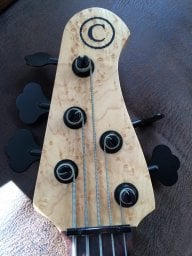
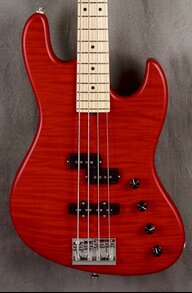
Since I posted of pic of my new Sadowsky a while back, it has gone through a bit of a change. The neck had kind of a strange dead spot around the 9th fret on the G string, so the bass was sent back to the shop. Roger decided the bass needed a new neck and as I live in an area of extreme climate changes, Roger suggested going with a quartersawn, roasted maple neck for extra stability.

I also found that the P/J setup wasn't really the tone I was after, so I decided to have them load the bass with a pair of Big Splits, as we already had the routs for them in place when the bass was made. I must say that Sadowsky's customer service is absolutely top notch and the entire crew went out of their way to make sure the bass was exactly what I wanted. Roger's reputation as a world class operation is truly deserved. Here's the pic of the bass with the old neck and pick up layout.

Sadowsky6653_zps2a58060d.jpg


Here's the bass with its new neck and pickup layout. I'm just floored by how gorgeous this bass is!
Sadowsky1_zps38006180.jpg

Sadowsky2_zpsefd68f86.jpg

Cool Man, much happiness to you. Rock it hard!
 
Not to get all fuzzy and metaphysical, but what if the difference is "inaudible," yet there is a difference in vibration patterns that alters the tactile feel of the axe in a way that makes you want to play more, or that lets you play "better" in some fashion?

I'd suggest they all are called "instruments" because they are biofeedback machines that register our emotional and technical input, and feed it back to us in the form of vibrations - some consonant, some agreeable, etc. etc.

So I have no trouble believing that a difference in neck wood - even if the same species, and treated similarly - can make a difference in the ultimate musical output.

There…I said it…let the bricks fly accordingly!

Hey! I want some of what you're having!
 
Hey! I want some of what you're having!

If you can't get to it, then you can't have any!

Seriously…so many posts, all over TB, about "this doesn't make a difference, that doesn't make a difference…" It all makes a difference. Whether it is a material difference, or a material difference to you, is a relative question. And that is not meant to be a putdown in any way. I know some killer musicians, on different instruments, whose skill and force of will overcome inferior axes.

But in the end…why do we play music?

Because it FEELS good!

Which is an inherently subjective, relativist thing…but if it feels good - or at least feels good enough - then please, do it by all means!
 
Last edited:
  • Like
Reactions: pickles and Holdsg
You may remember me as the resident pickup obsessive. I've tried pretty much everything under the sun in my old MS4, and recently purchased a new metro will lee RV5. Great bass. But I still didn't love the nordstrand singles. I scored a set of the old duncan-made sadowsky singles and installed them, and the are PERFECT. The nordstrands have a really grindy snarl to the tone. The duncans sound like a great old J-bass when passive, then you can juice them up to taste with the electronics.

Here's a bunch of old clips I've posed:

http://www.talkbass.com/threads/club-sadowsky-part-36.1026175/page-41#post-15493239

and here's some freshies of the WL5:

http://www.themadmonkey.com/clips/2014/sadowsky rv5wl - passive blend - hi beams.wma
http://www.themadmonkey.com/clips/2014/sadowsky rv5wl - active blend - hi beams.wma
http://www.themadmonkey.com/clips/2014/sadowsky rv5wl - active blend midboost - hi beams.wma


http://www.themadmonkey.com/clips/2014/sadowsky rv5wl - old singles - passive blend - XLs.wma
http://www.themadmonkey.com/clips/2014/sadowsky rv5wl - old singles - active blend - XLs.wma
http://www.themadmonkey.com/clips/2014/sadowsky rv5wl - old singles - active blend mid boost EQ - XLs.wma


And after all this I still don't hate Moby Dick. You might though, proceed with caution.
 
Last edited:
  • Like
Reactions: Fuzzbass