Yes, the number after the dash is the year the German bass was built.

TalkBass has been independent since 1998. Add your voice.
Create a free account to reply to discussions, view embedded media, and browse with fewer display ads.
Join free Log in
Want zero display ads or expanded classifieds tools? Compare plans.
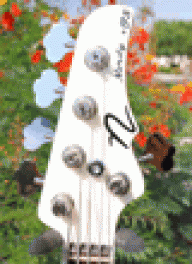

This ^^^^^ is an accurate description in my case, too. My W-CS was built Fall ‘22. To be clear, it’s not like they ‘don’t’ work…just not even close to the smooth/precise-turning USA UL’s on my NYC’s.Wobbly and did not turn smoothly - noticeable “catches” in them. One, no matter how adjusted, tightened, loosened, etc. always felt like it was grinding against something…

This ^^^^^ is an accurate description in my case, too. My W-CS was built Fall ‘22. To be clear, it’s not like they ‘don’t’ work…just not even close to the smooth/precise-turning USA UL’s on my NYC’s.
If I didn’t have the USA version on hand, I might never have considered changing the W’s out…

Don't know what machine heads were used on the Japan metrolines, but both of mine had the smoothest and moist reliable movement I have ever experienced. I always assumed they are the same as in the nyc models, ɓut not sure about that now.
My 2008 Metro Japan UV70 5 string had the licensed Hipshot Ultralight tuners. 2 of them got wobbly and failed a few months ago. I replaced the whole set with Hipshot USA versions, which look a bit nicer and are really smooth.


I just purchased a German Metroline MM/J. There is a Sadowsky Will Lee circuit inside with 2 trim pots…A for gain and B for output. I had reduce the gain slightly on mine. The gain is the one adjacent to the Sadowsky Will Lee label on the circuit.I lowered my MM pickup a little. It didn't take much for me to feel real good about the balance after I did.
I just purchased a German Metroline MM/J. There is a Sadowsky Will Lee circuit inside with 2 trim pots…A for gain and B for output. I had reduce the gain slightly on mine. The gain is the one adjacent to the Sadowsky Will Lee label on the circuit.

Curious if anyone has experience with a Sadowsky 21 with a Super J bridge PU and J PU in the neck? What are your thoughts about the Super J Bridge specifically? What does the toggle switch do? Does it make it a 60's J position or 70's J position or is it a coil tap or ???
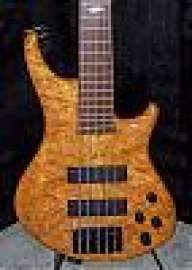
That Super P/Super J is a winning pickup configuration. Too bad it's only available on $6k+ NYC basses. It would be a nice option on Sadowsky/Warwick MasterBuilt.I don’t have a Sadowsky J with single coils currently, but do have the Super J pickup in the bridge position of my Super P/Super J. To my ears it does a great job of capturing either the 60’s or 70’s bridge J sound at a flick of the mini-toggle, and it’s pretty cool to be able to combine the two in the “middle” setting (I really like this setting with a Reverse P on my Super P pickup in the neck for when I’ve got to add some overdrive on my sound and keep up with guitarists who are playing modern humbuckers and stacking overdrives).

That Super P/Super J is a winning pickup configuration. Too bad it's only available on $6k+ NYC basses. It would be a nice option on Sadowsky/Warwick MasterBuilt.
That Super P/Super J is a winning pickup configuration. Too bad it's only available on $6k+ NYC basses. It would be a nice option on Sadowsky/Warwick MasterBuilt.
Since the super J started out as NYC proprietary, but was released for use in German builds, maybe the super P might follow at some point. As Roger’s said before, “all constants are variable.”


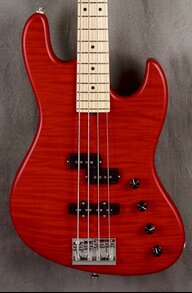


Love the green, the 'standard' clean look, and especially the playing!
Hahahaha thanksAll that plus movie star looks. I'm green with envy.