Agreed, it may be possible but will probably affect the break angle and string tension. Hard to tell until people get their hands on one.It appears that the saddles are adjusted much further back on the white ME which suggests the bridge is in a different location but perhaps within the range to still be intonated correctly.

Enjoy the benefits of a premium membership!
Upgrade Account
-
TalkBass has been independent since 1998. Add your voice.
Create a free account to reply to discussions, view embedded media, and browse with fewer display ads.
Join free Log in
Want zero display ads or expanded classifieds tools? Compare plans.
You are using an out of date browser. It may not display this or other websites correctly.
You should upgrade or use an alternative browser.
You should upgrade or use an alternative browser.
More options
Who Replied?



re bridge location
Important tolerance: alignment with neck and fingerboard
Fore/aft placement on body: variable tolerance acceptable, given that bridge saddles have adjustability range for intonation.
I have seen handmade basses by a well known and respected maker, of the same model and scale length, with varying fore/aft bridge placements. In 1 instance, 3 were owned by 1 person. All 3 were fine.
No harm. No foul.
Important tolerance: alignment with neck and fingerboard
Fore/aft placement on body: variable tolerance acceptable, given that bridge saddles have adjustability range for intonation.
I have seen handmade basses by a well known and respected maker, of the same model and scale length, with varying fore/aft bridge placements. In 1 instance, 3 were owned by 1 person. All 3 were fine.
No harm. No foul.

I just measured my RSD 5-21 JJ, German MetroLine 5-21 Hybrid PJ and NYC Satin Deluxe 4-21 JJ, nut to bottom of bridge:
RSD: 35 1/2"
GML: 35 5/8"
NYC: 35 5/8"
Bridge to end of body is clearly longer on the RSD, then the GML, with the NYC being closest. The saddles are highest on the NYC, followed by the GML, with the RSD being the lowest. Most importantly, the string length on the E string on all 3 is right around 34 1/4" nut to bridge saddle.
There isn't a lot of travel room left to shorten the string length on the NYC - thankfully it is setup beautifully and doesn't need any adjustment - where the GML and RSD have a decent amount of adjustment available either direction if needed. So from a practical/functional point of view you could even say they are better than the NYC in that regard!
RSD: 35 1/2"
GML: 35 5/8"
NYC: 35 5/8"
Bridge to end of body is clearly longer on the RSD, then the GML, with the NYC being closest. The saddles are highest on the NYC, followed by the GML, with the RSD being the lowest. Most importantly, the string length on the E string on all 3 is right around 34 1/4" nut to bridge saddle.
There isn't a lot of travel room left to shorten the string length on the NYC - thankfully it is setup beautifully and doesn't need any adjustment - where the GML and RSD have a decent amount of adjustment available either direction if needed. So from a practical/functional point of view you could even say they are better than the NYC in that regard!
Yes, but strange it appears to be consistent in this case. I'm not saying it's a big deal and I'll try the new one out, but with my personal basses the break angle is somewhat important to me. I like a shallow break angle so I lean towards Bad Ass style bridges (because there's plenty of distance between the balls of the string to the saddles). So even if these saddles do go far enough back to properly intonate, I'm concerned that the break angle will be steeper due to shortening this distance. It does make a difference to me for tone but time will tell.re bridge location
Important tolerance: alignment with neck and fingerboard
Fore/aft placement on body: variable tolerance acceptable, given that bridge saddles have adjustability range for intonation.
I have seen handmade basses by a well known and respected maker, of the same model and scale length, with varying fore/aft bridge placements. In 1 instance, 3 were owned by 1 person. All 3 were fine.
No harm. No foul.
Thank you, that's helpful! Sounds like there are small differences in overall design between all three (maybe a shallower neck pocket on the NYC to counteract the higher saddles, assuming you have them set up the same). I know the bridge design of the RSD is visually different but perhaps the Metro is too. Very interestingI just measured my RSD 5-21 JJ, German MetroLine 5-21 Hybrid PJ and NYC Satin Deluxe 4-21 JJ, nut to bottom of bridge:
RSD: 35 1/2"
GML: 35 5/8"
NYC: 35 5/8"
Bridge to end of body is clearly longer on the RSD, then the GML, with the NYC being closest. The saddles are highest on the NYC, followed by the GML, with the RSD being the lowest. Most importantly, the string length on the E string on all 3 is right around 34 1/4" nut to bridge saddle.
There isn't a lot of travel room left to shorten the string length on the NYC - thankfully it is setup beautifully and doesn't need any adjustment - where the GML and RSD have a decent amount of adjustment available either direction if needed. So from a practical/functional point of view you could even say they are better than the NYC in that regard!

This.re bridge location ... No harm. No foul.
As long as the instrument may be properly intonated, the bridge location is just fine.
WRT the break angle of the string, a sharper break angle of the saddles being further back on the bridge might possibly affect string life, but it will not affect tension. Tension is a function defined by pitch, gauge, material and length, where length is between the two fulcrum points (bridge saddle to nut). All those will be consistent in both cases where the only difference is the bridge plate location, as the bridge plate location is not part of that equation.
Some people may believe string length beyond the fulcrum points affect tension, but this has not been my experience at all.
The only difference I've experienced when talking outside the fulcrum points is break angle, down force and string life (where sharper break angles may shorten it, though it's never been an issue for me, since I don't play strings until they're rusty like JJ did (lol)). In theory, sharper break angles may also affect down force where a larger percentage of the overall string tension is directed downward, which could amplify the wood's involvement in tone, and possibly alter some compression aspect, but not overall string tension.
IMHO/IME/.02

These new Metro Express basses with roasted necks seem to be hitting overseas, anyone even seen a product listing or anything for a US seller?

I'm not saying it won't intonate correctly, but it's in a difference place to all other Sadowsky basses so it will have an effect on string tension at the very least.
As Vic said, all that matters for string tension is the pitch of the string and its speaking length, saddle to nut. Some famous ppl have erroneously believed otherwise, so confusion is understandable
Edit - string thickness matters, I guess I assumed that went without saying
Last edited:
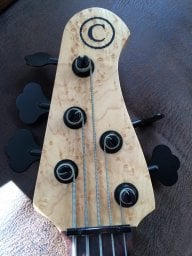
Hey, All: Isn't measuring nut to bridge the only thing that really matters? I look at these photos, and what I see is a different body shape, with more body extending past the bridge, to the bottom edge of the body. Personal points of reference... Alembic has that dual-piece bridge, and lot of body extending beyond, to the bottom edge - hence, a 34" scale seems to require a lot of left-hand reach. Counterpoint: Lakland's 55-94 has the bridge very close to the bottom edge...so their 35" scale has an easy-peasy reach. The bass in my TB avatar is a Carl Pedigo build; ergonomically, it's a 34" 55-94 with very different electronics. And it feels almost guitarish!

Joeykun
pronounced ジョーイくん
- Jun 22, 2007
- 4,200
- 16,150
- Disclosures
- Endorsing: LAKLAND SADOWSKY GENZLER DARKGLASS NORDSTRAND TEMPLEBOARD KIRLIN DRSTRINGS ACCESS
These new Metro Express basses with roasted necks seem to be hitting overseas, anyone even seen a product listing or anything for a US seller?
[Invalid or Expired Link Removed]
Specifically, nut to saddleIsn't measuring nut to bridge the only thing that really matters?

Hey, All: Isn't measuring nut to bridge the only thing that really matters? I look at these photos, and what I see is a different body shape, with more body extending past the bridge, to the bottom edge of the body. Personal points of reference... Alembic has that dual-piece bridge, and lot of body extending beyond, to the bottom edge - hence, a 34" scale seems to require a lot of left-hand reach. Counterpoint: Lakland's 55-94 has the bridge very close to the bottom edge...so their 35" scale has an easy-peasy reach. The bass in my TB avatar is a Carl Pedigo build; ergonomically, it's a 34" 55-94 with very different electronics. And it feels almost guitarish!
some making a fuzz and have not even played them yet, come on, lol these are Chinese models

Another 2023 Metro Express vid. Not in English, but you get the idea.
Last edited:

Even more specifically, nut to 12th fret. That's the most accurate way to measure scale-length.Specifically, nut to saddle
On a 34" scale bass, that'll be 17" ... 35" scale, 17.5", and so-on.
The bridge (whatever the shape/size of that is) is then usually placed on a center-line down the neck and is at a distance away from the 12th fret to make most use of the range of each saddle, so all strings can be intonated properly.
With most bridges, you'd figure out the maximum range of the saddles for intonation and have your line drawn in that middle range, 17" away from and parallel to the 12th fret, assuming that low B/E will need the most distance and G/C strings will need the least.
With that said, the most simple way to assume where the bridge lands on the body is usually determined by how deep into the body the neck joint is routed in conjunction with the scale length and the body design. It could be that the CNC design used at the Chinese factory incorporates both 34 and 35" scale length options (in case they ever want to expand in that direction), and that reasoning would end up pulling the bridge a little closer to the neck since this is a 34" scale bass instead of a 35".
That last assumption is pure speculation on my part, but the TL;DR here is that you can't simply ONLY move the same style bridge forward as that affects scale length and it would no longer intonate properly.
Sorry, I'm long-winded sometimes.
Last edited:

Finally I'm in the club too!
Metro Line 4 JJ Vintage
Arrived yesterday, beautiful finishes and really very light (7,37 lbs).
Guess I'll be selling some of my other basses...
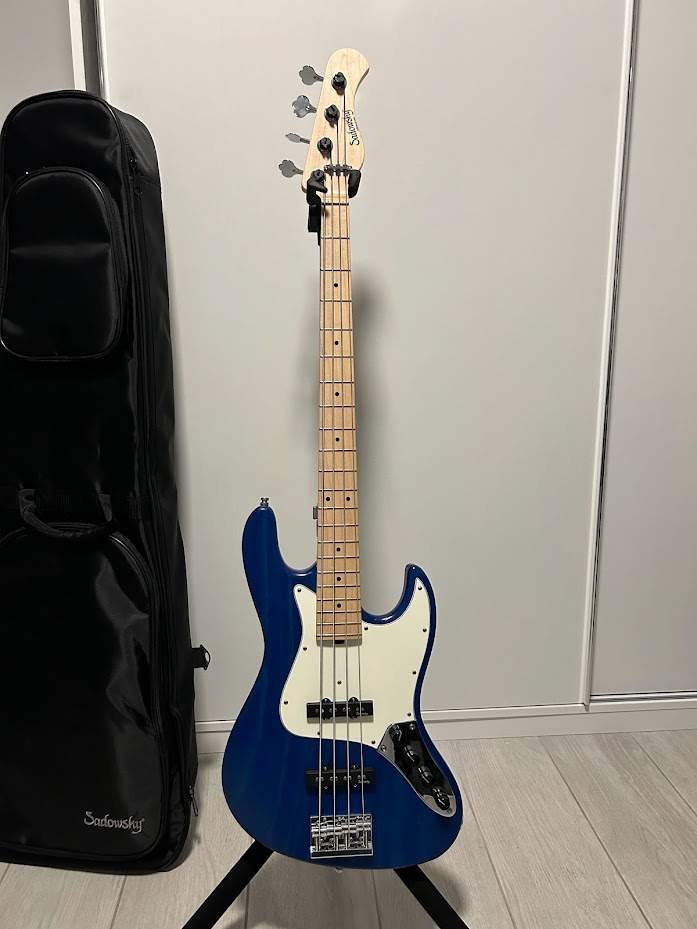
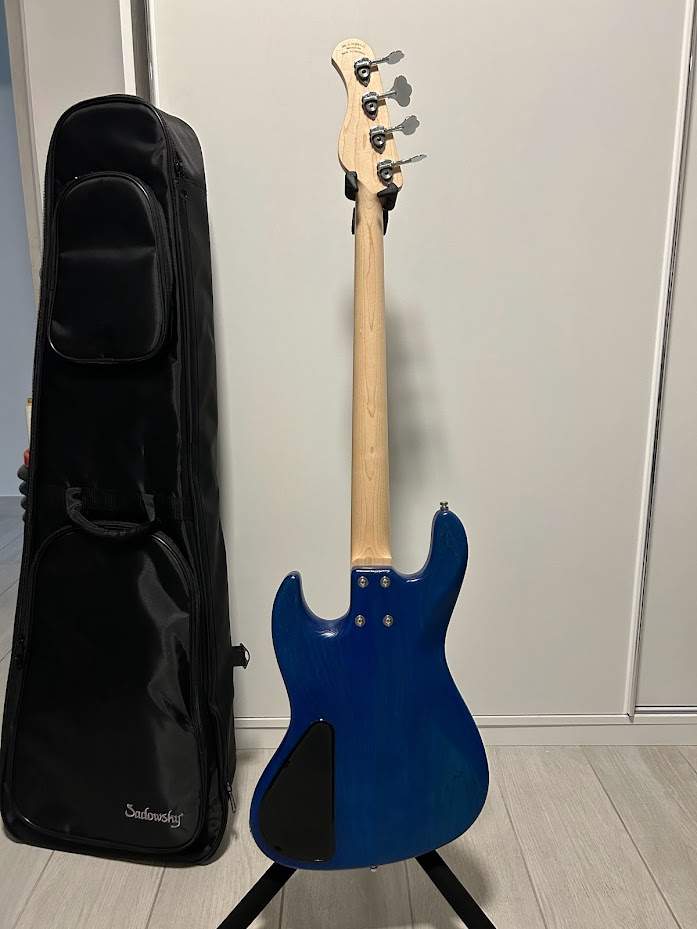
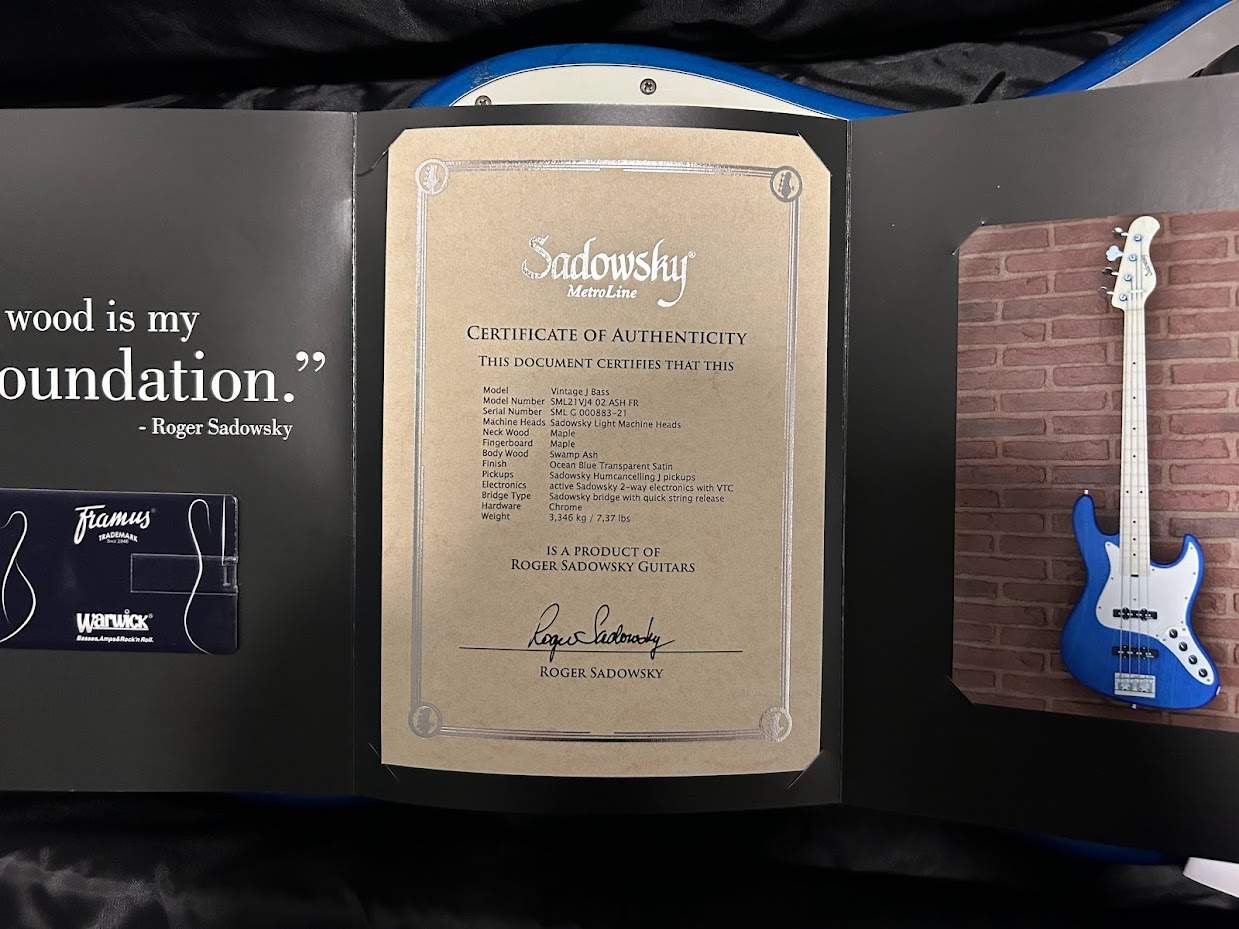
Metro Line 4 JJ Vintage
Arrived yesterday, beautiful finishes and really very light (7,37 lbs).
Guess I'll be selling some of my other basses...
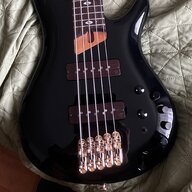

Finally I'm in the club too!
Metro Line 4 JJ Vintage
Arrived yesterday, beautiful finishes and really very light (7,37 lbs).
Guess I'll be selling some of my other basses...
View attachment 5094023 View attachment 5094024 View attachment 5094025
that looks like Dave Hope’s Sadowsky, although his has pao ferro fb.

Finally I'm in the club too!
Metro Line 4 JJ Vintage
Arrived yesterday, beautiful finishes and really very light (7,37 lbs).
Guess I'll be selling some of my other basses...
View attachment 5094023 View attachment 5094024 View attachment 5094025
One of my absolute favorite color combos. Gorgeous!


