
Enjoy the benefits of a premium membership!
Upgrade Account
-
TalkBass has been independent since 1998. Add your voice.
Create a free account to reply to discussions, view embedded media, and browse with fewer display ads.
Join free Log in
Want zero display ads or expanded classifieds tools? Compare plans.
You are using an out of date browser. It may not display this or other websites correctly.
You should upgrade or use an alternative browser.
You should upgrade or use an alternative browser.
More options
Who Replied?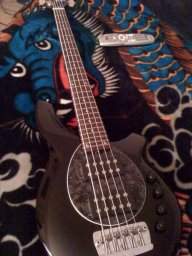

Looks like you might be a stingray guy as well. EB's slinkys will work just fine on your bass, and you can also try DR HiBeams.I don’t like the strings that came on my bass. The tension is too tight for me. This is the first time since I was young that my finger tips hurt.


Thanks -- more time to feed the piggy bank.I seem to recall Jason from FretNation saying in a Facebook post that they should be available in the US sometime this summer to early fall.
As of a couple of days ago that first 5-string ME Ultra Vintage P was on Reverb for sale. Made me really sad to find out that for right now they’re only being shipped with a 1 7/8” nut width, or I’d already have it.

I have no interest in six string basses, but these look very nice. I believe these will be popular.

Roger and Warwick seem to be very serious about the Metro Express line and with recent new models it is quite diverse and complete


Had the SMX out on the gig Friday night. Sounded great! I did my classic 20% on for both the bass and treble controls and then used the tone knob and p/u blend knob to fine tune for different songs. I put on a set of the light gauge Sadowsky black label strings and I think I might stick with those for now. They feel good under fingers and seem to have a nice balanced tone to them. Might have some video inbound too…..
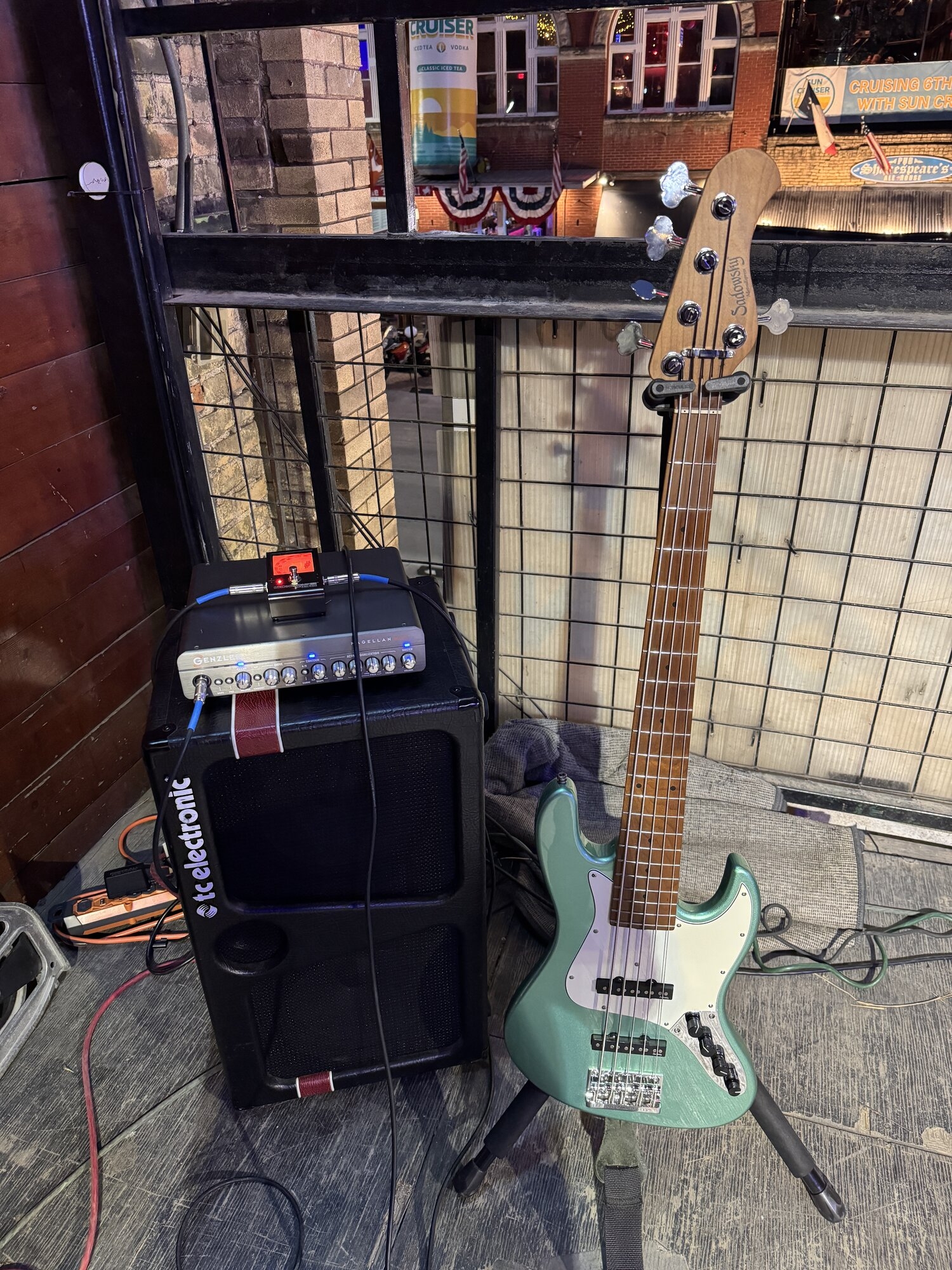

Jjk sounds great. If you dont mind telling, what were your Magellan settings for this? Same as you stated in previous post? Thanks.
EQ was flat on the Magellan and contour was about 10 o clock. Onboard EQ was both bass and treble at about 20% and tone rolled on at about 75%. I kept the EQ there for the gig and used the tone knob and p/u blend to dial in tone for different songs.Jjk sounds great. If you dont mind telling, what were your Magellan settings for this? Same as you stated in previous post? Thanks.

Nice- sounds great. Did a double take when I saw the bassoon. Have never heard/seen a bassoon in this setting. Love it.
I use DR Lo Riders on all my other bassesLooks like you might be a stingray guy as well. EB's slinkys will work just fine on your bass, and you can also try DR HiBeams.
that's interesting because those are DR's stiffer strings... with the intent of allowing lower action (hence the name). i figured since you didn't like how stiff the blues were you'd be maybe more of a slinky kinda' guy. oh well. lol. btw lo-riders are my faves, but then again, i also really like sadowsky blues a lot too.I use DR Lo Riders on all my other basses

I prefer the MIJ basses. Something about the feel of them i just l Iike better. Others prefer the German basses. I doubt there is much difference in how they sound.Are the MIJ better than German? Something I've wondered about. I guess I'm about to find out.

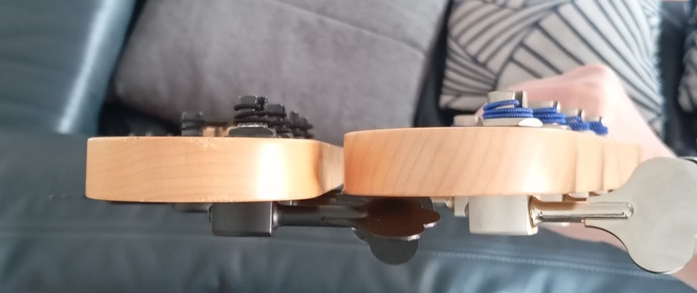
I bought a new Sadowsky Modern 5 NYC last week. It's my second one. Great instrument as expected, however I notice a bit more neck dive than my previous one.
The new one is chambered and its head slightly thicker than my previous one, non-chambered made in 2011.
Do you know why the new one has a thicker head? Could it also be because the new bass is chambered I notice this neck dive?
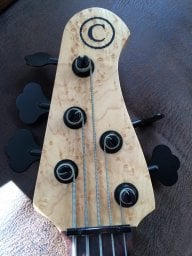
Pictures of the basses. Previous one on the left (spalted maple) made in October 2011, new one (black) made in February 2025 on the right.

The new one is chambered and its head slightly thicker than my previous one, non-chambered made in 2011.
Do you know why the new one has a thicker head? Could it also be because the new bass is chambered I notice this neck dive?
Pictures of the basses. Previous one on the left (spalted maple) made in October 2011, new one (black) made in February 2025 on the right.

I also noticed this change a while back, don't recall the exact year. I never asked Roger, but I assumed it was to further reduce the usual dead spots inherent to wood neck basses. If you may recall, over the years there have been several devices made to add mass to the headstock for this purpose, including some custom instruments using extra laminates, etc.I bought a new Sadowsky Modern 5 NYC last week. It's my second one.
...
Do you know why the new one has a thicker head?
All of my Sadowskys are solid body, around 8-9 pounds. I spec this weight range specifically for both tonal and ergonomic reasons. For me, that's the sweet spot. YMMV.
In your case, if it's enough to be annoying, the usual suggestions are to not use shirts/straps that are too "slickery", and for seated playing, either angle the bass up a bit, or wear the strap also for seated play.
Hope this helps.
Yes it does thanks. Especially your first paragraph.Hope this helps
Could you tell me more about those dead spots? How come having a thicker headstock reduces the probability for dead spots?
The DR. LO RIDERS are stiff, but not as stiff, and they are smootherthat's interesting because those are DR's stiffer strings... with the intent of allowing lower action (hence the name). i figured since you didn't like how stiff the blues were you'd be maybe more of a slinky kinda' guy. oh well. lol. btw lo-riders are my faves, but then again, i also really like sadowsky blues a lot too.
Haven't posted this here yet, though it's on other threads. My new MetroExpress 4 string fretless Hybrid P/J from SW. Weight 9lbs 2oz. The stock strings were Sadowsky SS Black Label RWs, and were a little rough for my 71 year old fingers. My other fretless, a lined Ibanez SR370EF, wears D'Addario light Chrome flats so I put those on this bass too, and I am pleased with the way it plays and sounds.
Attachments

it's not so much about the thickness of the headstock as it is the increased mass at that end of the neck that changes the resonant frequency of the neck itself, which is the real key to the puzzle. If you've ever seen those "fat fingers" which are literally just weights that clamp onto the headstock, it's the same idea.Yes it does thanks. Especially your first paragraph.
Could you tell me more about those dead spots? How come having a thicker headstock reduces the probability for dead spots?
A dead spot is not actually an construction or materials "problem" per se, but rather, a point of resonance in the neck itself which could have a cancellation (negative feedback) effect on certain notes. similarly, you can also have "hot spots" where that same resonant frequency can have a positive feedback condition that can make some notes louder than others.
on most 34" scale traditionally made wood necked Fender-ish basses, it's usually most noticeable around the 5th fret on the G string.
By adding mass to the headstock, the theory is you move that "cancellation" effect to a different frequency range that is not quite as noticeable when playing the bass for various reasons.
this is why some builders/luthiers moved to laminated necks, different kinds of integrated reinforcement rods, adding mass via wood or carbon fiber laminates at the headstock, even metal plates on the back of the headstock, and even necks made entirely of carbon fiber or composite material. The goal is to push that resonant effect out of the most typical playing area. Anything you can do to make the neck reflect, instead of absorb, the string's energy. Mass, rigidity, etc.
again, i did not ask Roger if making the headstocks thicker was done specifically to hopefully add this benefit, but it's a possibility.
Latest posts
-

-
 Do stainless steel strings loose there sound quicker than other material
- Latest: 5StringBlues
-

-

