• TalkBass has been independent since 1998. Add your voice.
    Create a free account to reply to discussions, view embedded media, and browse with fewer display ads.
    Join freeLog in
    Want zero display ads or expanded classifieds tools? Compare plans.

Club Sadowsky!!!

Actually, it can be both the stage and a nearby wall. I JUST had this problem a couple weeks ago, and I was using the gramma. I had to move my amp about 24" from the wall and angle it a bit and the problem was gone.

In my experience, moving your rig will not do anything if its a stage problem as suppose to a wall/bass trap problem. The Gramma work really well for me in most situations.
 
In my experience, moving your rig will not do anything if its a stage problem as suppose to a wall/bass trap problem. The Gramma work really well for me in most situations.
You're right, but you seem to have missed my point. My point was, you have to consider BOTH. Re-read my post... I already had the stage coupling taken care of, as I WAS using the Gramma.
 
Blair, that is a super tip! I will check into that. Man, maybe you could spawn that into a side business targeting bass players?
I also got some of these recently:

Link Removed

Link Removed

They're pretty dense tho, so I'm not sure if they would work as well as using larger area of softer material (for equal weight bearing capabilities and better absorption).

The site has a few other options too, and even mention a use case for speaker cabinets, so I might also try some of the blue foam core ones.

Kind of a low priority tho, 'cause I do have the Gramma, and will never need a rig it can't support.
 
I still think the proper solution was the one taken... move the rig. The boom was not coming from the bass or the amp, it was an amp placement problem in the room. You suck the lows out of the actual signal, then you also thin out the sound going to the board, which is also bad... assuming there was a PA. If there wasn't a PA, then this might be helpful, but I still feel the best solution was taken, which eliminated the proximity resonance issue so a more normal amp voicing could be used.

IMHO

Quite right, but sometimes there's nowhere to move the amp unfortunately. In those cases, it's a useful trick to have in my bag.
 
I just compared my brand new UV 5 string (ash/morado) to my older MV5 #M416 (ash/maple).
Both have the same Sadowsky single coils, new strings (Sadowsky Blue Steels) and I made sure, the distance between the PUs and the strings was the same on both basses.

Experience would lead me to experience a more lively, crisper sound from the MV (being an ash/maple bass).
But the opposite is true: the UV is a bit louder and snappier in all PU positions....

Could this be due to the UV's body being bigger?


I measured the neck and found out that the UV's neck is 2mm broader at the nut than the MV5.
I thought, all the Metros had the same neck dims.

Does anyone know more about this?
 
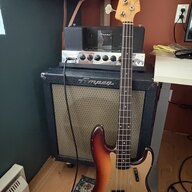
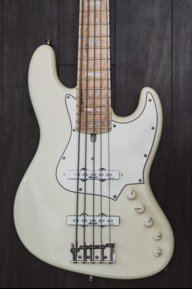
I'd like some feedback from some of you experienced with both Sadowskys and Fenders. I just returned from a sound check where the stage was hollow and incredibly boomy. I actually know this particular room and I brought my Sadowsky (JJ) thinking that it would be the best of my basses for the sound of that room (and for the band I'll be playing with). I'd been using my Fender Jazz '62 reissue during rehearsals but had also previously used my Sadowsky on a live gig with these guys. Anyway, the stage sound during sound check was awful and the band leader kept asking me to EQ out some of the lower frequencies and boost some of the upper mids. I'd already dropped a significant amount of low end out of my amp and the bass was starting to sound pretty wiry. At this point the band leader/guitarist tells me that I should have brought the Fender and left my "fancy" active bass at home. I then switched to passive mode and the bass on stage was still boomy. Finally, I put my cabinet on the floor to the side of the sage and the problem was fixed - I was able to pump the bass frequencies and get a sound that I (and everyone else) liked. Now here's what I was thinking when the band leader made his suggestion: my Sadowsky has a much more controllable low end than my Fender. If the Sadowsky wasn't sitting well "in the mix" then nothing - certainly not my Fender - was going to. To me, the Sadowsky has a certain compression in the low end that the Fender doesn't and I don't expect things to get as uncontrollably boomy with the Sadowsky as I do with the Fender. Is my thinking off here? I get sick of what I see as "Fender-centric" notions that seem to be based more on ignorant perceptions than anything else but I wanted some other folks' opinions on the Sadowsky versus Fender question in this particular context.

I have a similar issue when I play my Sadowsky with soaps in the J position at my church. My other Sadowsky basses do not have the problem. I do direct and don't use a rig on stage. The sound guy has spent a bunch of time trying to EQ it out at the board. It is a bit better but still a problem. So, I don't use that bass much there. :(

He says there are certain frequencies from some instruments that just bounce all around our sanctuary. Some day, when we move..we can get a room designed right, from the ground up.
 
Some sporting goods stores (where hockey supplies are sold) sell dense foam hockey practice pucks that work very well for isolating a heavy amp. I've used them for quieting a noisy refrigerator also.
B.

That is a great idea! I just picked up some from Sports Authority, they are street hockey pucks, but I think they will work fine.