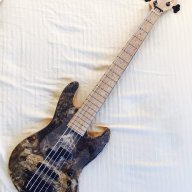
haha my apologies...bed it is (was busy cleaning, oiling, fretpolishing and restringing during this convo...i'm dead tired now lol)

TalkBass has been independent since 1998. Add your voice.
Create a free account to reply to discussions, view embedded media, and browse with fewer display ads.
Join free Log in
Want zero display ads or expanded classifieds tools? Compare plans.
He's not saying that. He's saying that we do need to not fall into the same trap that previous generations did - We can't just say that "a cable is a cable", just as they used to be able just say that "the universe revolves around the earth".
Just like we can point to graphs and say
"everything's is...the same... so it's the same", they pointed to the sky and said
"everything goes...around us..so they go around us".
And he's right. That's why science works, because things don't just stay the same. People constantly test things over
EDIT: I think i'm getting johndough's argument, am i right?

I think you're missing the point...facts are facts huh? 600 years ago it was a widely accepted 'fact' that the world was flat...


I for one was puzzled at first about the bottom and top-end rolloff in the first graph. Now that I think about it, that looks to me like it's not a property of the cables, but rather highpass/lowpass filters in the converters used for the test. Are you going in/out at 44.1khz?


Yes, and certainly it is reasonable to assume that there is some coloration or loss inherent to the testing mechanism itself. The reason I'm not bothered by that is that the systemic coloration or loss will occur identically with all cables tested.


 , do a double blind test including the modified cable.
I posted a question that I don't really know if it sounded dumb, I mean it did to JimmyM, but I think it's quite valid; Considering that the signal in the charts isn't dead flat, that means that we've never had a completely accurate way of transferring our sound.


can you do a cheap cable also?
I for one was puzzled at first about the bottom and top-end rolloff in the first graph. Now that I think about it, that looks to me like it's not a property of the cables, but rather highpass/lowpass filters in the converters used for the test. Are you going in/out at 44.1khz?
I propose a control sample where you test the response of the system without a cable...j/k
suggested) is a legit test for calibrating the measurement system. De rigeur, actually.
sorry if it sounded like i insulted you, but exact colorless reproduction only exists on paper for ANY gear no matter what it is. yeah, maybe you could stick a preamp into a cable, but then it's a preamp, not a cable. and what do you do if you need to have more than one cable in your rig? buy preamped cables to go between your effects? and then you're going to plug into an amp that has its own coloration, and a cab that has even more coloration. it becomes pointless to chase the flat tone to such a degree.I posted a question that I don't really know if it sounded dumb, I mean it did to JimmyM, but I think it's quite valid; Considering that the signal in the charts isn't dead flat, that means that we've never had a completely accurate way of transferring our sound. Thus, I asked if there's any way to make a cable that does. I suppose if we added an active circuit it could possibly do so. I know Alembic has done things like these, but their active cables were just their pre-amps inserted in the cables. I'm talking about exact, colorless reproduction.
Cyrus, you can factor in the "house curve" for your sound card in True RTA, so that the graphs reflect an applied inverse curve. But frankly, that's a pretty ugly house curve, by my standards at least.
I'd like to see a loop-through test in RMAA as well, for both the noise floor and distortion of your test jig. Also, does your card not support 24/96 resolution? Someone is gonna argue that we can't see high end behaviors properly because of the "low" Nyquist number in your test -- just watch!
sorry if it sounded like i insulted you, but exact colorless reproduction only exists on paper for ANY gear no matter what it is. yeah, maybe you could stick a preamp into a cable, but then it's a preamp, not a cable. and what do you do if you need to have more than one cable in your rig? buy preamped cables to go between your effects? and then you're going to plug into an amp that has its own coloration, and a cab that has even more coloration. it becomes pointless to chase the flat tone to such a degree.
Certainly, that all makes sense. Here is a test of the $9 cable and the $159 cable. I changed the conversion to 24/96, and I calibrated the RTA with the "house curve".


