Okay since this has been bumped here's a Q...
When you put a capo on your bass does that mean it has a zero fret?
When you put a capo on your bass does that mean it has a zero fret?

TalkBass has been independent since 1998. Add your voice.
Create a free account to reply to discussions, view embedded media, and browse with fewer display ads.
Join free Log in
Want zero display ads or expanded classifieds tools? Compare plans.

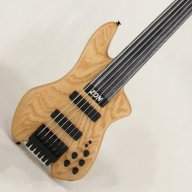
wouldnt this be accurate with a fretless as opposed to fretted since the fret sizes and distances of a true short scale vary from the ones starting at the 2nd fret of a standard scale?
wouldnt this be accurate with a fretless as opposed to fretted since the fret sizes and distances of a true short scale vary from the ones starting at the 2nd fret of a standard scale?
A friend of mine who's been playing guitar for many years says that using capos on basses or guitars throws off the intonation.
True?
Thread Revival!
Still doing it... still loving it!
Even though I have shortscale bass now, I still prefer putting a capo on a 34" bass as it gives me dead low action... lower than I can get without a capo.
Again, the biggest drawback is the comments you get from some people... traditional people.
There's no magic formula to fret placement, it's a continuing scale based upon the 12th root of 2. Placing a capo on the neck has no effect whatsoever on the intonation accuracy of the notes above the capo, no more than pushing down a string has an effect on the intonation of the notes above the fretted notes. IOW, we don't have to re-invent the wheel.
Using a capo on a fretless is a bit trickier but it still boils down to putting the capo in the right place.


Let's say that I don't have a capo, what could I do to ''make'' a capo?
Use a lace, tie it tight, not at the back of the neck.


You can temporarily convert a long scale instrument (34
inches) to a medium scale or short scale.
For close to medium scale put a capo on the first fret and
then retune E-A-D-G. This makes the scale length 32.1
inches (medium scale is 32 inches)
Go 2 frets and retune to EADG for 30.3 inch scale (short
scale is 30 inches.) Anything beyond that is too flabby...
The only problem is that you might get some buzz from
having less tension on the neck... and the bigger issue is that
if you want to do this semi-permanently you should adjust
the truss rod and re-intonate the bass... especially if you
play up higher than say the 5th fret. If you rely heavily on
the dots they will be in the wrong place (shifted by 1 or 2.)
But just for finding out the sound and feel of your bass if it
was a short/medium scale don't worry about the intonation...
just have a listen and then change it back.
cheers,
Joe
P.S. a 6 string guitar capo will fit on a 4 string jazz bass neck...
not sure of the p neck... but I haven't seen anything
that will accomodate a 5 string or more. I use a standard
kyser capo for guitar.
oh yeah and here is the fret spacing for a 34 inch scale...
(some builders adjust slightly by a few hundredths of an inch
to make up for the physics of the string and string bending.)
fretNum Distance from bridge(scaleLength)
0(nut) 34.00
1 32.09
2 30.29
3 28.59
4 26.99
5 25.47
6 24.04
7 22.69
8 21.42
9 20.22
10 19.08
11 18.01
12 17.00
13 16.05
14 15.15
15 14.30
16 13.49
17 12.74
18 12.02
19 11.35
20 10.71
21 10.11
22 9.54
23 9.01
24 8.50
the formula is:
34/(2^(fretNumber/12))
or for other scale lengths: (works for guitar too)
scaleLength/(2^(fretNumber/12))
 .
.